

 |
||

The 3 Part VOTE spots that had |

Cuéntame’s “Don’t Silence The Vote” Music Video.
|

Cuéntame takes on one of this year’s most racist Ad.
|
 |
||
 |
 |
 |
Category Archives: ~ Culture & History


A Beautiful Mix — Art & History …NMAAHC
 |
 |
||||||||||||||||||||||||||||||||
|
|

Share this:


Atlantic Wind Connection …Google

The wind cries transmission
10/11/2010 09:17:00 PM
We just signed an agreement to invest in the development of a backbone transmission project off the Mid-Atlantic coast that offers a solid financial return while helping to accelerate offshore wind development—so it’s both good business and good for the environment. The new project can enable the creation of thousands of jobs, improve consumer access to clean energy sources and increase the reliability of the Mid-Atlantic region‘s existing power grid.
When built out, the Atlantic Wind Connection (AWC) backbone will stretch 350 miles off the coast from New Jersey to Virginia and will be able to connect 6,000MW of offshore wind turbines. That’s equivalent to 60% of the wind energy that was installed in the entire country last year and enough to serve approximately 1.9 million households.
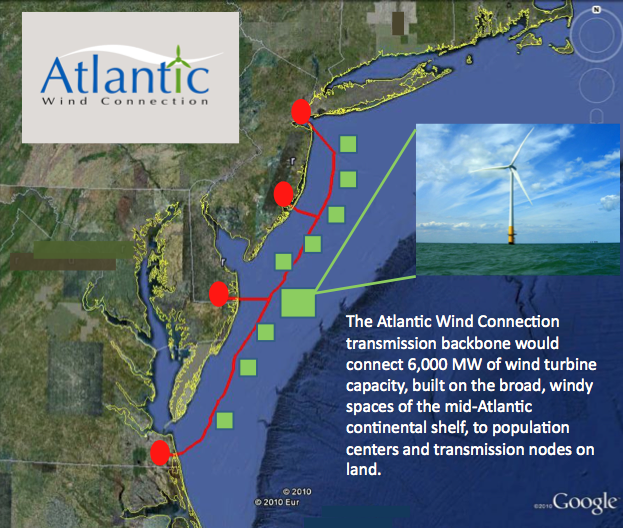
The AWC backbone will be built around offshore power hubs that will collect the power from multiple offshore wind farms and deliver it efficiently via sub-sea cables to the strongest, highest capacity parts of the land-based transmission system. This system will act as a superhighway for clean energy. By putting strong, secure transmission in place, the project removes a major barrier to scaling up offshore wind, an industry that despite its potential, only had its first federal lease signed last week and still has no operating projects in the U.S.
Why offshore wind and why the Mid-Atlantic? Many coastal areas in the United States have large population centers on an overstretched grid but limited access to a high-quality land-based wind resource. These coastal states can take advantage of their most promising renewable resource by using larger wind farms with larger turbines that can take advantage of stronger and steadier winds offshore.
The Mid-Atlantic region is ideally suited for offshore wind. It offers more than 60,000 MW of offshore wind potential in relatively shallow waters that extend miles out to sea. These shallow waters make it easier to install turbines 10-15 miles offshore, meaning wind projects can take advantage of stronger winds and are virtually out-of-sight from land. With few other renewable energy options ideally suited for the Atlantic coast, the AWC backbone helps states meet their renewable energy goals and standards (PDF) by enabling a local offshore wind industry to deploy thousands of megawatts of clean, cost-effective wind energy.
The AWC backbone is critical to more rapidly scaling up offshore wind because without it, offshore wind developers would be forced to build individual radial transmission lines from each offshore wind project to the shore, requiring additional time consuming permitting and environmental studies and making balancing the grid more difficult. As those in the Northeast remember from the 2003 blackout, transmission is severely overstretched on the east coast. The AWC project relieves grid congestion in one of two National Interest Electric Transmission Corridors which were deemed to have significant network congestion and need speedy creation of transmission capacity.
The AWC project is led by independent transmission company Trans-Elect and is financed by Google, Good Energies and Marubeni Corporation. We are investing 37.5% of the equity in this initial development stage, with the goal of obtaining all the necessary approvals to finance and begin constructing the line. Although the development stage requires only a small part of the total estimated project budget, it represents a critical stage for the project.
We believe in investing in projects that make good business sense and further the development of renewable energy. We’re willing to take calculated risks on early stage ideas and projects that can have dramatic impacts while offering attractive returns. This willingness to be ahead of the industry and invest in large scale innovative projects is core to our success as a company.
From the Great Plains to the waters off the coast of Northern Europe, windmills churn out clean power that lights our homes and powers our economies. We are pleased to support this investment that will ultimately enable the Mid Atlantic to benefit from the tremendous wind resource off its coast.
Posted by Rick Needham, Green Business Operations Director
Share this:

IMMIGRATION: Arizona’s D-Day
Ninety days after it was signed into law, Arizona’s new immigration law — SB-1070 — is set to take effect tomorrow. U.S. Ninth District Judge Susan Bolton is currently considering some of the seven lawsuits brought against the law along with a request by federal government that she approve a federal injunction of the law. Last night, Gov. Jan Brewer (R-AZ) announced that she expects a ruling within 24 hours. Much is at stake. As one law professor pointed out, if the law is struck down, it will take the “wind out of the sails” of local efforts to pass immigration laws. If it isn’t, Bolton’s decision will “unleash more copycat legislation.” Both sides are bracing themselves for implementation. National and local organizations are preparing a state-wide demonstration that will kick off today with a vigil in several cities. Demonstrators are set to descend on the Arizona state capital without their papers and “dare law enforcement in Phoenix, Arizona, to put SB-1070 to the test.” The U.S. attorney for Arizona is encouraging those who believe their civil rights have been violated to contact the FBI. Meanwhile, Arizona Sheriff Joe Arpaio is “setting aside space” in his tent city for more undocumented immigrants as local law enforcement gears up to enforce SB-1070. And while most Americans support Arizona’s immigration law, they also think its looming implementation tomorrow will “increase discrimination against Hispanics while not necessarily making a dent in the [immigration] problem.”
LEGAL BRAWL: Beginning a couple weeks ago, Bolton started hearing arguments filed by the U.S. Department of Justice, civil rights organizations, clergy groups, a researcher, and a Tucson police officer over whether Arizona’s new immigration law should take effect. University of Arizona law professor Jack Chin explains that Bolton will have to weigh the likelihood of success of the lawsuits challenging the law, judge who will suffer “irreparable harm,” and look at the “balance of hardships.” Bolton has the options of issuing a temporary injunction, blocking parts of the law, or doing nothing. So far, Bolton has dropped only a few hints as to how she will rule. During the hearings, she suggested that the part of Arizona’s law that requires immigrant residents to carry immigration documents “may not pass constitutional muster.” After challenging her assessment, the defense conceded, stating, “I didn’t have the feeling I persuaded you last week either.” Bolton also questioned a sentence in SB-1070 that requires police to verify the immigration status of arrested inmates before releasing them along with a separate part of the law that allows police to arrest anyone they believe has committed a crime that would make them removable from the country. However, Bolton did make one thing clear: she will not invalidate the whole law, but may halt the enactment of a handful of its sections. SB-1070 supporters are fighting back. Attorneys for the Arizona governor asked a federal judge to dismiss the Justice Department’s lawsuit, insisting that the federal government’s claim is based on “hypothetical scenarios.” Pinal County Sheriff Paul Babeu and Cochise County Sheriff Larry Dever have also hired lawyers to fight lawsuits against SB-1070 and pursue countersuits against the Obama administration.
WINNERS AND LOSERS: As the SB-1070 legal battle rages on, a growing list of stakeholders is taking shape. A local Arizona TV news station recently discovered that “two of Brewer’s top advisers have connections” to private prison giant Corrections Corporation of America (CCA). Paul Senseman, Brewer’s deputy chief of staff, is a former lobbyist for CCA and his wife continues to lobby for the company. Chuck Coughlin, who leads her re-election campaign, chaired her transition into the governorship, and is one of the governor’s policy advisers, also happens to be the president of HighGround Public Affairs Consultants, which lobbies for CCA. Brewer’s connections to the CCA are significant because the company currently bills $11 million a month to the state of Arizona to house immigrant detainees, and if SB-1070 is successfully implemented, its profits would soar as it would take responsibility for imprisoning immigrants arrested by Arizona police. Brewer herself, who has essentially built her campaign around the law, has also benefited from signing off on SB-1070 in terms of her local popularity. So far, Brewer has raised over $1,104,935 just for her legal defense fund. However, Brewer’s star may not shine forever. Arizona public schools are experiencing a drop in enrollment which could account for a drop in millions of dollars of federal funding. Arizona’s Office of Tourism is reporting a $12 million loss in canceled hotels and reservations. Attendance has also been dropping at several local churches serving largely to Hispanics, and as the Arizona Republic points out, “fewer attendees means less in the collection plate.” In the end, embracing the law also carries the risk of permanently alienating the critical Latino vote.
RIPPLE EFFECT: The rest of the Western hemisphere is watching Arizona closely. The Reform Immigration for American campaign reports that “there are twenty two copycats [laws] waiting to see which way the wind blows on states’ ability to preempt federal immigration law.” In Utah, one state lawmaker is prepared to introduce copycat legislation as early as the second week of August. Gubernatorial candidates in states like Florida, Colorado, and Georgia have made campaign promises to pass similar laws based on the presumption that SB-1070 is constitutional. Meanwhile, tensions on the issue are high. Activists argue that SB-1070 has contributed to a fresh round of discrimination such a surge of hate crimes in Staten Island and the disturbing release of a “witch-hunt” list of the names of 1,300 suspected undocumented immigrants by Utah citizen vigilantes. The white supremacist National Socialist Movement has also entered the debate and will demonstrate in downtown Knoxville next month as a show of support for a tougher state immigration law. On the other side of the border, Latin America is keeping a close watch. Bolivia, Colombia, El Salvador, Guatemala, Nicaragua, Paraguay and Peru have all filed motions to join Mexico’s legal brief supporting the lawsuits of the U.S. government and advocacy groups. Mexico is additionally preparing for the implementation of Arizona’s new immigration law. Expecting a surge of deportees, the Mexican government has also added more workers to its consulate in Phoenix and migrant shelters have added more beds. Mexico’s National Human Rights Commission plans on sending inspectors to U.S. border crossings to monitor deportations and ensure deportees are treated properly.
Share this:

News from Hands Up Holidays …
|
|||||||||||||||||||||
|
|
||||||||||||||||||||



 Be a Seed for Change
You must be logged in to post a comment.