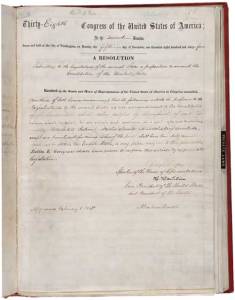
The 13th Amendment to the U.S. Constitution was passed by the U.S. House of Representatives. It was ratified by the necessary number of states on December 6, 1865. The amendment abolished slavery in the United States.

The 13th Amendment to the U.S. Constitution was passed by the U.S. House of Representatives. It was ratified by the necessary number of states on December 6, 1865. The amendment abolished slavery in the United States.

National Oceanic and Atmospheric Administration U.S. Department of Commerce
EAK51 PAAQ 051954
TSUAK1

BULLETIN
Public Tsunami Message Number 3
NWS National Tsunami Warning Center Palmer AK
1154 AM PST Thu Dec 5 2024

...THE TSUNAMI WARNING IS CANCELLED...

 * The Tsunami Warning is canceled for the coastal areas of
   California and Oregon


OBSERVATIONS OF TSUNAMI ACTIVITY
--------------------------------
 * No tsunami observations are available to report.


RECOMMENDED ACTIONS - UPDATED
-----------------------------
 * Do not re-occupy hazard zones until local emergency officials
   indicate it is safe to do so.


IMPACTS - UPDATED
-----------------
 * No destructive tsunami has been recorded.

 * No tsunami danger exists for the U.S. west coast, British
   Columbia and Alaska.


ADDITIONAL INFORMATION AND NEXT UPDATE
--------------------------------------
 * Refer to the internet site tsunami.gov for more information.

 * Pacific coastal regions outside California, Oregon,
   Washington, British Columbia, and Alaska should refer to the
   Pacific Tsunami Warning Center messages at tsunami.gov.

 * This will be the final U.S. National Tsunami Warning Center
   message issued for this event.

Lillian (Evans) Evanti, one of the first African American women to become an internationally prominent opera performer, was born in Washington, D.C. in 1891. Evanti was born into a prominent Washington, D.C. family. Her father, Wilson Evans, was a medical doctor and teacher in the city. He was the founder of Armstrong Technical High School and served many years as its principal. Anne Brooks, Evanti’s mother, taught music in the public school system of Washington D.C.
Evanti received her education from Armstrong Technical High School and graduated from Howard University in 1917 with her bachelor’s degree in music. A gifted student and performer, she was able to speak and sing in five different languages. The following year she and Roy W. Tibbs, her Howard University music professor, married and had a son, Thurlow Tibbs.
Combining her maiden and married names into the stage name, Evanti, a lyric soprano, began singing professionally in 1918. Her career progressed slowly until she moved to France in 1925 where she became the first African American to sing with a European opera company. From France she traveled around Europe and on occasion returned to the United States to perform. During her travels she gave radio performances, sang in a variety of operas and in 1932 was given a chance to audition for the New York Metropolitan Opera. Evanti was not asked to join the Company and for some time blamed the decision on racial discrimination.
blackpast.com
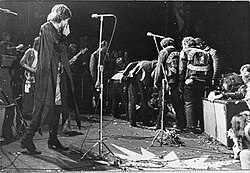
On December 6, 1969, in a shocking act of violence, a Hells Angel biker stabs to death an 18-year-old concertgoer during a set by the British rock group Rolling Stones at the Altamont music festival.
Altamont, a new festival in Northern California, was the brainchild of the Stones, who hoped to cap off their U.S. tour in late 1969 with a concert that would be the West Coast equivalent of Woodstock, in both scale and spirit. Unlike Woodstock, however, which was the result of months of careful planning by a team of well-funded organizers, Altamont was a largely improvised affair that did not even have a definite venue arranged just days before the event.
It was only on Thursday, December 4, 1969, that organizers settled on the Altamont Speedway location for a free concert that was by then scheduled to include Santana, the Jefferson Airplane, Crosby, Stills, Nash and Young and the Grateful Dead, all in support of the headlining Stones. The event would also include, infamously, several dozen members the Hells Angels motorcycle gang acting as informal security staff in exchange for $500 worth of beer as a “gratuity.”


You must be logged in to post a comment.