Category Archives: ~ politics petitions pollution and pop culture

Areal Flood – Watch


Areal Flood – Watch

From Sun, Jun 2, 11:00 AM PDT To Wed, Jun 5, 11:00 AM PDT

What

Flooding caused by excessive rainfall is possible.

Where

Portions of northwest and west central Washington, including the following counties, in northwest Washington, Mason and Skagit. In west central Washington, King, Pierce and Snohomish.

When

From Sunday morning through Wednesday morning.

Impacts

Excessive runoff may result in flooding of rivers, creeks, streams, and other low-lying and flood-prone locations. Creeks and streams may rise out of their banks. Flooding may occur in poor drainage and urban areas.

Issued By

NWS Seattle WA

* ADDITIONAL DETAILS… – http://www.weather.gov/safety/flood You should monitor later forecasts and be alert for possible Flood Warnings. Those living in areas prone to flooding should be prepared to take action should flooding develop.

Issued By

NWS Seattle WA

MLK jr. speech 5/17/1957 ~ Give Us the Ballot ~ In Memory


“Give Us the Ballot, We Will Transform the South”
giveustheballot

by Martin Luther King, Jr.
Speech given before the Lincoln Memorial at the March on Washington, May 17, 1957

Three years ago the Supreme Court of this nation rendered in simple, eloquent and unequivocal language a decision which will long be stenciled on the mental sheets of succeeding generations. For all men of good will, this May 17 decision came as a joyous daybreak to end the long night of segregation. It came as a great beacon light of hope to millions of distinguished people throughout the world who had dared only to dream of freedom. It came as a legal and sociological deathblow to the old Plessy doctrine of “separate-but-equal.” It came as a reaffirmation of the good old American doctrine of freedom and equality for all people.

Unfortunately, this noble and sublime decision has not gone without opposition. This opposition has often risen to ominous proportions. Many states have risen up in open defiance. The legislative halls of the South ring loud with such words as “interposition” and “nullification.” Methods of defiance range from crippling economic reprisals to the tragic reign of violence and terror. All of these forces have conjoined to make for massive resistance.

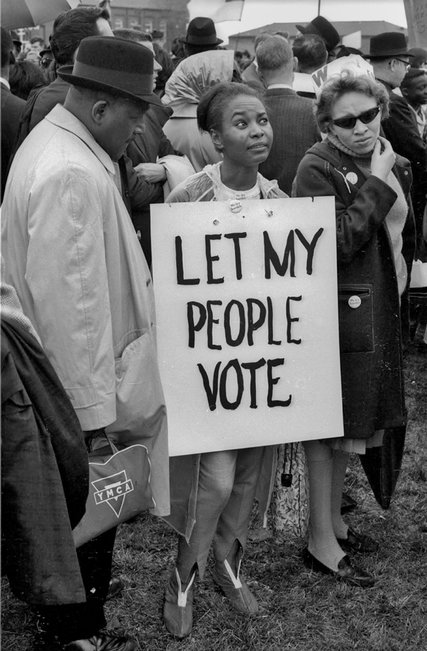
But, even more, all types of conniving methods are still being used to prevent Negroes from becoming registered voters. The denial of this sacred right is a tragic betrayal of the highest mandates of our democratic traditions and its is democracy turned upside down.

So long as I do not firmly and irrevocably possess the right to vote I do not possess myself. I cannot make up my mind — it is made up for me. I cannot live as a democratic citizen, observing the laws I have helped to enact — I can only submit to the edict of others.

So our most urgent request to the president of the United States and every member of Congress is to give us the right to vote. Give us the ballot and we will no longer have to worry the federal government about our basic rights. Give us the ballot and we will no longer plead to the federal government for passage of an anti-lynching law; we will by the power of our vote write the law on the statute books of the southern states and bring an end to the dastardly acts of the hooded perpetrators of violence. Give us the ballot and we will transform the salient misdeeds of blood-thirsty mobs into calculated good deeds of orderly citizens. Give us the ballot and we will fill our legislative halls with men of good will, and send to the sacred halls of Congressmen who will not sign a Southern Manifesto, because of their devotion to the manifesto of justice. Give us the ballot and we will place judges on the benches of the South who will “do justly and love mercy,” and we will place at the head of the southern states governors who have felt not only the tang of the human, but the glow of the divine. Give us the ballot and we will quietly and nonviolently, without rancor or bitterness, implement the Supreme Court’s decision of May 17, 1954.

<!–Read about recent allegations of voter disenfranchisement in Florida
and other states across the country in these articles.

17

–>

Learn more about Martin Luther King, Jr. and read more of his speeches and writings at The Martin Luther King, Jr. Papers Project at Stanford University.

Resources: pbs.org

Late Season Atmospheric River


Hydrologic – Outlook

From Thu, May 30, 1:45 PM PDT To Fri, May 31, 3:00 PM PDT

A late season atmospheric river will bring moderate to heavy precipitation from Sunday afternoon through Tuesday across all of western Washington. Heavy rainfall rates are possible over the southwest Olympics, and the Cascades. Total rainfall amounts will range from 1 to 2 inches in the lowlands, and 2 to 4 inches in the mountains. Snow levels above 5000 feet will result in most precipitation falling as rain.

This will result in rivers running unusually high, with the Skagit, Snohomish, Skykomish, White, and Skokomish Rivers potentially over action stage. The Snoqualmie River potentially will reach minor flood stage. This may impact any use of the river flood planes that are normally dry this time of year.

Rivers will crest sometime between Sunday and Tuesday.

The next update will be provided Friday afternoon.

Please monitor the latest river forecasts from the National Weather Service for additional information.

© 2024 National Weather Service

Justice For Some … things to remember in this 21st Century, a repost from 2015


By CAP Action War Room

The Cleveland Police Department Reaches a Settlement with the Department of Justice

Memorial Day weekend has hosted several important developments in the world of criminal justice. Today, the Cleveland Police department—which has come under fire in recent months in the nationwide debate over police tactics—agreed to follow some of the strictest standards in the nation over its officers’ use of force. Cleveland agreed to the terms as part of a settlement reached with the Department of Justice over what justice officials called a “pattern of unconstitutional policing and excessive use of force.”

According to the Justice Department’s report, the Cleveland police department used stun guns inappropriately, punched and kicked unarmed people, shot at people who did not pose a threat, and failed to report or investigate most of these incidents. As a part of the settlement, Cleveland agreed to some of the most rigorous policing standards in the nation. These include:

  • Prohibiting officers from unholstering a firearm “unless the circumstances create a reasonable belief that lethal force may become necessary,” and documenting every time that occurs.
  • Banning pistol whipping, the firing of warning shots, and the use of neck holds (that pistol whipping had to be explicitly barred says enough).
  • Creating a community police commission, made up of ten representatives from around the community.
  • Allowing an independent monitor to track its progress.

The settlement comes just two days after a white Cleveland officer who fired at least 49 shots at two unarmed African Americans was acquitted of manslaughter by an Ohio judge. Officer Brelo’s acquittal—as the latest in a series of troubling racially charged incidents across the US in places like Baltimore, Staten Island, and Ferguson, MO—prompted protests that remained largely peaceful but still resulted in the arrest of 71 people.

Some bad news also came out of the criminal justice sphere this weekend. On Friday, Maryland Governor Larry Hogan vetoed three important criminal justice reform bills. In addition to vetoing a bill to limit civil asset forfeiture, and a bill to remove the penalty for marijuana paraphernalia, Hogan also vetoed a felon re-enfranchisement bill that would have restored voting rights to 60,000 ex-felons. Restoring access to the ballot for ex-felons is a priority in the criminal justice reform community and Hogan’s veto will serve as an important test to see whether reform advocates will show that choices like Hogan’s can have political repercussions.

BOTTOM LINE: Agreements like the one made between Cleveland and the Department of Justice have the potential to create meaningful change to a flawed system. But as Gov. Hogan’s vetoes remind us, there is much more work to be done to convince some elected officials to do their part.