
 Time to pass the Voting Rights Act, change redistricting rules, and make it easier for ALL Americans to VOTE
“Those who do not remember the past are condemned to repeat it.” -George Santayana (16 December 1863 in Madrid, Spain – 26 September 1952 in Rome, Italy) was a philosopher, essayist, poet, and novelist.
On March 7, 1965, hundreds of brave unarmed nonviolent women and men dared to March for African Americans’ right to vote.
The fact is, that less than 1% of eligible Blacks could vote or register to vote.
A group of people organized a Peaceful Protest: The March would start in Selma, then move on to the state capitol in Montgomery.
However, as these peaceful protesters tried to cross the Edmund Pettus Bridge to Montgomery the police, seemingly already assuming a defensive posture; some on horses had, looking back, a predetermined tactical intervention plan against protesters. The protesters, mostly young African Americans also walked quietly with a mixture of older individuals and white Students as well: and as they did so; police proceeded to try and control the protesters which quickly resulted in the “excessive use of force.”
As protesters continued, it became clear that the excessive force was now an active use of police brutality and acts of murder; the grotesque beating of a young black leader of nonviolent protesting #RepJohnLewis had his skull cracked open among other injuries to his body. These Montgomery officers were out to do harm as they surrounded and knocked out young protesters using their nightsticks, and sprayed water cannons at close range, while others used tear gas.
These kids had no weapons; they did NOT fight back because they were not there to fight, but showed much courage and strength in the face of absolute brutal violence by an adversarial organization minorities are expected to respect. The men in police uniforms, hired to protect and serve citizens, were actually a force activated by the state to show physical power, discrimination, and racism in all its worse forms.
We must never forget that some of our fellow Americans died for our right to vote! This was an attempt to March in peaceful disobedience quickly became an adverse harmful environment to young black and white women and men, students from all backgrounds, and folks who believed voting is a right had to quickly retreat while journalists and photographers became witnesses to the suffering, violence, and death.
The brutal reaction by the police was not only caught on tape, but it also forced then-President Johnson, once against civil rights programs as a Senator, to call on Congress for equal voting rights for all on March 15.

The Voting Act of 1965 became a law on August 6; and is a landmark piece of national legislation in the United States that outlawed discriminatory voting practices that had been responsible for the widespread disenfranchisement of African Americans in the U.S.
A day that started out peacefully quickly descended into an awful, 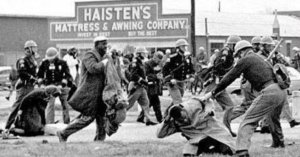 ugly March of death for the right to vote called, “Bloody Sunday”.
Now, some 50 years later, a new “Jim Crow” era has emerged with a major step backward in the fight for civil and voting rights. Conservative states are targeting not only African Americans but Senior citizens, first-time voters, early voting, Students, low-income, immigrants, and the undocumented though Republicans call them (illegals), those who lean left call them Dreamers; some born or brought to the US as youngsters all victims of circumstance are now, voting age. Also, Governors from Republican controlled States allowed election officials to purge voters, people without birth certificates were given limited or completely denied access to the voting booth failing to meet new voter ID regulations, and some were treated like possible (illegals). This is the 21st Century; we should be on a progressive path toward equality for all, not one that will re-engage folks in the act of racism or exclusion leading to suppressing participation in the election process. In 2017, Republicans tried to pass and or enforce new, even stricter voter ID legislation or influence their districts with strange redistricting rules and regulations. While some judges … have struck down some of these restrictive laws that ultimately suppress the vote, it is clear the effort to shut people of colour out of the election process sadly continues.
We need to push back on all attempts to suppress the Right to Vote.
With so much at stake, it is time to stop sitting on the sidelines. If we are going to succeed, Conservative lawmakers NEED to hear our Voices.
We cannot turn back the clock on Voting Rights For the sake of the Next Generation
Thank You for Taking Action

~ Nativegrl77



 1454 – Amerigo Vespucci was born in Florence, Italy. Matthias Ringmann, a German mapmaker, named the American continent in his honor.


You must be logged in to post a comment.