

Tuskegee Institute founder Booker T. Washington becomes the first Black American to be honored with a postage stamp. It will take nearly four decades for a Black woman to receive a similar honor: Harriet Tubman in 1978.
history.com

Tuskegee Institute founder Booker T. Washington becomes the first Black American to be honored with a postage stamp. It will take nearly four decades for a Black woman to receive a similar honor: Harriet Tubman in 1978.
history.com

On April 7, 1961, President John F. Kennedy sends a letter to Congress in which he recommends the U.S. participate in an international campaign to preserve ancient temples and historic monuments in the Nile Valley of Egypt. The campaign, initiated by UNESCO, was designed to save sites threatened by the construction of the Aswan High Dam.
JFK believed that America’s participation in the project would reflect “the interests of the United States,” as well as the country’s interest in ancient Egyptian culture “from which many of our own cultural traditions have sprung” and the U.S.’s “deep friendship for the people who live in the valley of the Nile.” Kennedy possessed a personal interest in the sciences and history and, from the beginning of his presidency, set out to promote American scholarship in these areas. His administration also wanted to develop diplomatic ties with the Arab nations in the Middle East and North Africa.
Article Title: JFK lobbies Congress to help save historic sites in Egypt
Author: History.com Editors
Website Name: HISTORY
URL: https://www.history.com/this-day-in-history/jfk-lobbies-congress-to-help-save-historic-sites-in-egypt Date April 7, 2023
Publisher A&E Television Networks
Last Updated April 5, 2022
Original Published Date November 16, 2009
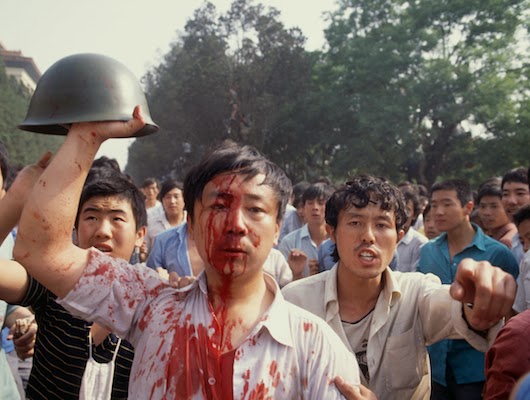
Six days after the death of Hu Yaobang, the deposed reform-minded leader of the Chinese Communist Party, some 100,000 students gather at Beijing’s Tiananmen Square to commemorate Hu and voice their discontent with China’s authoritative communist government. The next day, an official memorial service for Hu Yaobang was held in Tiananmen’s Great Hall of the People, and student representatives carried a petition to the steps of the Great Hall, demanding to meet with Premier Li Peng. The Chinese government refused such a meeting, leading to a general boycott of Chinese universities across the country and widespread calls for democratic reforms.
Ignoring government warnings of violent suppression of any mass demonstration, students from more than 40 universities began a march to Tiananmen on April 27. The students were joined by workers, intellectuals, and civil servants, and by mid-May more than a million people filled the square, the site of communist leader’s Mao Zedong’s proclamation of the People’s Republic of China in 1949. On May 20, the government formally declared martial law in Beijing, and troops and tanks were called in to disperse the dissidents. However, large numbers of students and citizens blocked the army’s advance, and by May 23 government forces had pulled back to the outskirts of Beijing.
On June 3, with negotiations to end the protests stalled and calls for democratic reforms escalating, the troops received orders from the Chinese government to reclaim Tiananmen at all costs. By the end of the next day, Chinese troops had forcibly cleared Tiananmen Square and Beijing’s streets, killing hundreds of demonstrators and arresting thousands of protesters and other suspected dissidents. In the weeks after the government crackdown, an unknown number of dissidents were executed, and communist hard-liners took firm control of the country.
The international community was outraged at the incident, and economic sanctions imposed by the United States and other countries sent China’s economy into decline. However, by late 1990, international trade had resumed, thanks in part to China’s release of several hundred imprisoned dissidents.
Citation Information
Article Title
Chinese students begin protests at Tiananmen Square
Author
History.com Editors
Website Name
HISTORY
On June 4, 1989, however, Chinese troops and security police stormed through Tiananmen Square, firing indiscriminately into the crowds of protesters. Turmoil ensued, as tens of thousands of the young students tried to escape the rampaging Chinese forces. Other protesters fought back, stoning the attacking troops and overturning and setting fire to military vehicles. Reporters and Western diplomats on the scene estimated that at least 300, and perhaps thousands, of the protesters had been killed and as many as 10,000 were arrested.
The savagery of the Chinese government’s attack shocked both its allies and Cold War enemies. Soviet leader Mikhail Gorbachev declared that he was saddened by the events in China. He said he hoped that the government would adopt his own domestic reform program and begin to democratize the Chinese political system.
history.com
A march and rally in support of reproductive justice for women draws several hundred thousand people to demonstrations in Washington, D.C. One of the largest protest marches on the nation’s capital, the pro-choice rally came as the U.S. Supreme Court was about to consider the …read more
 1242 – Russian troops repelled an invasion attempt by the Teutonic Knights.
1614 – American Indian Pocahontas married English colonist John Rolfe in Virginia.
1621 – The Mayflower sailed from Plymouth, MA, on a return trip to England.
1792 – U.S. President George Washington cast the first presidential veto. The measure was for apportioning representatives among the states.
1806 – Isaac Quintard patented the cider mill.
1827 – James H. Hackett became the first American actor to appear abroad as he performed at Covent Garden in London, England.
1843 – Queen Victoria proclaimed Hong Kong to be a British crown colony.
1869 – Daniel Bakeman, the last surviving soldier of the U.S. Revolutionary War, died at the age of 109.
1887 – Anne Sullivan taught Helen Keller the meaning of the word “water” as spelled out in the manual alphabet.
1892 – Walter H. Coe patented gold leaf in rolls.
1892 – In New York, the Ithaca Daily Journal published an ad introducing a new 10 cent Ice Cream Specialty called a Cherry Sunday.
1895 – Playwright Oscar Wilde lost his criminal libel case against the Marquess of Queensberry. Wilde had been accused of homosexual practices.
1908 – The Japanese Army reached the Yalu River as the Russians retreated.
1919 – Eamon de Valera became president of Ireland.
1923 – Firestone Tire and Rubber Company began the first regular production of balloon tires.
1930 – Mahatma Ghandi defied British law by making salt in India.
1933 – The first operation to remove a lung was performed at Barnes Hospital in St. Louis, MO.
1941 – German commandos secured docks along the Danube River in preparation for Germany’s invasion of the Balkans.
1951 – Americans Julius and Ethel Rosenberg were sentenced to death for committing espionage for the Soviet Union.
1953 – Jomo Kenyatta was convicted and sentenced to 7 years in prison for orchestrating the Mau-Mau rebellion in Kenya.
1955 – Winston Churchill resigned as British prime minister.
1984 – Kareem Abdul-Jabbar (Los Angeles Lakers) became the all-time NBA regular season scoring leader when he broke Wilt Chamberlain’s record of 31,419 career points.
1986 – A discotheque in Berlin was bombed by Libyan terrorists. The U.S. attacked Libya with warplanes in retaliation on April 15, 1986.
1987 – FOX Broadcasting Company launched “Married….With Children” and “The Tracey Ullman Show”. The two shows were the beginning of the FOX lineup.
1989 – In Poland, accords were signed between Solidarity and the government that set free elections for June 1989. The eight-year ban on Solidarity was also set to be lifted.
1998 – The Akashi Kaikyo Bridge in Japan opened becoming the largest suspension bridge in the world. It links Shikoku and Honshu. The bridge cost about $3.8 billion.
1999 – Two Libyans suspected of bombing a Pan Am jet in 1988 were handed over so they could be flown to the Netherlands for trial. 270 people were killed in the bombing.
1999 – In Laramie, WY, Russell Henderson pled guilty to kidnapping and felony murder in the death of Matthew Shepard.
2004 – Near Mexico City’s international airport, lightning struck the jet Mexican President Vicente Fox was on.
2009 – North Korea launched the Kwangmyongsong-2 rocket, prompting an emergency meeting of the United Nations Security Council.


 Be a Seed for Change
You must be logged in to post a comment.