
FREEDOM RIDERS : A Stanley Nelson Film : American Experience – In memory


  Get Inspired

 The World Premiere: In 2010 at Sundance Film Festival, US

 A Documentary Competition
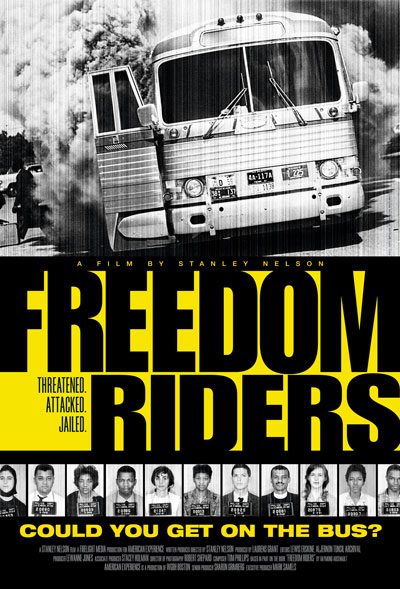
Award-winning filmmaker Stanley Nelson (Wounded Knee, Jonestown: The Life and Death of Peoples Temple, The Murder of Emmett Till) returns to the Sundance Film Festival with his latest documentary FREEDOM RIDERS, the powerful, harrowing and ultimately inspirational story of six months in 1961 that changed America forever. From May until November 1961, more than 400 black and white Americans risked their lives—and many endured savage beatings and imprisonment—for simply traveling together on buses and trains as they journeyed through the Deep South. Deliberately violating Jim Crow laws, the Freedom Riders’ belief in non-violent activism was sorely tested as mob violence and bitter racism greeted them along the way.

FREEDOM RIDERS features testimony from a fascinating cast of central characters: the Riders themselves, state and federal government officials, and journalists who witnessed the rides firsthand.

“I got up one morning in May and I said to my folks at home, I won’t be back today because I’m a Freedom Rider. It was like a wave or a wind that you didn’t know where it was coming from or where it was going, but you knew you were supposed to be there.” — Pauline Knight-Ofuso, Freedom Rider

Despite two earlier Supreme Court decisions that mandated the desegregation of interstate travel facilities, black Americans in 1961 continued to endure hostility and racism while traveling through the South. The newly inaugurated Kennedy administration, embroiled in the Cold War and worried about the nuclear threat, did little to address domestic Civil Rights.See the source image

“It became clear that the Civil Rights leaders had to do something desperate, something dramatic to get Kennedy’s attention. That was the idea behind the Freedom Rides—to dare the federal government to do what it was supposed to do, and see if their constitutional rights would be protected by the Kennedy administration,” explains Raymond Arsenault, author of Freedom Riders: 1961 and the Struggle for Racial Justice, on which the film is partially based.

Organized by the Congress of Racial Equality (CORE), the self-proclaimed “Freedom Riders” came from all strata of American society—black and white, young and old, male and female, Northern and Southern. They embarked on the Rides knowing the danger but firmly committed to the ideals of non-violent protest, aware that their actions could provoke a savage response but willing to put their lives on the line for the cause of justice.

Each time the Freedom Rides met violence and the campaign seemed doomed, new ways were found to sustain and even expand the movement. After Klansmen in Alabama set fire to the original Freedom Ride bus, student activists from Nashville organized a ride of their own. “We were past fear. If we were going to die, we were gonna die, but we can’t stop,” recalls Rider Joan Trumpauer-Mulholland. “If one person falls, others take their place.”

Later, Mississippi officials locked up more than 300 Riders in the notorious Parchman State Penitentiary. Rather than weaken the Riders’ resolve, the move only strengthened their determination. None of the obstacles placed in their path would weaken their commitment.

The Riders’ journey was front-page news and the world was watching. After nearly five months of fighting, the federal government capitulated. On September 22, the Interstate Commerce Commission issued its order to end the segregation in bus and rail stations that had been in place for generations. “This was the first unambiguous victory in the long history of the Civil Rights Movement. It finally said, ‘We can do this.’ And it raised expectations across the board for greater victories in the future,” says Arsenault.

“The people that took a seat on these buses, that went to jail in Jackson, that went to Parchman, they were never the same. We had moments there to learn, to teach each other the way of nonviolence, the way of love, the way of peace. The Freedom Ride created an unbelievable sense: Yes, we will make it. Yes, we will survive. And that nothing, but nothing, was going to stop this movement,” recalls Congressman John Lewis, one of the original Riders.

Says Stanley Nelson, “The lesson of the Freedom Rides is that great change can come from a few small steps taken by courageous people. And that sometimes to do any great thing, it’s important that we step out alone.”

CREDITS
A Stanley Nelson Film
A Firelight Media Production for AMERICAN EXPERIENCE

Produced, Written and Directed by
Stanley Nelson

Produced by
Laurens Grant

Edited by
Lewis Erskine, Aljernon Tunsil

Archival Producer
Lewanne Jones

Associate Producer
Stacey HolmanDirector of Photography
Robert Shepard

Composer
Tom Phillips

Music Supervisor
Rena Kosersky

Based in part on the book Freedom Riders by
Raymond Arsenault

AMERICAN EXPERIENCE is a production of WGBH Boston.
Senior producer
Sharon Grimberg

Executive producer
Mark Samels

1897 – “The Stars and Stripes Forever” by John Phillip Sousa was performed for the first time. It was at a ceremony where a statue of George Washington was unveiled.


“The Stars and Stripes Forever” by John Phillip Sousa was performed for the first time on May 14, 1897 at a ceremony unveiling a statue of George Washington. Listen here (as performed by the United States Marines Band):

Tell California Judges: Stop setting high bail amounts


https://d11gn0ip9m46ig.cloudfront.net/images/editor-2021-05-07.jpg

In partnership with Essie Justice Group, Color of Change is calling on the California Judicial Council to issue guidance to judges to stop setting high bails.

Right now, thousands of Black women in California are disproportionately being held pretrial simply because they cannot afford to pay bail. But these judges have the power to put a stop to it. 

Approximately 44,241 people are locked in cages across county jails in California. These people haven’t been convicted or sentenced for a crime. Unsurprisingly, Black and brown people bear the brunt of this unjust system. in Los Angeles County, where Black people make up only 9% of the overall population, Black women make up a third (33%) of the population of the women’s jail. Most of these women are being held pretrial, and the crisis has gotten even worse throughout the COVID-19 pandemic. Some people have been forced to wait more than 5 years for a trial — that’s 5 years separated from loved ones, friends, and community members all because they can’t afford to pay bail. 

Let’s get one thing clear, no one should have to sit in a jail cell because they are too poor to pay bail. The harms of pretrial detention reverberate beyond the accused person, often leading to a heightened risk of loss of a job, housing, or custody of children, and increased risk of future arrest.  

Judges have not been following constitutional law, and as a result, Black people without resources are being held pretrial with sometimes life-risking consequences. 

Sign the petition. California judges must act NOW to ensure our communities won’t continue to be subjected to the harmful and constitutional practice of issuing high bail amounts. 

See the letter that will be sent to the California Judicial Council:  

Please go to colorofchange.org Sign the Petition !

Here is the Petition:

“As a public official, you have the power to put an end to the unconstitutional practice of issuing bail beyond what someone can afford to pay. As you know, the California Supreme Court recently held in the landmark case In re Humphrey that it is unconstitutional for judges to set bail beyond someone’s ability to pay as a way to keep them in jail pretrial.

Nevertheless, judges across the state have continued to issue astronomical bail amounts, which disproportionately harm poor Black people. 

We’re calling on judges in California to commit to the following: 
1. Judges follow In re Humphrey and stop setting bail beyond someone’s ability to pay as a way to keep them in jail pretrial. Judges must promptly hold hearings on renewed bail motions from individuals in jail whose bail was set prior to the Humphrey decision.

2. Every judge across the state must determine a person’s ability to pay before setting bail and people should not have to bear any costs associated with conditions of their release.

3. Denying bail altogether should only be allowed in the extraordinary cases listed in Article 1, Section 12 of the California Constitution. Judges must consider all non-monetary alternatives to detention before denying someone of their freedom before a trial. The burden is on the State to prove by clear and convincing evidence that pretrial detention is necessary; it is not the individual’s burden to show that she should be released.

Protect the House Majority and our Fight for Progress and Justice in Congress


Jim and House Democrats are fighting to build back our country stronger and more equitably than before by expanding broadband, making health care more affordable, protecting and expanding voting rights, and ensuring opportunity for every American. 

But all of our progress will be lost if we lose the House, and Republicans only need five seats to take back the Majority.

Contribute today to help protect and expand Democrats’ House Majority.

Source: clyburnforcongress.com

Honoring the 70th Anniversary of V-E Day


In this week’s address, the President honored the 70th anniversary of V-E Day. On this occasion, we commemorate the Allied victory in Europe during World War II. It is a day to pay tribute to the men and women who decades ago served and sacrificed for the cause of freedom. This was the generation that, by ending the war, literally saved the world, laying a foundation for peace.

The President asked that in addition to commemorating this important anniversary, we honor the men and women in uniform who currently serve our country, and recommit ourselves to the values we share with our allies in Europe and beyond: freedom, security, democracy, human rights, and the rule of law around the world.

Watch the President’s Weekly Address here.

Watch the President's address here.

P.S. — Make sure to see the President’s exchange with World War II veteran Ernest Lovato, who served in the Army Air Corps’ 100th Bombardment Group.

The President hikes with his family in Maine.

President Barack Obama and his family hike on Cadillac Mountain at Acadia National Park in Maine, July 16, 2010.

READ MORE

From Community College to the White House: Meet These Three Staffers

From students just out of high school to those returning to the classroom for more training or a career change, community college students make up 40 percent of the Americans enrolled in higher education.

Here at the White House, we understand the impact that community colleges are having on students throughout the country. On National College Signing Day, three White House staffers shared their story of attending community college and credited their schools with helping them reach their full potential.

Listen to the stories of these three staffers.

READ MORE

“We’ve Got to Learn the Right Lessons”

Yesterday, the President dropped by Nike headquarters in Oregon to talk about the impact his trade deal — the Trans-Pacific Partnership (TPP) — will have on American businesses, large and small.

President Obama talks about trade at Nike

Manufacturing and exports help drive the success of our businesses and the financial security of our workers. Companies that export their goods and services pay their employees up to 18 percent more, and are more able to expand and hire.

In fact, Nike announced that the President’s trade deal, if secured, could lead to the creation of up to 10,000 advanced manufacturing and engineering jobs — and up to 40,000 indirect supply chain and services jobs — here in the U.S. over the next decade.

READ MORE

To see more from the past week, watch the latest edition of West Wing Week here.

politics,pollution,petitions,pop culture & purses