Dalia Hashad – Avaaz


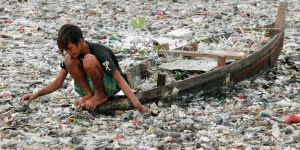
100 MILLION plastic bottles are thrown away every day, choking our oceans in plastic waste. Governments meet in days to outline clean ocean commitments. If a million of us call on top polluters to stop the flood of plastics, the Head of the UN’s Environment Programme will announce our petition to the plenary and use our voices to help oceans breathe again.

SIGN NOW

Dear friends,

By 2050, our oceans will have more plastic trash than fish.

It’s shameful. Half of the plastic made we use just once and throw out, choking our seas and all the animals in it.

But in days, our governments can stem this tide when they meet at a historic summit to outline their clean ocean commitments. Public pressure just got #2 polluter Indonesia to commit to a 70% reduction in plastic waste! Now we need to go after the other top polluters.

If one million of us get behind a global call, the Head of the UN Environment Programme will announce our petition from the summit podium and work with us to push countries to ban single-use plastics and let oceans breathe again. Add your name:

Click to save our oceans!

No matter where we live, each breath we take connects us to our oceans. Most of our oxygen is generated by them. They regulate our climate and weather, turn water into clouds that give us rain. And oceans provide a home for near 80% of all living things on earth. We can’t live without our oceans.

But now, our oceans can’t live without us.

Humans have destroyed ocean health and we need to fix it. The good news is, more than half the plastic trash in our oceans come from just five nations. If we focus global attention on the biggest polluters now, we can create global system-change for plastic-free seas. What’s missing is the motivation — and that’s where we come in.

Let’s build a massive call on our governments to stop suffocating our oceans. Once we reach a million signers, Avaaz will launch targeted campaigns on the top polluters to ramp up the pressure for them to act.

Click to save our oceans!

Our community has fought fiercely to protect magnificent rainforests and vast areas of our oceans. Now time is running out to kill plastic pollution before it kills us.

With hope and determination,

Dalia, Lisa, Alice, Carol, Danny and the entire Avaaz team

MORE INFORMATION:

The Oceans Are Drowning In Plastic — And No One’s Paying Attention (Huffington Post)
http://www.huffingtonpost.com/entry/plastic-waste-oceans_us_58fed37be4b0c46f0781d426

The Arctic Ocean Is Clogging With Billions of Plastic (The Atlantic)
https://www.theatlantic.com/science/archive/2017/04/the-arctic-ocean-is-filling-with-billions-of-plastic-bits/523713/

Even your sea salt is almost certainly contaminated with plastic (Quartz)
https://qz.com/979101/sea-salt-is-likely-to-contain-microparticles-of-plastic-according-to-a-new-study/

Full scale of plastic in the world’s oceans revealed for first time (The Guardian)
https://www.theguardian.com/environment/2014/dec/10/full-scale-plastic-worlds-oceans-revealed-first-time-pollution

Ask jeff sessions why have mandatory minimum sentences for nonviolent drug offenders?


Petitioning Jeff Sessions

Don’t escalate the failed war on drugs.

Petition by Weldon Angelos
Midvale, Utah

Attorney General Jeff Sessions has just ordered federal prosecutors to seek the harshest punishments possible, including mandatory minimum sentences for nonviolent drug offenders.

In 2004, I was given a 55-year mandatory minimum sentence as a first-time marijuana offender — virtually a sentence to die in prison. I had sold marijuana three times to an informant who stated that I had a firearm in my possession.

I never used or even showed the firearm, but this allowed prosecutors to charge me with three counts of using a firearm in the course of a drug trafficking offense, that carried a mandatory minimum of five years for the first offense and 25 years for each of the other two offenses.

At my sentencing, even the judge disagreed with the sentence. He called it “unjust, cruel, and even irrational,” and pointed out that shorter federal sentences have been given to violent criminals such as murderers, child rapists, and even terrorists.

I was only 24 years old when I was sentenced. While imprisoned for 13 years, I missed my children growing up and the fruits of a promising music career. Yet, no problem was solved. This waste of human life must end.

I’m only free because bipartisan lawmakers and advocates, and even the man who prosecuted me, came together to say that my sentence was wrong. My release was part of a changing attitude toward nonviolent drug offenders, with both Republicans and Democrats working together to make sentences fairer. But now, Attorney General Jeff Sessions is working to undo this progress. 

Sessions decision to order prosecutors to seek the longest sentences possible reverses a directive from former Attorney General Eric Holder that instructed prosecutors to use their discretion and avoid long sentences for low-level drug offenders.

Please sign my petition asking Attorney General Jeff Sessions to reconsider his push for mandatory minimum sentences. 

If the federal budget were a pie…#MomsEqualPay Twitter storm on Tuesday, May 23, at 2:00 p.m. Eastern Time ~ Sabrina Joy Stevens


… Trump would try to give us the burnt crust.


After seeing the Trump administration’s leaked education budget, we can’t help but imagine how Secretary of Education Betsy DeVos plans to answer for these attacks on America’s most vulnerable students.


Budget Breakdown
The Trump administration is about to formally release its full budget proposal. Based on what we’ve seen in his “Skinny Budget,” especially when considered side by side with his tax principles, we’re pretty sure it’s going to be yet another opportunity for him to promote deep cuts to essential programs for working families to make room for giant tax cuts for corporations and the uber-wealthy.

Fortunately, presidential budget frameworks are just a suggestion, not the final word on our nation’s spending. But if we’re going to keep Trump’s allies in Congress from enacting the worst of his budget, we’ve got to spread the word and make his proposals as politically toxic as possible.

Moms’ Equal Pay Day
 Moms’ Equal Pay Day, the date that represents how much further into the current year working moms must work in order to be paid the same amount working dads were paid by the end of last year. Like the other Equal Pay Days we observe throughout the year, it’s an important opportunity to raise awareness about the combination of factors that make economic justice elusive for too many women and families—and to promote policy solutions that advance equality.

Resistance Must-Do’s

Resistance Must-Reads


We the Resistance is our fight to protect our rights and freedoms and to defend the most vulnerable among us through powerful collective action. Every conversation you have with a loved one about the issues important to you, every call you make to Congress, every rally you attend is a part of that resistance. Join us — sign on to the We The Resistance manifesto.

Standing Up to Walmart, and Other News From A Better Balance


Headlines from the Frontlines — May 2017

A Better Balance

“WALMART: SUPERCENTER” by alpha geek is licensed under CC BY-NC-SA 2.0
ABB Files Class Action Lawsuit Against Walmart 
On May 15th, we filed a national class action lawsuit, along with our partners, on behalf of thousands of pregnant workers discriminated against by Walmart. The complaint alleges that Walmart’s policies discriminate against pregnant workers like our client Talisa Borders, who asked to stay off tall ladders and avoid heavy lifting while pregnant and working at Walmart, but instead was pushed onto unpaid leave. Despite amendments to its policy in 2014, Walmart continues to explicitly exclude pregnancy while providing accommodations for workers with disabilities and on-the-job injuries. We won’t stop until no pregnant Walmart worker has to choose between her health and her job.
Rallying and Testifying for Workers in New York 
In April, ABB testified at three separate hearings to argue for stronger legal protections, and stronger enforcement of the laws, on behalf of workers in New York who struggle to support their families while also providing care. First, we testified before the New York City Council Committee on Women’s Issues in support of legislation to promote gender and racial equality in New York City and make the municipal government a model employer for the private sector. The next day, ABB offered expert testimony at a joint hearing sponsored by the Department of Consumer Affairs, the Commission on Human Rights, and the Mayor’s Office of Immigrant Affairs, to address the state of workers’ rights in New York City. Workers and advocates from across the five boroughs participated in the fully bilingual hearing, and ABB testified on the pressing need for strong enforcement of existing laws, such as the Earned Sick Time Act, as well as passage of new protections such as those proposed in the Fair Work Week package to address unpredictable and unfair scheduling practices. Finally, ABB testified at a hearing before the New York City Council Small Business Committee on potential changes to the penalties required by a variety of city laws. We also rallied with fellow advocates on May Day in support of immigrant and workers rights.
Victory for Working Famlies in Georgia
Georgia Governor Deal signed the Georgia Family Care Act into law by on May 8, 2017, after the bill passed the Georgia Legislature with strong bipartisan support. The law permits workers in Georgia who receive paid sick days to use that time to care for their family members in addition to themselves. This victory is a powerful example of the strength of strategic, persistent advocacy, and shows that success in support of working families is possible, even in a Southern state like Georgia where worker protections are often difficult to come by. A Better Balance provided support to advocates in the campaign’s early years and was instrumental in working with the coalition to expand the bill’s family definition to include tax dependents, in addition to children, spouses, grandchildren, grandparents, or parents.
More State Wins for Pregnant Workers 
We have seen significant progress for pregnant workers at the state level in the past month. Vermont became the 19th state to provide stronger protections for pregnant workers when Governor Scott signed their Pregnant Workers Fairness Act into law on May 4th. ABB provided technical support and testimony to advance the bill. Next door in Massachusetts, the House voted unanimously to pass a similar bill that ABB has been advising advocates on closely since 2014. Across the country, Washington State’s legislature also passed a PWFA bill that now awaits the governor’s signature. This continued momentum puts further pressure on Congress to take up the federal PWFA, which was re-introduced last week with bi-partisan support in both chambers.
Bans on Salary History Advance in New York  
Low wages in the past can lock workers into low wages in the future and perpetuate gender and race-based wage gaps. That is why ABB has been working on legislation in New York City and at the State level to prevent employers from relying on or inquiring into an applicant’s past salary. We were in Albany earlier this month to speak at a press conference in support of a statewide salary history bill we helped to draft and are leading the charge to pass this session. And on May 4th, we attended the ceremony at City Hall where Mayor de Blasio signed into law a similar bill that ABB supported with close input on language and revisions, as well as testimony, on its path to passage.
Voices from the Clinic 
“Once I felt so sick that I did not have the strength to go to work as I was very sick. As any employee would do, I called in sick and my employer suspended me for a week. My employer even questioned the veracity of my situation. Thanks to a friend who helped me to find help, I found you [ABB]. You [ABB] guided me and I was able to return to work right away. Please do not be silent, look for help, we are people and as such we need respect, not injustice.”
–Yorkshiris Paulino

Public Health


Public Health Emergency. Resilient People. Healthy Communities. A Nation Prepared.

National Peace Officers’ Memorial:  ASPR Provides Public Health and Medical Support

Every day, men and women in law enforcement put their lives on the line to serve and protect our communities.  The National Peace Officers’ Memorial honors those men and women who have been killed or disabled in the line of duty.  ASPR was proud to provide public health and medical support during the event at the request of the Office of the Attending Physician to Congress and the U.S. Capitol Police. News in Pictures >>

NDMS set up medical tents at the National Peace Officer’s Memorial Service near the U.S. Capitol.

#IAmHHS: Putting Policy to Work on the Ground

Before, during and after disasters, dedicated professionals from the U.S. Department of Health and Human Services work together to help protect health and save lives.  Meet one of these remarkable people:  Rachel Kaul.  When disaster strikes, Rachel helps identify where the needs are and quickly mobilizes resources to meet them. After 9-11, she was there.  After Hurricane Katrina, she was there. And she continues to serve during disasters and every day.    Learn More >>

Rachel Kaul - ASPR. "This work is about humanity, compassion and meaning."

How Students Can Empower Their Communities to Protect Against Zika

If you work with students, then you probably know that they offer unique connections with their communities, are better able to communicate with their fellow students, and motivate action among their peers. Find out how you can help inspire the students in your community to learn about Zika and teach others. Learn more >>

A child spraying insect repellant on their legs

Preparing to Meet the Needs of Pediatric Patients in Disasters: Progress and the Path Forward

The Flint water crisis and the Zika outbreak have highlighted ways that children can be especially vulnerable when disaster strikes. Find out what actions HHS and its partners are taking to protect children’s health during and after disasters and emergencies. Learn More >>

A rescue worker wrapping a child in a warming blanket

Preparing to Keep Everyone Healthy in a Disaster:  Delivering Gender-Informed Services

During National Women’s Health Week, many people and organizations are taking a look at concrete steps they can take to improve women’s health.  If you are a public health or emergency planner, take a few minutes to think about steps you can take now to decrease gender-based violence, ensure equal access to services, and address the special concerns of at-risk groups when disaster strikes.  Learn More >>

male and female gender icons on chalk board

politics,pollution,petitions,pop culture & purses