
1982 – The U.S. Senate approved an immigration bill that granted permanent resident status to illegal aliens who had arrived in the United States before 1977.


As a reminder, it was President Reagan who was the first to use the phrase, “we can make America great again.” Says Ronald Reagan said immigrants “brought with them courage and the values of family, work, and freedom. Let us pledge to each other that we can make America great again.”.

Why Immigrants Were Given Legal Status by Ronald Reagan. The Immigration Reform and Control Act of 1986 was signed into law by Ronald Reagan and allowed illegal immigrants who entered the U.S. before 1982 to be legalized.

As the nation’s attention turns back to the fractured debate over immigration, it might be helpful to remember that in 1986, Ronald Reagan signed a sweeping immigration reform bill into law. It was sold as a crackdown: There would be tighter security at the Mexican border, and employers would face strict penalties for hiring undocumented workers.

But the bill also made any immigrant who’d entered the country before 1982 eligible for amnesty — a word not usually associated with the father of modern conservatism.

In his renewed push for an immigration overhaul this week, President Obama called for Republican support for a bill to address the growing population of illegal immigrants in the country. This time, however, Republicans know better than to tread near the politically toxic A-word.

Part of this aversion is due to what is widely seen as the failure of Reagan’s 1986 Immigration Reform and Control Act. However, one of the lead authors of the bill says that unlike most immigration reform efforts of the past 20 years, amnesty wasn’t the pitfall.

“We used the word ‘legalization,’ ” former Wyoming Sen. Alan K. Simpson tells NPR’s Guy Raz. “And everybody fell asleep lightly for a while, and we were able to do legalization.”

for the complete article npr.com

~  NPR
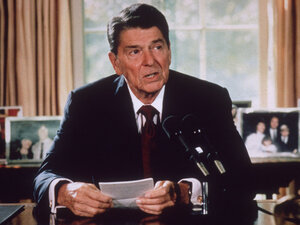
“I believe in the idea of amnesty for those who have put down roots and lived here, even though sometime back they may have entered illegally,” Ronald Reagan said in 1984.

Hulton Archive/Getty Images

on this day … 8/17 1982 – The U.S. Senate approved an immigration bill that granted permanent resident status to the undocumented


1790 – The capital city of the U.S. moved to Philadelphia from New York City.

1807 – Robert Fulton’s “North River Steam Boat” (known as the “Clermont”) began heading up New York’s Hudson River on its successful round-trip to Albany.

1815 – Napoleon began serving his exile when he arrived at the island of St. Helena.

1859 – A hot air balloon was used to carry mail for the first time. John Wise left Lafayette, IN, for New York City with 100 letters. He had to land after only 27 miles.

1863 – Federal batteries and ships bombarded Fort Sumter in Charleston, SC, harbor during the Civil War.

1894 – John Wadsworth of Louisville set a major league record when he gave up 28 base hits in a single game.

1896 – The Klondike gold rush was set off by George Carmack discovering gold on Rabbit Creek in Alaska.

1903 – Joseph Pulitzer donated a million dollars to Columbia University. This started the Pulitzer Prizes in his name.

1915 – Charles F. Kettering received a patent for the first electric ignition device.

1939 – The movie “Wizard of Oz” premiered in New York. It had premiered in Hollywood on August 15.

1943 – The Allied conquest of Sicily was completed as U.S. and British forces entered Messina.

1945 – The nationalists of Indonesia declared their independence from the Netherlands.

1961 – The Communist East German government completed the construction of the Berlin Wall.

1973 – Lee Trevino got the first hole in one of his career at the U.S.I. Golf Classic, in Sutton, MA.

1977 – Florists Transworld Delivery (FTD) reported that in one day the number of orders for flowers to be delivered to Graceland had surpassed the number for any other event in the company’s history.

1978 – Maxie Anderson, Ben Abruzzo and Larry Newman became the first to land after a successful trans-Atlantic balloon flight. The voyage began in Presque Isle, ME and ended in Miserey, France.

1982 – The U.S. Senate approved an immigration bill that granted permanent resident status to illegal aliens who had arrived in the United States before 

1985 – A year-long strike began when 1,400 Geo. A. Hormel and Co. meat packers walked off the job.

1987 – The Dow Jones Industrial Average closed above 2,700 for the first time.

1996 – A military cargo plane crashed in Wyoming killing eight crewmembers and a Secret Service employee. The plane was carrying gear for U.S. President Clinton.

1996 – Ross Perot was announced to be the Reform Party’s presidential candidate. It was the party’s first-ever candidate.

1998 – NationsBank and BankAmerica merge to create the largest U.S. bank.

1998 – Russia devalued the ruble.

2002 – In Santa Rosa, CA, the Charles M. Schulz Museum opened to the public.

1812 ~ The U.S. surrenders Fort Detroit to the British


During the War of 1812, American General William Hull surrenders Fort Detroit and his army to the British without a fight. Hull, a 59-year-old veteran of the American Revolution, had lost hope of defending the settlement after seeing the large English and Indian force gathering outside Detroit’s walls. The general was also preoccupied with the presence of his daughter and grandchildren inside the fort.

Of Hull’s 2,000-man army, most were militiamen, and British General Isaac Brock allowed them to return to their homes on the frontier. The regular U.S. Army troops were taken as prisoners to Canada. With the capture of Fort Detroit, Michigan Territory was declared a part of Great Britain and Shawnee chief Tecumseh was able to increase his raids against American positions in the frontier area. Hull’s surrender was a severe blow to American morale. In September 1813, U.S. General William Henry Harrison, the future president, recaptured Detroit.

In 1814, William Hull was court-martialed for cowardice and neglect of duty in surrendering the fort, and sentenced to die. Because of his service in the revolution, however, President James Madison remitted the sentence.

Source: history.com

on this day 8/16 1984 – The U.S. Jaycees voted to admit women to full membership in the organization


1777 – During the American Revolutionary War, the Battle of Bennington took place. New England’s minutemen routed the British regulars.

1812 – Detroit fell to Indian and British troops in the War of 1812.

1829 – The “Siamese twins,” Chang and Eng Bunker, arrived in Boston, MA. They had come to the Western world to be exhibited. They were 18 years old and joined at the waist.

1842 – In New York City, the U.S. government took over operations of the City Despatch Post. This was the first congressionally authorized local postage delivery. 

1858 – A telegraphed message from Britain’s Queen Victoria to U.S. President Buchanan was transmitted over the recently laid trans-Atlantic cable.

1861 – U.S. President Lincoln prohibited the Union states from trading with the states of the Confederacy. 

1923 – Carnegie Steel Corporation put into place the eight-hour workday for its employees.

1930 – The first British Empire Games were held at Hamilton, Ontario, Canada. The event is now called the British Commonwealth Games.

1937 – Harvard University became the first school to have graduate courses in traffic engineering and administration.

1954 – Sports Illustrated was published for the first time. It was claimed that 250,000 subscriptions had been sold before the first issue came off of the presses.

1954 – Jack Paar replaced Walter Cronkite as host of “The Morning Show” on CBS-TV.

1960 – Cyprus was granted independence by Britain.

1960 – The free-fall world record was set by Joseph Kittinger. He fell more than 16 miles (about 84,000 feet) before opening his parachute over New Mexico.

1978 – Xerox was fined for excluding Smith-Corona Mfg. from the copier market. The fine was $25.6 million.

1984 – The U.S. Jaycees voted to admit women to full membership in the organization.

1995 – Voters in Bermuda rejected independence from Great Britain.

1999 – In Russia, Vladimir V. Putin was confirmed as prime minister by the lower house of parliament.

6 Ways to Reduce Gun Violence in America – a repost


politics,pollution,petitions,pop culture & purses