

on this day … 8/2 1939 – U.S. President Roosevelt signed the Hatch Act. The act prohibited civil service employees from taking an active part in political campaigns.

1776 – Members of the Continental Congress began adding their signatures to the Declaration of Independence.
1791 – Samuel Briggs and his son Samuel Briggs, Jr. received a joint patent for their nail-making machine. They were the first father-son pair to receive a patent.
1824 – In New York City, Fifth Avenue was opened.
1858 – In Boston and New York City the first mailboxes were installed along streets.
1861 – The United States Congress passed the first income tax. The revenues were intended for the war effort against the South. The tax was never enacted.
1887 – Rowell Hodge patented barbed wire.
1892 – Charles A. Wheeler patented the first escalator.
1921 – Eight White Sox players were acquitted of throwing the 1919 World Series.
1926 – John Barrymore and Mary Astor starred in the first showing of the Vitaphone System. The system was the combining of picture and sound for movies.
1938 – Bright yellow baseballs were used in a major league baseball game between the Brooklyn Dodgers and the St. Louis Cardinals. It was hoped that the balls would be easier to see.
1939 – Albert Einstein signed a letter to President Roosevelt urging the U.S. to have an atomic weapons research program.
1939 – U.S. President Roosevelt signed the Hatch Act. The act prohibited civil service employees from taking an active part in political campaigns.
1943 – The U.S. Navy patrol torpedo boat, PT-109, sank after being attacked by a Japanese destroyer. The boat was under the command of Lt. John F. Kennedy.
1945 – The Allied conference at Potsdam was concluded.
1964 – The Pentagon reported the first of two North Vietnamese attacks on U.S. destroyers in the Gulf of Tonkin.
1983 – U.S. House of Representatives approved a law that designated the third Monday of January would be a federal holiday in honor of Dr. Martin Luther King, Jr. The law was signed by President Reagon on November 2.
1987 – “Snow White and the Seven Dwarfs” was re-released. The film was 50 years old at the time of its re-release.
1990 – Iraq invaded the oil-rich country of Kuwait. Iraq claimed that Kuwait had driven down oil prices by exceeding production quotas set by OPEC.
1995 – China ordered the expulsion of two U.S. Air Force officers. The two were said to have been caught spying on military sights.
Share this:

1619 – First enslaved Africans arrive in Jamestown, setting the stage for slavery in North America
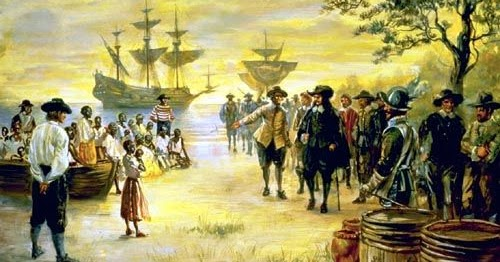
On August 20, 1619, “20 and odd” Angolans, kidnapped by the Portuguese, arrive in the British colony of Virginia and are then bought by English colonists. The arrival of enslaved Africans in the New World marks a beginning of two and a half centuries of slavery in North America.
Founded at Jamestown in 1607, the Virginia Colony was home to about 700 people by 1619. The first enslaved Africans to arrive in Virginia disembarked at Point Comfort, in what is today known as Fort Monroe. Most of their names, as well as the exact number who remained at Point Comfort, have been lost to history, but much is known about their journey.
They were originally kidnapped by Portuguese colonial forces, who sent captured members of the native Kongo and Ndongo kingdoms on a forced march to the port of Luanda, the capital of modern-day Angola. From there, they were ordered on the ship San Juan Bautista, which set sail for Veracruz in the colony of New Spain. As was quite common, about 150 of the 350 captives aboard the ship died during the crossing. Then, as it approached its destination, the ship was attacked by two privateer ships, the White Lion and the Treasurer. Crews from the two ships kidnapped up to 60 of the Bautista’s enslaved people. It was the White Lion which docked at Virginia Colony’s Point Comfort and traded some of the prisoners for food on August 20, 1619.
history.com
READ MORE: The Last American Slave Ship
Citation Information
Article Title
First enslaved Africans arrive in Jamestown, setting the stage for slavery in North America
AuthorHistory.com Editors
Website Name
HISTORY
URL
https://www.history.com/this-day-in-history/first-african-slave-ship-arrives-jamestown-colony
Access Date
August 20, 2022
Publisher
A&E Television Networks
Last Updated
August 16, 2022
Original Published Date
August 13, 2019
Share this:

Harlem Riots – August 1, 1943
Simmering racial tensions and economic frustrations boil over in New York City on the night of August 1, 1943, culminating in what is now known as the Harlem Riot of 1943. During an altercation in the lobby of the Braddock Hotel, a white police officer shoots a Black soldier, Robert Bandy, triggering a massive uprising.
Overwhelmingly white before the Great Migration, Harlem was 89 percent Black by the time the United States entered World War II. Despite the cultural innovations that accompanied these changes, known as the Harlem Renaissance, the neighborhood’s businesses remained mostly white-owned, and landlords and business owners continued to discriminate against Black residents. World War II brought not only conscription but also a higher cost of living, putting even more strain on a Black community whose economy was still controlled almost entirely by whites
Share this:

a Letter From Virginia ~In Memory~ (Free Before Emancipation) ~~ July/August edition

Letter From Virginia
Excavations are providing a new look at some of the Civil War’s earliest fugitive slaves—considered war goods or contraband—and their first taste of liberty
click on the graphic below to get the complete story, it’s six pages of American History
(Library of Congress)
Following an 1861 decision by a Union general, escaped slaves were declared contraband, or illegal war goods, and freed. Thousands of fugitive slaves, including this group in Pamunkey Run, Virginia, provided the Union army with labor and established independent communities.


 Be a Seed for Change
You must be logged in to post a comment.