1787 Congress enacts the Northwest Ordinance


On July 13, 1787, Congress enacts the Northwest Ordinance, structuring settlement of the Northwest Territory and creating a policy for the addition of new states to the nation. The members of Congress knew that if their new confederation were to survive intact, it had to resolve 

read more

On this day … 7/13


1096 – Crusaders under Peter the Hermit reached Sofia, Bulgaria. There they met their Byzantine escort, which brought them safely the rest of the way to Constantinople. by August 1.

1543 – England’s King Henry VIII married his sixth and last wife, Catherine Parr.

1690 – Protestant forces led by William of Orange defeated the Roman Catholic army of James II.

1691 – William III defeated the allied Irish and French armies at the Battle of Aughrim, Ireland.

1790 – The French Assembly approved a Civil Constitution providing for the election of priests and bishops.

1806 – The Confederation of the Rhine was established in Germany.

1862 – The U.S. Congress authorized the Medal of Honor.

1864 – U.S. President Abraham Lincoln witnessed the battle where Union forces repelled Jubal Early’s army on the outskirts of Washington, DC.

1870 – The first rotary can opener with a cutting wheel was patented by William W. Lyman.

1912 – The first foreign-made film to premiere in America, “Queen Elizabeth”, was shown.

1931 – A major league baseball record for doubles was set as the St. Louis Cardinals and the Chicago Cubs combined for a total of 23.

1933 – A minimum wage of 40 cents an hour was established in the U.S.

1941 – Moscow was bombed by the German Luftwaffe for the first time.

1946 – “The Adventures of Sam Spade” was heard on ABC radio for the first time.

1954 – U.S. President Dwight D. Eisenhower proposed a highway modernization program, with costs to be shared by federal and state governments.

1954 – The Major League Baseball Players Association was organized in Cleveland, OH.

1957 – The U.S. surgeon general, Leroy E. Burney, reported that there was a direct link between smoking and lung cancer.

1960 – Manufacturing began for the Etch A Sketch®.

1974 – John Ehrlichman, a former aide to U.S. President Nixon, and three others were convicted of conspiring to violate the civil rights of Daniel Ellsberg’s former psychiatrist. 

1982 – “E.T.: The Extra-Terrestrial” broke all box-office records by surpassing the $100-million mark of ticket sales in the first 31 days of its opening.

1982 – The last of the distinctive-looking Checker taxicabs rolled off the assembly line in Kalamazoo, MI.

1984 – Democratic presidential candidate Walter F. Mondale named U.S. Rep. Geraldine A. Ferraro of New York to be his running mate. Ferraro was the first woman to run for vice president on a major party ticket.

1990 – Russian republic president Boris N. Yeltsin announced his resignation from the Soviet Communist Party.

1998 – 1.7 billion people watched soccer’s World Cup finals between France and Brazil. France won 3-0.

1999 – Walt Disney Co. announced that it was merging all of its Internet operations together with Infoseek into Go.com.
Disney movies, music and books

2000 – Russia launched the Zvezda after two years of delays. The module was built to be the living quarters for the International Space Station (ISS.)

2000 – The movie “X-Men” premiered in New York.

on this day … 7/10


1609 – The Catholic states in Germany set up a league under the leadership of Maximillian of Bavaria.

1679 – The British crown claimed New Hampshire as a royal colony.

1776 – The statue of King George III was pulled down in New York City.

1778 – In support of the American Revolution, Louis XVI declared war on England.

1821 – U.S. troops took possession of Florida. The territory was sold by Spain.

1832 – U.S. President Andrew Jackson vetoed legislation to re-charter the Second Bank of the United States.

1866 – Edison P. Clark patented his indelible pencil.

1890 – Wyoming became the 44th state to join the United States.
Today in Wyoming History

1900 – ‘His Master’s Voice’, was registered with the U.S. Patent Office. The logo of the Victor Recording Company, and later, RCA Victor, shows the dog, Nipper, looking into the horn of a gramophone machine.

1910 – W.R. Brookins became the first to fly an airplane at an altitude of one mile.

1913 – The highest temperature ever recorded in the U.S. was 134 degrees in Death Valley, CA.

1919 – The Treaty of Versailles was hand delivered to the U.S. Senate by President Wilson.

1925 – The official news agency of the Soviet Union, TASS, was established.

1928 – George Eastman first demonstrated color motion pictures.

1929 – The U.S. government began issuing paper money in the small size.

1938 – Howard Hughes completed a 91 hour flight around the world.

1940 – The 114-day Battle of Britain began during World War II.

1943 – Arthur Ashe, the first African-American inducted into the International Tennis Hall of Fame, was born. He had won 33 career titles.

1947 – Saab introduced the Model 92 prototype as its first automobile.

1949 – The first practical rectangular television was presented. The picture tube measured 12 by 16 and sold for $12.

1951 – Armistice talks aimed at ending the Korean conflict began at Kaesong.

1951 – Sugar Ray Robinson was defeated for only the second time in 133 fights as Randy Turpin took the middleweight crown.

1953 – American forces withdraw from Pork Chop Hill in Korea after heavy fighting.

1962 – The Telstar Communications satellite was launched. The satellite relayed TV and telephone signals between Europe and the U.S.

1962 – Fred Baldasare swam the English Channel underwater. It was a 42 miles and took 18 hours.

1969 – The National League was divided up into two baseball divisions.

1973 – Britain granted the Bahamas their independence after three centuries of British colonial rule.

1984 – Dwight ‘Doc’ Gooden, of the New York Mets, became the youngest player to appear in an All-Star Game as a pitcher. He was 19 years, 7 months, and 24 days old.

1985 – Coca-Cola resumed selling the old formula of Coke, it was renamed “Coca-Cola Classic.” It was also announced that they would continue to sell “New” Coke.

1990 – Mikhail Gorbachev won re-election as the leader of the Soviet Communist Party.

1991 – Boris Yeltsin took the oath of office as the first elected president of the Russian republic.

1991 – U.S. President Bush lifted economic sanctions against South Africa, citing its “profound transformation” toward racial equality.

1993 – Kenyan runner Yobes Ondieki became the first man to run 10,000 meters in less than 27 minutes.

1997 – Scientists in London said DNA from a Neanderthal skeleton supported a theory that all humanity descended from an “African Eve” 100,000 to 200,000 years ago.

1998 – The World Bank approved a $700 million loan to Thailand.

1998 – The U.S. military delivered the remains of Air Force 1st Lt. Michael Blassie to his family in St. Louis. He had been placed in Arlington Cemetery’s Tomb of the Unknown in 1984. His identity had been confirmed with DNA tests.

1999 – The heads of six African nations that had troops in the Democratic Republic of the Congo signed a cease-fire agreement that would end the civil war in that nation.

2002 – Peter Paul Rubens’ painting “The Massacre of the Innocents” sold for $76.2 million at Sotheby’s.

2015 – In South Carolina, the Confederate flag was removed from the Capitol grounds and taken to a state military museum.

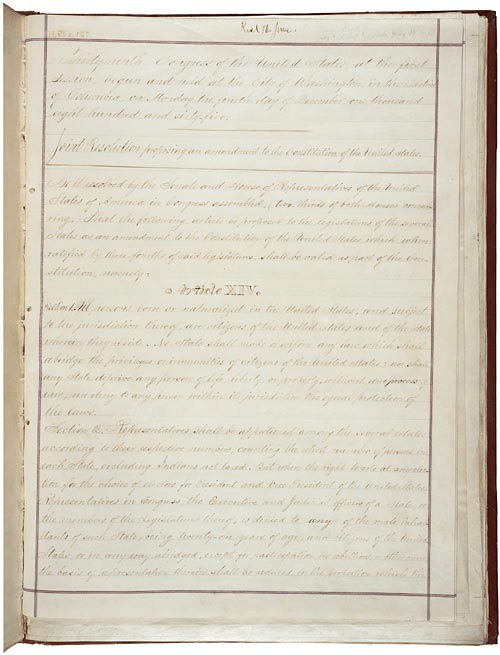
14th Amendment to the U.S. Constitution: Civil Rights (1868)


Passed by Congress June 13, 1866, and ratified July 9, 1868, the 14th Amendment extended liberties and rights granted by the Bill of Rights to formerly enslaved people.

Citation: The House Joint Resolution Proposing the 14th Amendment to the Constitution, June 16, 1866; Enrolled Acts and Resolutions of Congress, 1789-1999; General Records of the United States Government; Record Group 11; National Archives.
View All Pages in the National Archives Catalog
View Transcript

Following the Civil War, Congress submitted to the states three amendments as part of its Reconstruction program to guarantee equal civil and legal rights to Black citizens. A major provision of the 14th Amendment was to grant citizenship to “All persons born or naturalized in the United States,” thereby granting citizenship to formerly enslaved people.

Another equally important provision was the statement that “nor shall any state deprive any person of life, liberty, or property, without due process of law; nor deny to any person within its jurisdiction the equal protection of the laws.” The right to due process of law and equal protection of the law now applied to both the federal and state governments.

On June 16, 1866, the House Joint Resolution proposing the 14th Amendment to the Constitution was submitted to the states. On July 28, 1868, the 14th amendment was declared, in a certificate of the Secretary of State, ratified by the necessary 28 of the 37 States, and became part of the supreme law of the land.

Congressman John A. Bingham of Ohio, the primary author of the first section of the 14th Amendment, intended that the amendment also nationalize the Bill of Rights by making it binding upon the states. When introducing the amendment, Senator Jacob Howard of Michigan specifically stated that the privileges and immunities clause would extend to the states “the personal rights guaranteed and secured by the first eight amendments.” Historians disagree on how widely Bingham’s and Howard’s views were shared at the time in the Congress, or across the country in general. No one in Congress explicitly contradicted their view of the amendment, but only a few members said anything at all about its meaning on this issue. For many years, the Supreme Court ruled that the amendment did not extend the Bill of Rights to the states.

Not only did the 14th Amendment fail to extend the Bill of Rights to the states; it also failed to protect the rights of Black citizens. A legacy of Reconstruction was the determined struggle of Black and White citizens to make the promise of the 14th Amendment a reality. Citizens petitioned and initiated court cases, Congress enacted legislation, and the executive branch attempted to enforce measures that would guard all citizens’ rights. While these citizens did not succeed in empowering the 14th Amendment during Reconstruction, they effectively articulated arguments and offered dissenting opinions that would be the basis for change in the 20th century.

politics,pollution,petitions,pop culture & purses