history… may 15


1602 – Cape Cod was discovered by Bartholomew Gosnold.

1614 – An aristocratic uprising in France ended with the treaty of St.Menehould.

1618 – Johannes Kepler discovered his harmonics law.

1702 – The War of Spanish Succession began.

1768 – Under the Treaty of Versailles, France purchased Corsica from Genoa.

1795 – Napoleon entered the Lombardian capital of Milan.

1849 – Neapolitan troops entered Palermo, and were in possession of Sicily.

1856 – Lyman Frank Baum, author of “The Wonderful Wizard of Oz,” was born.

1862 – The U.S. Congress created the U.S. Department of Agriculture.

1911 – The U.S. Supreme Court ordered the dissolution of Standard Oil Company, ruling it was in violation of the Sherman Antitrust Act.

1916 – U.S. Marines landed in Santo Domingo to quell civil disorder.

1918 – Regular airmail service between New York City, Philadelphia and Washington, DC, began under the direction of the Post Office Department, which later became the U.S. Postal Service.

1926 – Roald Amundsen and Lincoln Ellsworth were forced down in Alaska after a four-day flight over an icecap. Ice had begun to form on the dirigible Norge.

1926 – The New York Rangers were officially granted a franchise in the NHL. The NHL also announced that Chicago and Detroit would be joining the league in November.

1930 – Ellen Church became the first female flight attendant.

1940 – Nylon stockings went on sale for the first time in the U.S.

1941 – Joe DiMaggio began his historic major league baseball hitting streak of 56 games.

1942 – Gasoline rationing began in the U.S. The limit was 3 gallons a week for nonessential vehicles.

1948 – Israel was attacked by Transjordan, Egypt, Syria, Iraq and Lebanon only hours after declaring its independence.

1951 – AT&T became the first corporation to have one million stockholders.

1957 – Britain dropped its first hydrogen bomb on Christmas Island in the Pacific Ocean.

1958 – Sputnik III, the first space laboratory, was launched in the Soviet Union.

1963 – The last Project Mercury space flight was launched.

1964 – The Smothers Brothers, Dick and Tom, gave their first concert in Carnegie Hall in New York City.

1970 – U.S. President Nixon appointed America’s first two female generals.

1970 – Phillip Lafayette Gibbs and James Earl Green, two black students at Jackson State University in Mississippi, were killed when police opened fire during student protests.

1972 – Alabama Gov. George C. Wallace was shot by Arthur Bremer in Laurel, MD while campaigning for the U.S. presidency. Wallace was paralyzed by the shot.

1975 – The merchant ship U.S. Mayaguez was recaptured from Cambodia’s Khmer Rouge.

1980 – The first transcontinental balloon crossing of the United States took place.

1983 – In Boston,MA, the Madison Hotel was destroyed by implosion.

1988 – The Soviet Union began their withdrawal of its 115,000 troops from Afghanistan. Soviet forces had been there for more than eight years.

1990 – Vincent Van Gogh’s “Portrait of Doctor Gachet” was sold for $82.5 million. The sale set a new world record.

1997 – The Space shuttle Atlantis blasted off on a mission to deliver urgently needed repair equipment and a fresh American astronaut to Russia’s orbiting Mir station.

1999 – The Russian parliament was unable a attain enough votes to impeach President Boris Yeltsin.

2014 – The National September 11 Memorial Museum was dedicated in New York City.

on-this-day.com

1961 – A bus carrying Freedom Riders was bombed and burned in Alabama.


In Memory

May 14, 1961, Anniston, Alabama, — Passengers of this smoking Greyhound bus, some of the members of the “Freedom Riders,” a group sponsored by the Congress of Racial Equality (CORE), sit on the ground after the bus was set afire 5/14, by a mob of Caucasians who followed the bus from the city. The mob met the bus at the terminal, stoned it & slashed the tires, then followed the bus from town. BPA2# 47. — Image by © Bettmann/CORBIS

What is the Purcell Principle?


It’s a rule the Supreme Court created in Purcell v. Gonzalez (2006). It says:

Courts should avoid changing election rules close to an election because it might confuse voters.

This principle has been used to:

  • block fixes to illegal maps
  • freeze lower‑court rulings
  • allow elections to proceed under maps already found to violate the Voting Rights Act

In other words:

If a map is illegal but the election is near, the Supreme Court often says: “Use the illegal map anyway — we’ll deal with it later.”

This is why you see Black districts eliminated or weakened right before elections, even when courts agree the maps are discriminatory.

me and AI … let me know if you think it’s not accurate and cite the source for the correction if needed

history… may 14


1264 – King Henry III was captured by his brother in law Simon deMontfort at the Battle of Lewes in France.

1509 – In the Battle of Agnadello, French defeated Venitians in Northern Italy.

1607 – An expedition led by Captain Christopher Newport went ashore at Jamestown, Virginia. The group had arrived at the location the day before. This became the first permanent English colony in America.

1610 – French King Henri IV (Henri de Navarre) was assassinated by a fanatical monk, François Ravillac.

1643 – Louis XIV became King of France at age 4 upon the death of his father, Louis XIII.

1727 – Thomas Gainsborough was born. He was an English painter.

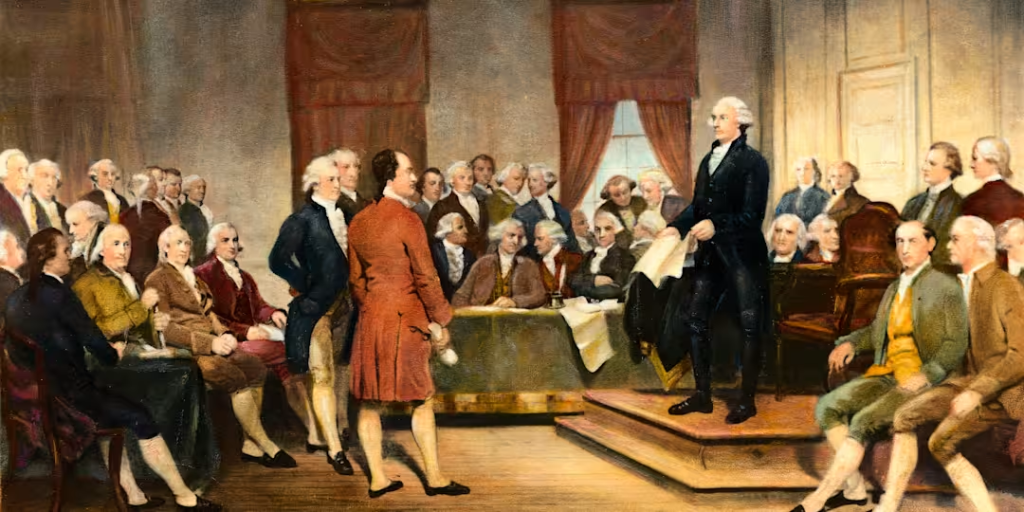
1787 – Delegates began gathering in Philadelphia for a convention to draw up the U.S. Constitution.

1796 – The first smallpox vaccination was given by Edward Jenner.

1804 – William Clark set off the famous expedition from Camp Dubois. A few days later, in St. Louis, Meriwether Lewis joined the group. The group was known as the “Corps of Discovery.”

1811 – Paraguay gained independence from Spain.

1853 – Gail Borden applied for a patent for condensed milk.

1862 – The chronograph was patented by Adolphe Nicole.

1874 – McGill University and Harvard met at Cambridge, MA, for the first college football game to charge admission.

1878 – The name Vaseline was registered by Robert A. Chesebrough.

1879 – Thomas Edison incorporated the Edison Telephone Company of Europe.

1897 – “The Stars and Stripes Forever” by John Phillip Sousa was performed for the first time. It was at a ceremony where a statue of George Washington was unveiled.

1897 – Guglielmo Marconi made the first communication by wireless telegraph.

1913 – The Rockefeller Foundation was created by John D. Rockefeller with a gift of $100,000,000.

1935 – The Philippines ratified an independence agreement.

1940 – The Netherlands surrendered to Nazi Germany.

1942 – The Women’s Auxiliary Army Corps (WAAC) was established by an act of the U.S. Congress.

1942 – “Lincoln Portrait” by Aaron Copland was performed for the first time by the Cincinnati Symphony Orchestra.

1942 – The British, while retreating from Burma, reached India.

1948 – Prime Minister David Ben-Gurion proclaimed the independent State of Israel as British rule in Palestine came to an end.

1955 – The Warsaw Pact, a Easter European mutual-defense treaty, was signed in Poland by eight communist bloc countries including the Soviet Union.

1961 – A bus carrying Freedom Riders was bombed and burned in Alabama.

1967 – Mickey Mantle hit his 500th homerun.

1969 – Jacqueline Susann’s second novel, “The Love Machine,” was published by Simon and Schuster.

1973 – Skylab One was launched into orbit around Earth as the first U.S. manned space station.

1975 – U.S. forces raided the Cambodian island of Koh Tang and recaptured the American merchant ship Mayaguez. All 40 crew members were released safely by Cambodia. About 40 U.S. servicemen were killed in the military operation.

1980 – U.S. President Carter inaugurated the Department of Health and Human Services.

1985 – Ray Kroc’s first McDonald’s restaurant became the first fast-food business museum. It is located in Des Plaines, Illinois.

1988 – In the Andean village of Cayara, Peru’s military was involved in a massacre of at least 26 peasants.

1992 – Former Soviet President Mikhail S. Gorbachev addressed members of the U.S. Congress, appealing to them to pass a bill to aid the people of the former Soviet Union.

1996 – A tornado hit 80 villages in nothern Bangladesh. More than 440 people were killed.

1998 – The Associated Press marked its 150th anniversary.

1998 – The final episode of the TV series “Seinfeld” aired after nine years on NBC.

1999 – North Korea returned the remains of six U.S. soldiers that had been killed during the Korean War.

1999 – Jess Marlow received a star on the Hollywood Walk of Fame.

2005 – The art exhibit “Gumby and Friends: The First 50 Years” opened at the Lynn House Gallery in Antioch, CA.

on-this-day.com

What “preclearance” meant under the Voting Rights Act (VRA)


If the courts consistently applied precedent, a lot of this would already be stopped! Thing is, it feels like SCOTUS stopped following it!

Guess what, precedent isn’t gone — it’s dormant!

Preclearance came from Section 5 of the Voting Rights Act of 1965. It required certain states and counties — mostly in the South — to get federal approval before changing any voting rules.

This included changes like:

  • redistricting maps
  • voter ID laws
  • polling place closures
  • early voting cuts
  • registration rules
  • ballot access changes

They could not take effect until the federal government said:

“This change does not discriminate against minority voters.”

This was a proactive protection — it stopped discrimination before it happened.

What preclearance prevented

Before 2013, preclearance blocked:

  • strict voter ID laws
  • racially gerrymandered maps
  • polling place closures in Black neighborhoods
  • cuts to early voting
  • discriminatory registration rules

The Department of Justice blocked over 1,000 discriminatory changes between 1965 and 2013.

Without preclearance, many of those changes would have gone into effect.

What happened after preclearance was removed

Within hours of the Shelby ruling:

  • Texas implemented a voter ID law previously blocked as discriminatory.
  • North Carolina passed a sweeping voting law that a court later said targeted Black voters “with almost surgical precision.”
  • States began closing polling places in minority communities.
  • Redistricting maps like Tennessee’s became far easier to pass.

This is why you’re seeing the pattern you described — and why it feels like it’s spreading.

Who had to follow preclearance?

The areas covered were determined by Section 4(b), which used data on:

  • literacy tests
  • voter suppression history
  • low minority turnout

This included states like:

  • Alabama
  • Georgia
  • Mississippi
  • Louisiana
  • South Carolina
  • Virginia
  • Texas
  • Arizona

And many counties in other states.

These were places with long, documented histories of suppressing Black voters.

politics,pollution,petitions,pop culture & purses