One month before signing the Emancipation Proclamation, President Lincoln sent a long message to Congress which was largely routine, but also proposed controversial measures such as voluntary colonization of slaves and compensated emancipation.
Lincoln devoted so much attention to preparing the message that his friend David Davis said, “Mr. Lincoln’s whole soul is absorbed in his plan of remunerative emancipation.” The concluding paragraphs shown below demonstrate Lincoln’s passion for this plan and contain some of the most famous statements he ever wrote. Composer Aaron Copland used excerpts in his evocative “Lincoln Portrait.”
I do not forget the gravity which should characterize a paper addressed to the Congress of the nation by the Chief Magistrate of the nation. Nor do I forget that some of you are my seniors, nor that many of you have more experience than I, in the conduct of public affairs. Yet I trust that in view of the great responsibility resting upon me, you will perceive no want of respect yourselves, in any undue earnestness I may seem to display.
Is it doubted, then, that the plan I propose, if adopted, would shorten the war, and thus lessen its expenditure of money and of blood? Is it doubted that it would restore the national authority and national prosperity, and perpetuate both indefinitely? Is it doubted that we here–Congress and Executive–can secure its adoption? Will not the good people respond to a united, and earnest appeal from us? Can we, can they, by any other means, so certainly, or so speedily, assure these vital objects? We can succeed only by concert. It is not “can any of us imagine better?” but, “can we all do better?” The dogmas of the quiet past, are inadequate to the stormy present. The occasion is piled high with difficulty, and we must rise — with the occasion. As our case is new, so we must think anew, and act anew. We must disenthrall ourselves, and then we shall save our country.
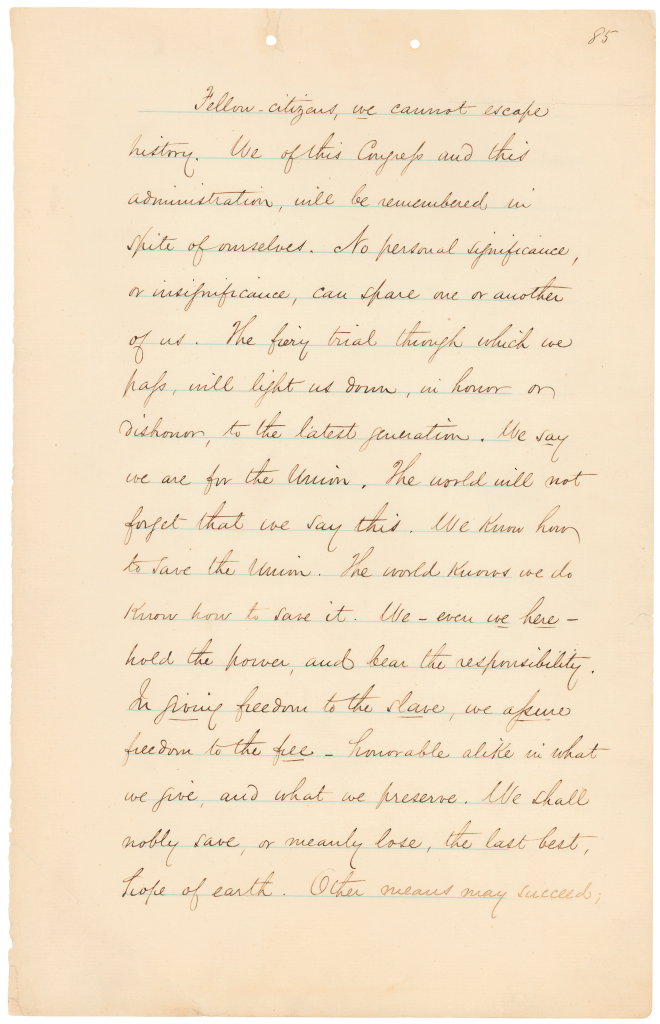
Fellow-citizens, we cannot escape history. We of this Congress and this administration, will be remembered in spite of ourselves. No personal significance, or insignificance, can spare one or another of us. The fiery trial through which we pass, will light us down, in honor or dishonor, to the latest generation. We say we are for the Union. The world will not forget that we say this. We know how to save the Union. The world knows we do know how to save it. We — even we here — hold the power, and bear the responsibility. In giving freedom to the slave, we assure freedom to the free — honorable alike in what we give, and what we preserve. We shall nobly save, or meanly lose, the last best hope of earth. Other means may succeed; this could not fail. The way is plain, peaceful, generous, just — a way which, if followed, the world will forever applaud, and God must forever bless.
abrahamlincolnonline.org





You must be logged in to post a comment.