history… may 20


0325 – The Ecumenical council was inaugurated by Emperor Constantine in Nicea, Asia Minor.

1303 – A peace treaty was signed between England and France over the town of Gascony.

1347 – Cola di Rienzo took the title of tribune in Rome.

1506 – In Spain, Christopher Columbus died in poverty.

1520 – Hernando Cortez defeated Spanish troops that had been sent to punish him in Mexico.

1690 – England passed the Act of Grace, forgiving followers of James II.

1674 – John Sobieski became Poland’s first King.

1774 – Britain’s Parliament passed the Coercive Acts to punish the American colonists for their increasingly anti-British behavior

1775 – North Carolina became the first colony to declare its independence. This is the date that is on the George state flag even though the date of this event has been questioned.

1784 – The Peace of Versailles ended a war between France, England, and Holland.

1830 – The fountain pen was patented by H.D. Hyde.

1861 – North Carolina became the eleventh state to secede from the Union.

1861 – During the American Civil War, the capital of the Confederacy was moved from Montgomery, AL, to Richmond, VA.

1873 – Levi Strauss began marketing blue jeans with copper rivets.

1875 – The International Bureau of Weights and Measures was established.

1899 – Jacob German of New York City became the first driver to be arrested for speeding. The posted speed limit was 12 miles per hour.

1902 – The U.S. military occupation of Cuba ended.

1902 – Cuba gained its independence from Spain.

1916 – Norman Rockwell’s first cover on “The Saturday Evening Post” appeared.

1926 – The U.S. Congress passed the Air Commerce Act. The act gave the Department of Commerce the right to license pilots and planes.

1927 – Charles Lindbergh took off from New York to cross the Atlantic for Paris aboard his airplane the “Spirit of St. Louis.” The trip took 33 1/2 hours.

1930 – The first airplane was catapulted from a dirigible.

1932 – Amelia Earhart took off to fly solo across the Atlantic Ocean. She became the first woman to achieve the feat.

1933 – “Charlie Chan” was heard for the final time on the NBC Blue radio network, after only six months on the air.

1939 – The first telecast over telephone wires was sent from Madison Square Garden to the NBC-TV studios at 30 Rockefeller Center in Manhattan. The event was a bicycle race.

1939 – The first regular air-passenger service across the Atlantic Ocean began with the take-off of the “Yankee Clipper” from Port Washington, New York.

1941 – Germany invaded Crete by air.

1942 – Japan completed the conquest of Burma.

1961 – A white mob attacked the Freedom Riders in Montgomery, AL. The event prompted the federal government to send U.S. marshals.

1969 – U.S. and South Vietnamese forces captured Apbia Mountain, which was referred to as Hamburger Hill.

1970 – 100,000 people marched in New York supporting U.S. policies in Vietnam.

1978 – Mavis Hutchinson, at age 53, became the first woman to run across America. It took Hutchinson 69 days to run the 3,000 miles.

1980 – The submarine Nautilus was designated as a National Historic Landmark by the U.S. Secretary of the Interior.

1982 – TV’s “Barney Miller” was seen for the last time on ABC-TV.

1985 – The Dow Jones industrial average broke the 1300 mark for the first time. The Dow closed at 1304.88.

1985 – The FBI arrested U.S. Navy Chief Petty Officer John Walker. Walker had begun spying for the Soviet Union in 1968.

1985 – Radio Marti was launched.

1990 – The Hubble Space Telescope sent back its first photographs.

1993 – The final episode of “Cheers” was aired on NBC-TV.

1996 – The U.S. Supreme Court struck down a Colorado measure banning laws that would protect homosexuals from discrimination.

1999 – At Heritage High School in Conyers, GA, a 15-year-old student shot and injured six students. He then surrendered to an assistant principal at the school.

2010 – Scientists announced that they had created a functional synthetic genome.

2010 – Five paintings worth 100 million Euro were stolen from the Musée d’Art Moderne de la Ville de Paris.

on-this-day.com

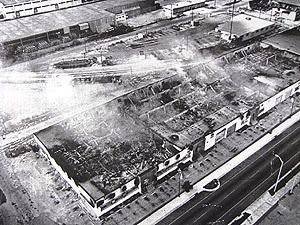
1980 – Rioting erupted in Miami’s Liberty City neighborhood after an all-white jury in Tampa acquitted four former Miami police officers of fatally beating black insurance executive Arthur McDuffie. Eight people were killed in the rioting.


Burning Buildings, Liberty City Riot, 1980Fair use image

The 1980 race riots in Miami’s Liberty City and Overtown neighborhoods was sparked after the acquittal of four White Miami-Dade police officers who beat a Black motorcyclist to death then attempted to hide the crime. On May 17, 1980, the mostly-Black neighborhood erupted in violence after an all-white, all-male Tampa jury didn’t find sufficient evidence to convict the cops.

The incident that sparked the rioting occurred on December 17, 1979 when Arthur McDuffie, a U.S. Marine veteran and businessman, was riding his Kawasaki motorcycle through the neighborhood. The Miami-Dade officers gave chase claiming McDuffie was going 80-plus miles per hour. Officers said after McDuffie lost control of his bike he sped off on foot. According to the officers’ initial reports, McDuffie was involved in a scuffle with the cops with a reported six to eight officers present at the scene.

Later testimony by Officer Charles Veverka revealed that the cops struck McDuffie with nightclubs and their fists until he lay still. Veverka also said that one of the cops ran over McDuffie’s bike with their car to make it appear he had a bad wreck. Another officer, William Hanlon, claims he was the cop who choked McDuffie to the ground while officer Alex Marrero struck him with a heavy-duty flashlight.

The cops who testified in exchange for immunity were given lesser charges, save for Hanlon, who says he was the cop who ran over the motorbike. Mark Meier, another officer who testified against the defendants in the Tampa trial, said that McDuffie actually surrendered at one point. Two other officers, Herbert Evans, Jr. and Ubaldo Del Toro, were charged as accessories to the crime but both walked as well. On May 8, the judge in the case acquitted Del Toro and said that state prosecutors failed to make a case despite the testimonies.

On May 17, the jury acquitted the remaining cops, leading to the riots. Liberty City residents began rioting and burning cars, while reportedly attacking whites in the street. Gov. Bob Graham called in the National Guard. In three days of rioting, 17 were reported dead and over 1,000 arrested. The area was declared a disaster zone. Then President Jimmy Carter came to Miami and asked the community to quell the tension and take action before he would approve much needed federal assistance.

Like BlackAmericaWeb.com on Facebook. Follow us on Twitter.

history… may 16


1770 – Marie Antoinette, at age 14, married the future King Louis XVI of France, who was 15.

1866 – The U.S. Congress authorized the first 5-cent piece to be minted.

1868 – U.S. President Andrew Johnson was acquitted during the Senate impeachment, by one vote.

1879 – The Treaty of Gandamak between Russia and England set up the Afghan state.

1881 – In Germany, the first electric tram for the public started service.

1888 – The first demonstration of recording on a flat disc was demonstrated by Emile Berliner.

1888 – The capitol of Texas was dedicated in Austin.

1910 – The U.S. Bureau of Mines was authorized by the U.S. Congress.

1914 – The American Horseshoe Pitchers Association (AHPA) was formed in Kansas City, Kansas.

1920 – Joan of Arc was canonized in Rome.

1929 – The first Academy Awards were held in Hollywood.

1939 – The Philadelphia Athletics and the Cleveland Indians met at Shibe Park in Philadelphia for the first baseball game to be played under the lights in the American League.

1946 – “Annie Get Your Gun” opened on Broadway.

1946 – Jack Mullin showed the world the first magnetic tape recorder.

1948 – The body of CBS News correspondent George Polk was found in Solonika Bay in Greece. It had been a week after he’d disappeared.

1960 – A Big Four summit in Paris collapsed due to the American U-2 spy plane incident.

1960 – Theodore Maiman, at Hughes Research Laboratory in California, demonstrated the first working laser.

1963 – After 22 Earth orbits Gordon Cooper returned to Earth, ending Project Mercury.

1965 – Spaghetti-O’s were sold for the first time.

1969 – Venus 5, a Russian spacecraft, landed on the planet Venus.

1971 – U.S. postage for a one-ounce first class stamp was increased from 6 to 8 cents.

1975 – Japanese climber Junko Tabei became the first woman to reach the summit of Mount Everest.

1977 – Five people were killed when a New York Airways helicopter, idling on top of the Pan Am Building in Manhattan, toppled over, sending a huge rotor blade flying.

1985 – Michael Jordan was named Rookie of the Year in the NBA.

1987 – The Bobro 400 set sail from New York Harbor with 3,200 tons of garbage. The barge travelled 6,000 miles in search of a place to dump its load. It returned to New York Harbor after 8 weeks with the same load.

1988 – A report released by Surgeon General C. Everett Koop declared that nicotine was addictive in similar was as heroin and cocaine.

1988 – The U.S. Supreme Court ruled that police do not have to have a search warrant to search discarded garbage.

1991 – Queen Elizabeth II became the first British monarch to address the U.S. Congress.

1992 – The Endeavour space shuttle landed safely after its maiden voyage.

1996 – Admiral Jeremy “Mike” Boorda, the nation’s top Navy officer, died from a self-inflicted gunshot wound after some of his military awards were called into question.

1997 – In Zaire, President Mobutu Sese Seko gave control of the country to rebel forces ending 32 years of autocratic rule.

2000 – U.S. First Lady Hillary Rodham Clinton was nominated to run for U.S. Senator in New York. She was the first U.S. first lady to run for public office.

2003 – Adam Rich was placed on three years probation after he pled no contest to misdemeanor charges of driving under the influence and being under the influence of a controlled substance. He was also ordered to take part ina 60-day treatment program and pay about $1,200 in fines.

2005 – Sony Corp. unveiled three styles of its new PlayStation 3 video game machine.

on-this-day.com

1789 – The first U.S. congressional act on administering oaths became law.


ERIC - Institute of Education Sciences
The First Act of Congress: Administering Oaths for a New Kind of Government
Potter, Lee Ann
Social Education, v68 n7 p430 Nov-Dec 2004
In the spring of 1789, the first Congress faced a daunting task. Although the newly adopted Constitution provided a blueprint for the new government, Congress needed to enact legislation that would ensure a smooth transition from the Articles of Confederation and lay the groundwork for a strong national government, while simultaneously protecting individual liberties. Between March (actually April, when they reached a quorum) and late September, the first session of the first Congress met in New York City. The Congress proposed and debated numerous bills, and ultimately passed twenty-six acts. The very first act, signed into law by President George Washington on June 1, 1789, was “An Act to regulate the Time and Manner of administering certain Oaths.” The Constitution contained an oath of office only for the president. Article II, Section 1, directed the president to take the following oath before entering office: “I do solemnly swear (or affirm) that I will faithfully execute the Office of President of the United States, and will to the best of my Ability, preserve, protect and defend the Constitution of the United States.” This is the same oath that every president since George Washington has taken. In this issue’s “Teaching With Documents,” a regular feature of “Social Education,” teaching suggestions include providing students with a copy of the featured document and its transcription, asking a volunteer to read it aloud while the others follow along, and leading a class discussion with the following questions: (1) What type of document is this? (2) When was it created? (3) Who created it? and (4) What was the purpose of the document? Other suggestions include asking students what issues they think a brand new government might face.
National Science Teachers Association, 1840 Wilson Boulevard, Arlington, VA 22201-3000. Web site: http://www.nsta.org.
ERIC.ed.gov

politics,pollution,petitions,pop culture & purses