
-
Homestead Creamery of Wirtz, VA is voluntarily recalling glass bottled products because of a suspected issue with the bottle sanitizing process. Glass bottled product in question may have a strong sanitizer odor which may affect the taste and quality of the product. There is no known health risk associated with the issue at this time.
Affected products include:
| Product |
UPC |
Best Buy Dates |
| A2A2 2% half gallon |
875252000289 |
Nov 8 |
| Creamline Whole Milk half gallon |
875252000074 |
Nov 4, Nov 8, Nov 9 |
| Homogenized Whole Milk half gallon |
875252000173 |
Nov 4, Nov 8, Nov 9 |
| Homogenized Whole Milk quart |
875252000159 |
Nov 5, Nov 8, Nov 9 |
| 2% Milk half gallon |
875252000272 |
Nov 4, Nov 8, Nov 9 |
| 2% Milk quart |
875252000258 |
Nov 4, Nov 8, Nov 9 |
| Non-Fat Creamline Milk half gallon |
875252000371 |
Nov 4, Nov 8, Nov 9 |
| Non-Fat Creamline Milk quart |
875252000357 |
Nov 8, Nov 9 |
| Chocolate Milk half gallon |
875252000470 |
Nov 4, Nov 8, Nov 9 |
| Chocolate Milk quart |
875252000456 |
Nov 4, Nov 5, Nov 9 |
| Orange Cream Milk quart |
875252000623 |
Nov 8 |
| Cowpuccino Milk quart |
875252000760 |
Nov 8 |
| Heavy Cream quart |
875252000890 |
Nov 4, Nov 8, Nov 9 |
| Half and Half quart |
875252000869 |
Nov 8, Nov 9 |
| Buttermilk quart |
875252000821 |
Nov 29 |
| Lemonade half gallon |
875252002658 |
Dec 19, Dec 20 |
| Eggnog quart returnable bottle |
875252000982 |
Nov 15 |
| Old Fashioned Custard quart returnable bottle |
875252000920 |
Nov 15 |
| Eggnog half gallon returnable bottle |
875252000999 |
Nov 15 |
| Eggnog quart nonreturnable bottle |
875252001002 |
Nov 15 |
| Old Fashioned Custard quart nonreturnable bottle |
875252000951 |
Nov 15 |
These returnable glass bottles were distributed in Virginia, West Virginia, North Carolina, South Carolina, Georgia, Alabama, Ohio, Pennsylvania, Maryland, New Jersey, and New York in October through retail stores, direct delivery, and wholesale distributors. Shipments of this product started on October 15, 2020.
Eggnog and custard round, non-returnable glass bottles with the best by date of Nov 15 were distributed to The Fresh Market stores in Alabama, Arkansas, Connecticut, Delaware, Florida, Georgia, Illinois, Indiana, Kentucky, Louisiana, Maryland, Massachusetts, Mississippi, New Jersey, New York, North Carolina, Ohio, Oklahoma, Pennsylvania, South Carolina, Tennessee, and Virginia. Shipments of this product started on October 14th, 2020.
The best by date of the bottle is located on the side of the bottle cap. No serious illnesses have been reported to date in connection with this problem.
The recall was initiated after it was discovered that product smelled like cleaning agent.
Consumers should return the bottles to the place of purchase for a full refund. The recall should be carried out to the user level. Consumers with questions may contact the company at 540-721-2045 Monday- Friday 8:00am-4:30pm Eastern Time.
-
Sunstar Americas, Inc. (SAI) is voluntarily recalling Paroex® Chlorhexidine Gluconate Oral Rinse USP, 0.12% products bearing an expiration date from 6/30/22 – 9/30/22 (see specific lots below) to the consumer level. This product may be contaminated with the bacteria Burkholderia lata.
Use of the defective product in the immunocompetent host may result in oral and, potentially, systemic infections requiring antibacterial therapy. In the most at-risk populations, the use of the defective product may result in life-threatening infections, such as pneumonia and bacteremia. To date, no adverse events have been reported to SAI related to this recall.
The prescription oral rinse product, available through healthcare professionals only, is indicated for use as part of a professional program for the treatment of gingivitis and is packaged as follows:
- 1789P GUM® Paroex® is distributed in cases each containing 6 amber bottles of 16 fluid ounce (473 ml) chlorhexidine rinse. The bottle has a childproof cap and a 15 ml metered dosage cup, is safety sealed, and is decorated with a multiple-panel wrap-around label.
- 1788P GUM® Paroex® is distributed in cases each containing 24 amber bottles of 4 fluid ounce (118.25 ml) chlorhexidine rinse. The bottle has a childproof cap, is safety sealed, and is decorated with a multiple-panel wrap-around label.
The product can be identified by as shown in the images below:
Paroex was distributed Nationwide to Dental offices, Dental distributors, Pharmaceutical wholesalers, Dental schools, and Pharmacies.
SAI is notifying its direct distributors and customers by USPS Priority mail and is arranging for return of all recalled products. Patients, pharmacies, and healthcare facilities in possession of these products should stop using and dispensing immediately.
Consumers with questions regarding this recall can contact SAI by phone at 1-800-528-8537 or email us.pcr@us.sunstar.com on Monday-Friday from 8am-5pm CST. Consumers should contact their physician or healthcare provider if they have experienced any problems that may be related to using this drug product.
Affected products and lot numbers follow below:
AFFECTED LOTS
| Product name: Paroex® Chlorhexidine Gluconate Oral Rinse USP, 0.12% NDC # 052376-021-02 P/N 1789P 16 fl oz |
| Lot # |
Exp Date |
Lot # |
Exp Date |
Lot # |
Exp Date |
| C170FY |
6/30/22 |
C191KT |
7/31/22 |
C205BL |
7/31/22 |
| C170FZ |
6/30/22 |
C191KU |
7/31/22 |
C205BM |
7/31/22 |
| C170GA |
6/30/22 |
C191KW |
7/31/22 |
C205BN |
7/31/22 |
| C170GB |
6/30/22 |
C191KX |
7/31/22 |
C219DS |
8/31/22 |
| C170GC |
6/30/22 |
C191KY |
7/31/22 |
C240GM |
9/30/22 |
| C177GP |
6/30/22 |
C198LJ |
7/31/22 |
C219DK |
8/31/22 |
| C177GQ |
6/30/22 |
C198LK |
7/31/22 |
C219DL |
8/31/22 |
| C177GR |
6/30/22 |
C198LL |
7/31/22 |
C219DM |
8/31/22 |
| C240GP |
9/30/22 |
C198LM |
7/31/22 |
C219DN |
8/31/22 |
| C240GQ |
9/30/22 |
C205BH |
7/31/22 |
C219DP |
8/31/22 |
| C240GR |
9/30/22 |
C205BJ |
7/31/22 |
C219DQ |
8/31/22 |
| C191KS |
7/31/22 |
C205BK |
7/31/22 |
C219DR |
8/31/22 |
| Product name: Paroex® Chlorhexidine Gluconate Oral Rinse USP, 0.12% NDC # 052376-021-04 P/N 1788P 4.0 fl oz |
| Lot # |
Exp Date |
| C191KR |
7/31/22 |
Adverse reactions or quality problems experienced with the use of this product may be reported to the FDA’s MedWatch Adverse Event Reporting program either online, by regular mail or by fax.
- Complete and submit the report Online
- Regular Mail or Fax: Download form or call 1- 800-332-1088 to request a reporting form, then complete and return to the address on the pre-addressed form, or submit by fax to 1-800-FDA-0178
Sunstar is committed to delivering safe, fully compliant products of the highest quality and is taking necessary steps to prevent future occurrence of this issue.
This recall is being conducted with the knowledge of the U.S. Food and Drug Administration.
About Sunstar Americas Inc.
Sunstar Americas, Inc., a member of the Sunstar Group of companies, is a global organization headquartered in Switzerland that is a leader in the oral care industry and the manufacturer and distributor of the GUM and Butler Brands.
-
Comercial Mexicana International Inc. in Bethpage New York is recalling the product because it may pose a choking hazard. Small jelly cups containing seaweed extract (carrageenan) has been identified as a potential choking hazard in children
No incidents of consumers choking have been reported to date in connection with this problem. The potential choking hazard was discovered during a routine inspection by the New York State Department of Agriculture and Markets, Food Safety and inspection.
The recalled jelly cups were sold in NY, NJ, CT, PA retail stores.
The recall products are:
|
Description
|
UPC
|
GRAMS
|
PACKAGED
|
BEST BEFORE
|
CUPS
|
| TROPIQUE ASSORTED FRUIT JELLY 30/9PCS/10.6oz |
732068496333 |
301 |
PLASTIC BAG |
9/17/2021 |
9 |
| TROPIQUE JELLY ANIMAL TIGER JAR 6/26OZ |
732068496050 |
737 |
PLASTIC JAR |
1/18/2022 |
22 |
| TROPIQUE JELLY ANIMAL OWL JAR 6/26OZ |
732068496012 |
737 |
PLASTIC JAR |
1/18/2022 |
22 |
| TROPIQUE JELLY ANIMAL DUCK JAR 6/26OZ |
732068495992 |
737 |
PLASTIC JAR |
1/18/2022 |
22 |
| TROPIQUE JELLY ANIMAL BEAR JAR 6/26OZ |
732068496098 |
737 |
PLASTIC JAR |
1/18/2022 |
22 |
| TROPIQUE JELLY ANIMAL PANDA JAR 6/26OZ |
732068496036 |
737 |
PLASTIC JAR |
1/18/2022 |
22 |
| TROPIQUE JELLY ANIMAL PIG JAR 6/26OZ |
732068496074 |
737 |
PLASTIC JAR |
1/18/2022 |
22 |
| TROPIQUE JELLY ANIMAL CAT JAR 6/26OZ |
732068496111 |
737 |
PLASTIC JAR |
1/18/2022 |
22 |
The product is packaged in a Plastic Green Bag with fruit design on the front, with 9 individual plastic jelly cups inside each pack. The second product is a Jelly jar packaged in a Plastic Jar with an animal shape. It has 22 individual plastic jelly cups inside each container. The UPC number on the products are all listed above. The Container code marked on the package is “best before” 09/17/2021 for TROPIQUE ASSORTED FRUIT JELLY BAG and ‘best before”01/18/2022” for TROPIQUE JELLY ANIMAL JAR.
-
Sauer Brands, Inc. is voluntarily recalling The Spice Hunter Products listed below due to the potential presence of Salmonella. After initially certifying that our raw material had tested negative for Salmonella, and was fit for human consumption, our supplier notified us of the potential presence of salmonella in specific lots of organic parsley that it provided to us. Those lots of parsley were used on two specific days in our production. We are recalling other products produced on those same days out of an abundance of caution regarding potential cross-contamination.
While Sauer is aware of no reports of illness to date, that relate to these products, Salmonella is an organism which can cause serious and sometimes fatal infections in young children, frail or elderly people, and others with weakened immune systems. Healthy persons infected with Salmonella often experience fever, diarrhea, nausea, vomiting and abdominal pain. If you are experiencing these symptoms, and believe you may have been exposed to Salmonella, please report to a medical provider.
The Spice Hunter Products in question were distributed to the states of Alaska, Alabama, Arizona, California, Colorado, Delaware, Florida, Georgia, Illinois, Indiana, Kansas, Kentucky, Louisiana, Maryland, Michigan, Missouri, North Carolina, New Jersey, New Mexico, Nevada, New York, Ohio, Oklahoma, Pennsylvania, South Carolina, Tennessee, Texas, Utah, Virginia, Washington and Wisconsin. The product was produced for sale at retail and spicehunter.com
These products come in clear glass jars marked with lot codes 20217C, 20220C, 20269C and 20270C on the white field on the label. A list of the products is shown below:
1.3 ounce 1.6 ounce
| Item Num |
Product Name |
Brand Name |
Jar UPC |
Case UPC |
Lot Number |
Best By Date |
Description |
Product Size |
| 41659 |
Organic Parsley |
The Spice Hunter |
8105701659 |
40081057016594 |
20217C |
Aug-22 |
Parsley Flakes |
0.23 ounce |
| 41659 |
Organic Parsley |
The Spice Hunter |
8105701659 |
40081057016594 |
20269C |
Sep-22 |
Parsley Flakes |
0.23 ounce |
| 41245 |
Saigon Organic Cinnamon |
The Spice Hunter |
8105701245 |
40081057012459 |
20217C |
Aug-22 |
Ground Cinnamon |
1.7 ounce |
| 41260 |
Madagascar Cloves |
The Spice Hunter |
8105701260 |
40081057012602 |
20220C |
Aug-22 |
Ground Cloves |
1.9 ounce |
| 41937 |
Gourmet Sesame Seeds |
The Spice Hunter |
8105701937 |
40081057019373 |
20220C |
Aug-22 |
Sesame seeds |
2.4 ounce |
| 41440 |
Herbes De Provence |
The Spice Hunter |
8105701440 |
40081057014408 |
20220C |
Aug-22 |
French Herb Blend |
0.6 ounce |
| 41850 |
Pumpkin Pie Spice |
The Spice Hunter |
8105701850 |
40081057018505 |
20220C |
Aug-22 |
Pumpkin pie spice |
1.8 ounce |
| 41935 |
Seafood Grill & Broil |
The Spice Hunter |
8105701935 |
40081057019359 |
20220C |
Aug-22 |
Seafood seasoning blend |
1.3 ounce |
| 41275 |
Coriander |
The Spice Hunter |
8105701275 |
40081057012756 |
20220C |
Aug-22 |
Ground Coriander |
1.4 ounce |
| 41400 |
California Garlic |
The Spice Hunter |
8105701400 |
0081057014002 |
20220C |
Aug-22 |
Granulated Garlic |
2.7 ounce |
| 42256 |
Green Hatch Chile |
The Spice Hunter |
8105702256 |
40081057022564 |
20220C |
Aug-22 |
green chile |
2.4 ounce |
| 41541 |
Mexican Seasoning |
The Spice Hunter |
8105701541 |
40081057015412 |
20269C |
Sep-22 |
Organic Mexican Spice blend |
1.4 ounce |
| 41703 |
Black Pepper |
The Spice Hunter |
8105701703 |
40081057017034 |
20269C |
Sep-22 |
Coarse Ground Black Pepper |
1.7 ounce |
| 41653 |
Paprika |
The Spice Hunter |
8105701653 |
40081057016532 |
20269C |
Sep-22 |
Organic Paprika |
1.4 ounce |
| 41955 |
Szechwan Seasoning |
The Spice Hunter |
8105701955 |
40081057019557 |
20269C |
Sep-22 |
Chinese Seasonin Blend |
2.1 ounce |
| 41706 |
Fine Black Pepper |
The Spice Hunter |
8105701706 |
40081057017065 |
20269C |
Sep-22 |
Fine Ground Black Pepper |
1.6 ounce |
| 41420 |
Chinese Ginger |
The Spice Hunter |
8105701420 |
40081057014200 |
20269C |
Sep-22 |
Ginger |
1.6 ounce |
| 41792 |
Muntock White Pepper |
The Spice Hunter |
8105701792 |
40081057017928 |
20269C |
Sep-22 |
White Pepper |
2.1 ounce |
| 41402 |
Roasted Garlic |
The Spice Hunter |
8105701402 |
40081057014026 |
20269C |
Sep-22 |
Roasted Granulated Garlic |
2.2 ounce |
| 41351 |
Everything Bagel Crunch |
The Spice Hunter |
8105701351 |
40081057013517 |
20270C |
Sep-22 |
Bagel Seasoning Blend |
2.3 ounce |
| 41700 |
Malabar Black Peppercorns |
The Spice Hunter |
8105701700 |
40081057017003 |
20270C |
Sep-24 |
Black Peppercorns |
2.1 ounce |
| 41230 |
Freeze-Dried Chives |
The Spice Hunter |
8105701230 |
40081057012305 |
20270C |
Sep-23 |
Green Chives |
0.13 ounce |
| 41450 |
Italian Seasoning |
The Spice Hunter |
8105701450 |
40081057014507 |
20270C |
Sep-22 |
Mediterranean Herb Blend |
0.6 ounce |
| 41236 |
Cilantro |
The Spice Hunter |
8105701236 |
40081057012367 |
20270C |
Sep-22 |
Organic Cilantro |
0.3 ounce |
| 41363 |
Fennel Seeds |
The Spice Hunter |
8105741363 |
40081057413630 |
20270C |
Sep-24 |
Whole Fennel Seeds |
1.3 ounce |
| 41348 |
Dill Weed |
The Spice Hunter |
8105701348 |
40081057013487 |
20270C |
Sep-22 |
Organic Dill Weed |
0.5 ounce |
| 41050 |
Arrowroot |
The Spice Hunter |
8105701050 |
40081057010509 |
20270C |
Sep-22 |
Ground Arrowroot |
2.1 ounce |
| 41170 |
Cayenne Red Pepper |
The Spice Hunter |
8105701170 |
40081057011704 |
20270C |
Sep-24 |
Cayenne Red Pepper |
1.8 ounce |
| 41440 |
Herbes De Provence |
The Spice Hunter |
8105701440 |
40081057014408 |
20270C |
Sep-22 |
French Herb Blend |
0.6 ounce |
-
ADSON (TOKO) TRADING CO., INC. OF MASPETH, NY is recalling its 28.2oz (800g) bags of EISHINDO MINI CUP JELLY (50 pcs) (迷你果凍杯(大)) due to the product being a potential choking hazard based off of its product size and consistency. Small jelly cups have previously been implicated in choking deaths of children.
The recalled jelly cups were distributed nationwide in retail food stores and are sold in large clear bags of 50 jelly cups. The UPC code is, “4970481000034,” Product code is, “E007.”
No incidents of consumers choking have been reported to date in connection with this product.
The potential choking hazard was noted after discussion with a representative from the Food and Drug Administration.
Consumers who have purchased 28.2oz (800g) bags of EISHINDO MINI CUP JELLYS are urged to return them to the store where they were purchased for a full refund or throw them away in a sealed package inside a secure garbage can with a tight fitting lid. Consumers who have questions or concerns may contact the company at 718-628-6761 Monday thru Friday between 8AM and 6PM EST.
-
On October 20, 2020, FSIS will update the individual establishment Salmonella performance standard category information for raw poultry carcasses, raw chicken parts and comminuted poultry products at https://www.fsis.usda.gov/wps/portal/fsis/topics/data-collection-and-reports/microbiology/salmonella-verification-testing-program/establishment-categories.
-
The U.S. Food and Drug Administration (FDA) is providing recommendations about the use of dental amalgam in certain groups of people who may be at greater risk to the potential adverse health effects of mercury exposure, to include:
- Pregnant women and their developing fetuses;
- Women who are planning to become pregnant;
- Nursing women and their newborns and infants;
- Children, especially those younger than six years of age;
- People with pre-existing neurological disease;
- People with impaired kidney function; and
- People with known heightened sensitivity (allergy) to mercury or other components of dental amalgam.
For over 20 years, the FDA has been reviewing, considering and holding public discussions regarding the scientific literature and other evidence on the safety of dental amalgam. Key among our findings are the uncertainties about the acceptable reference exposure levels for mercury vapor (gas), the potential for mercury to convert to other mercury compounds in the body, and whether the degree of accumulation of mercury from dental amalgam results in negative (adverse) health outcomes. The FDA held a meeting of our Dental Products Panel of the Medical Devices Advisory Committee in December 2010External Link Disclaimer and a meeting of our Immunology Devices Panel in November 2019 to discuss these uncertainties. Elemental mercury used in dental amalgam is known to cause adverse health effects, particularly when the extent of exposure is high, in individuals who have reduced ability to remove mercury from their bodies, and in individuals who are sensitive to mercury. Although the majority of evidence suggests exposure to mercury from dental amalgam does not lead to negative health effects in the general population, little to no information is known about the effect this exposure may have on members of the specific groups listed above who may be at greater risk to potential negative health effects of mercury exposure. Accordingly, the FDA recommends that non-mercury restorations (fillings) such as composite resins and glass ionomer cements be used, when possible and appropriate, in people who may be at higher risk for adverse health effects from mercury exposure.
The FDA does not recommend anyone remove or replace existing amalgam fillings in good condition unless it is considered medically necessary by a health care professional (for example, a documented hypersensitivity to the amalgam material). Removing intact amalgam fillings may result in a temporary increase in exposure of mercury vapor released during the removal process in addition to the potential loss of healthy tooth structure.
At this time, the FDA does not find the available evidence supports a complete ban of the use of dental amalgam. The weight of the existing evidence does not show that exposure to mercury from dental amalgam leads to adverse health effects in the general population, and its longevity is better than that of alternatives, especially for large restorations. In addition, a ban on amalgam may result in deferred or no treatment and have unintended health implications,especially in communities where there might be limited availability of alternative materials.
-
The State of Virginia issued an Order of Summary Suspension and Notice of Formal Administrative Hearing and Statement of Allegations (“VA Order”) for the lead interpreting physician of Allison Breast Center at Monument Radiology. The VA Order suspended the medical license of the lead interpreting physician, who was also the only interpreting physician at the facility, and as a result, the FDA requested documentation demonstrating that the responsibilities of the lead interpreting physician had been assigned to another MQSA-qualified interpreting physician. Based on the information contained in the Order of Summary Suspension and Notice of Formal Administrative Hearing and Statement of Allegation, the FDA required the facility to participate in an Additional Mammography Review (AMR) to determine if the overall quality of mammography performed at the facility was compromised due to the failure of the facility to operate in compliance with the Mammography Quality Standards Act.
The American College of Radiology (ACR), at the request of the FDA, contacted the facility to request the clinical images and documentation needed to conduct the AMR of mammograms performed at Allison Breast Center at Monument Radiology. The facility did not comply with the ACR’s request, and as a result, on August 11, 2020, the ACR revoked the facility’s accreditation. On August 12, 2020, the FDA placed the facility’s Mammography Quality Standards Act certificate in a “no longer in effect” status.
Under the Mammography Quality Standards Act of 1992, the FDA requires that all mammography facilities meet certain baseline quality standards and be certified to legally operate in the United States. This facility did not meet the standards for mammography quality under the Act. This facility may not legally perform mammography at this time, as it does not have an active MQSA certificate.
On August 27, 2020, the FDA directed the facility to notify all patients who received mammograms at Allison Breast Center at Monument Radiology on or after June 17, 2018, along with their referring health care providers, about the problems with the mammography quality at the facility. To date, the facility has not performed the ordered notifications.
-
Meijer, in conjunction with Eagle Produce, LLC in Aguila, AZ., is announcing a voluntary recall of whole cantaloupe and select cut cantaloupe fruit trays and bowls. The recall is part of a sampling investigation by the Michigan Department of Agriculture and Rural Development and is due to the potential risk of Salmonella.
Salmonella, an organism which can cause serious and sometimes fatal infections in young children, frail or elderly people, and others with weakened immune systems. Healthy persons infected with Salmonella often experience fever, diarrhea (which may be bloody), nausea, vomiting and abdominal pain. In rare circumstances, infection with Salmonella can result in the organism getting into the bloodstream and producing more severe illnesses such as arterial infections (i.e., infected aneurysms), endocarditis and arthritis.
The multi-state recall involves whole cantaloupe and select cut cantaloupe fruit trays and bowls in various weights ranging from 6–40 ounces sold between Sept. 26 and Oct. 5 of this year at all Meijer stores in Michigan, Ohio, Indiana, Illinois, Kentucky and Wisconsin. There have been no illnesses reported to date.
The recalled whole cantaloupe would have a sticker label stating Kandy Brand from Eagle Produce, LLC. If there is no sticker label to identify it, then it should be considered part of the recall. In addition, Meijer may have used cantaloupe ingredients that originated from Eagle Produce, LLC in the store made products. The following packaged products are in clear plastic containers under the Meijer brand label include:
9450 – Gas Station Mixed Melon Chunk Cup
9505 – Gas Station Mixed Fruit Cup
9644 – Gas Station Cantaloupe 6 oz
21921000000 – Fruit Frenzy Bowl 40 oz
21921400000 – Fruit Tray
21924800000 – Fruit Tray with Dip
21932300000 – Cantaloupe Chunks Large PLU 4960
21933400000 – Mixed Melon Chunks Large Bowl
21933700000 – Mixed Melon Chunks Small Bowl
21960100000 – Fruit Frenzy 16 oz Bowl PLU
21971100000 – Strawberry/Pineapple Cup 6 oz
21971200000 – Mixed Fruit Cup 6 oz
21971700000 – Berry Explosion Cup 6 oz
21971800000 – Mixed Melon Chunk Cup 6 oz
21984400000 – Mixed Melon Cup
22012400000 – Mixed Fruit Cup
22019600000 – Cantaloupe Chunks Small Bowl
22020000000 – Fruit Frenzy 32 oz Bowl PLU 1
22021900000 – Cantaloupe and Honeydew Slices
22022000000 – Mixed Melon Slices
22045000000 – Fruit Palooza
22045200000 – Melons & Berries
22045300000 – Triple Treat & Melon
22061600000 – Cantaloupe Chunks Large Kosher
22061700000 – Cantaloupe Chunks Large Kosher
28873400000 – Fruit Salad
Consumers who have purchased this product should throw it away or return the product to the nearest Meijer store for a full refund. Consumers with questions regarding this recall should contact Meijer at 800-543-3704, available 24 hours a day, seven days a week. Consumers with questions or concerns about their health should contact their physician.
-
-
Ashtel Studios is recalling all lots of licensed hand sanitizer packaged in 0.84 oz pouches because these containers resemble food and drink pouches labeled with children’s characters. This recall does not affect any other hand sanitizer products from Ashtel Studios.
Ashtel Studios has received no reports of adverse reactions.
For product photos and lot numbers about the products being recalled, click the red “Read Recall” button below.
Ingesting hand sanitizer, which is intended for topical use, could potentially result in alcohol toxicity. Symptoms of alcohol toxicity may range from lack of coordination, slowed or slurred speech, drowsiness to coma, which can be fatal. Furthermore, ingesting alcohol can affect the brain and cause impaired driving or operating heavy machinery.
Alcohol can also interact with numerous drugs which may result in serious adverse effects. Ingesting alcohol by people with alcohol addiction may interfere with maintaining abstinence. Additionally, people with alcohol addiction may seek large amounts of ethanol-based hand sanitizers as a substitute. Ashtel Studios has received no reports of adverse reactions
BACKGROUND: The product is intended to be applied topically to help reduce bacteria on the skin that could cause diseases when soap and water are not available and is packaged in 0.84 oz. pouches.
RECOMMENDATION: FDA reminds consumers to wash their hands often with soap and water for at least 20 seconds, especially:
- After going to the bathroom
- Before eating
- After coughing, sneezing, or blowing one’s nose
-
Seneca Snack Company, a Washington Corporation, is announcing a voluntary recall of Seneca Cinnamon Apple Chips and Clancy’s Cinnamon Apple Chips due to possible Salmonella contamination.
Salmonella is an organism which can cause serious and sometimes fatal infections in young children, frail or elderly people, and others with weakened immune systems. Healthy persons infected with Salmonella often experience fever, diarrhea, nausea, vomiting and abdominal pain. In rare circumstances, infection with Salmonella can result in the organism getting in the bloodstream and producing more severe illnesses such as arterial infections, endocarditis and arthritis.
This recall is only for specific cinnamon flavor lot codes, no other flavor apple chips are affected. This only affects Clancy’s product sold by ALDI and Seneca products sold nationwide through Amazon and Gemline, no other retailers are affected.
Seneca is not aware of any reports of consumer illness related to this product.
Seneca was notified by an ingredient supplier that it shipped one lot of ingredients containing cinnamon that has the potential to be contaminated with Salmonella. In response to that notification; Seneca is now retrieving Cinnamon Apple Chips from its distribution system.
The recall extends to the following labels and package sizes ONLY:
Seneca Cinnamon Apple Chips 0.7 ounce Package
UPC: 0 18195-70140 4
-Individual Package Codes:
26JUN2021
Seneca Cinnamon Apple Chips 2.5 ounce Package
UPC: 0 18195-70100 8
-Individual Package Codes:
28JUN2021
Clancy’s Cinnamon Apple Chips 2.5 ounce Package
-Individual Package Codes:
26JUN2021
27JUN2021
Consumers with this product should return it for a full refund to the retail outlet where it was purchased. Consumers who want more information may call Seneca Foods Consumer Affairs at 1-800-872-1110.
-
Marksans Pharma Limited, India is voluntarily expanding its earlier initiated recall on June 05, 2020 to include an additional 76 unexpired lots of Metformin Hydrochloride Extended-Release Tablets, USP 500mg, & 750mg to the consumer level. Marksans performed N-Nitrosodimethylamine (NDMA) testing of unexpired identified marketed lots and observed that NDMA content in some lots is exceeding the acceptable Daily Intake Limit (ADI) of 96ng/day, therefore, out of an abundance of caution, an additional 76 lots are being recalled.
Risk Statement: NDMA is classified as a probable human carcinogen (a substance that could cause cancer) based on results from laboratory tests. NDMA is a known environmental contaminant found in water and foods, including meats, dairy products and vegetables. Marksans Pharma Limited has not received any reports of adverse events that have been related to this recall.
- Becton Dickinson CareFusion 303, Inc. Recalls Alaris™ System Pump Module and Pump Module Door Assembly Replacement Kits Due to the Potential for Stuck or Unresponsive Keys
- BD Alaris Pump Module and Pump Module Door Assembly Replacement Kits
- Affected Models:
- Model 8100 (Pump Module)
- Pump Module Door Assembly Replacement Kits, Part Numbers:
- 49000346
- 49000239
- 49000438
- 49000439
- Manufacturing Dates: December 1, 2016 to January 23, 2019
- Distribution Dates: December 1, 2016 to January 23, 2019
- Devices Recalled in the U.S.: 264,746
- Date Initiated by Firm: August 4, 2020
The Alaris System is an infusion pump and vital signs monitoring system.
The infusion pump module delivers fluids, medications, blood and blood products into a patient’s body in controlled amounts. The fluids are provided through an infusion tubing set into a patient’s vein or through other cleared routes of administration. The system is used in hospitals and other health care facilities.
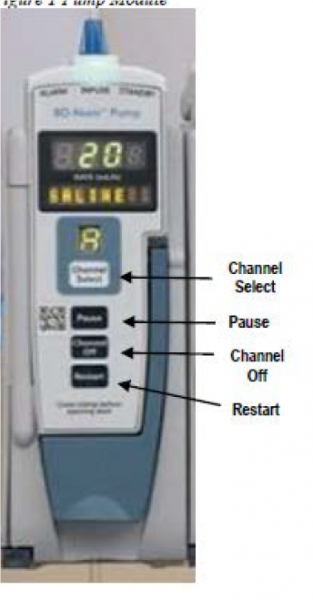
BD/CareFusion 303 is recalling the BD Alaris Pump Module and Pump Module Door Assembly Replacement Kits because the keypad may have one or more keys that become unresponsive or stuck. This may lead to an infusion delay or prevent clinicians from changing fluid or medication infusions on the affected devices.
High-risk patient populations who are receiving life-sustaining infusions are at the greatest risk of harm. For these patients, delays or interruption of infusion can cause serious injury or death.
BD has received 976 complaints about this device issue. There have been no reported injuries or deaths.
On August 4, 2020, BD/CareFusion 303, Inc. sent an Urgent Medical Device Recall notice to all affected customers and provided the following instructions:
If the if the pump module keypad becomes unresponsive or stuck, remove the pump from service and send it to your facility’s biomedical engineering staff. If a critical medication is being administered, continue the infusion until it is safe to replace the pump module. In an urgent situation, close the roller clamp on the IV administration set to stop an infusion.
BD and CareFusion sent letters with additional instructions for customers. These are linked in the resources section below.
Country Fresh is initiating a voluntary recall of a limited quantity of watermelon chunks from select stores as a precautionary measure due to possible health risk from Listeria monocytogenes detected on equipment used in packing this product. FDA made these findings during a recent inspection.
The recall affects product codes of watermelon items shipped directly to Walmart and RaceTrac’s retail distribution centers stores in select stores located in Arkansas, Missouri, Illinois, Oklahoma, and Texas. The product was packaged in a variety of clam shell containers (see photos). The best-if-used by dates of October 2, 3, and 4, 2020 and the SKUs are as follows:
Country Fresh has not received any reports of illnesses to date associated with these recalled items. The recalled products were distributed from 9/23/2020 – 9/25/2020. RaceTrac and Walmart retail stores are removing the recalled product from store shelves and inventories immediately. Customers with recalled watermelon should discard it immediately and not consume it.
This recall is being undertaken with the knowledge of the U.S. Food and Drug Administration.
Country Fresh takes food safety matters very seriously, stringently follows all mandated regulations and implements preventive measures designed to minimize potential risks. Country Fresh is working in close coordination with FDA in its continuing investigation to resolve the matter promptly and deeply regrets the inconvenience to our consumers and customers. If you have any questions, please contact Customer Service at: 1-877-251-8300 Monday – Friday, 8-5pm CST

 Comment




You must be logged in to post a comment.