

The Trump administration just announced a new rule limiting the amount of science allowed at the Environmental Protection Agency (EPA).1
That’s not a typo. The Trump EPA is cracking down on science.
The new rule bans the use of a huge range of scientific and medical studies that can be used to set environmental and public health protections — including some of the most groundbreaking and important research ever done on the health risks of environmental pollution.
This might be the Trump administration’s most egregious attack on the environment — and it will gut some of our most important environmental protections.
We need to do everything possible to block this new EPA rule before it is finalized. Will you donate to help stand up for science?
Trump’s new anti-science rule says that studies cannot be used unless researchers release all of the raw data, including confidential health reports — ruling out crucial science needed to stop dangerous air and water pollution.2
For instance, in 1993, Harvard University released a study of 22,000 people’s medical histories and home air-quality data in order to definitively link air pollution with mortality. The groundbreaking study was the basis for many of the emissions regulations we have in place today.3
But under Trump’s new rule, this study can no longer be used to set environmental rules.
That’s because to gain the data, the researchers had to guarantee confidentiality, which only makes sense: people don’t want their medical histories becoming part of the public record, and they won’t participate in these studies if that’s the case.
Worse yet, Trump’s science ban can be applied retroactively, giving the EPA grounds to roll back regulations that have been in place for decades.
Regulations for how much toxic waste an agribusiness can dump, how much coal ash can leak into groundwater, emissions levels from cars — all would be in question if this new rule is finalized.
This new rule goes against everything Food & Water Action and our supporters believe. We need science so we can organize for the change our planet needs. It’s important to know and understand all the scientific facts and research so we can fight for powerful laws to protect our access to healthy food and clean drinking water, and maintain a livable planet.
The good news is we’ve defeated this rule before. Trump’s former EPA administrator, Scott Pruitt, tried to propose nearly the same rule in 2018, and scientists and the public raised such an outcry that the rule was shelved
Now that the public’s attention is elsewhere, the new administrator, Andrew Wheeler, is trying to bring it back. We need to push back with the same public show of force until this rule is gone for good.
Will you donate to help stand for science and block the EPA’s new rule?
Onward together,
Wenonah Hauter
Founder and Executive Director
Food & Water Action and Food & Water Watch
1. E.P.A. to Limit Science Used to Write Public Health Rules, The New York Times, November 11, 2019.
2. E.P.A. to Limit Science Used to Write Public Health Rules, The New York Times, November 11, 2019.
3. E.P.A. to Limit Science Used to Write Public Health Rules, The New York Times, November 11, 2019.
fwaction.org
image is from the internet



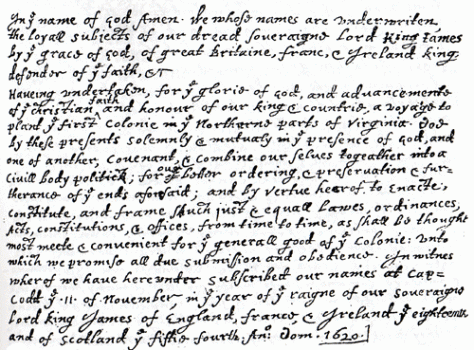 Signers … above


You must be logged in to post a comment.