Sign the petition: Making D.C. a state is one of the top civil rights issues of our time


Washington, D.C. has more residents than the states of Vermont and Wyoming, yet it has no Congressional representation—a basic tenet of our democracy.

Voter suppression is a grave injustice throughout the country, but nowhere is it more explicit than in D.C. Hundreds of thousands of Americans have no real representation in a government that dictates their local laws, courts, and budget.

D.C.’s mayor Muriel Bowser calls this lack of representation and local control a disgrace, saying: “We are not asking for a handout—we are demanding our fundamental rights as American citizens, and the rights for which many of our residents have fought and died.”
Why haven’t we rectified this injustice? Well, it’s no coincidence that D.C. is 50% Black. This is classic voter suppression, and modern-day colonialism, which specifically marginalizes people of color.

DC Residents are:
50% Black & majority people of color.
More populous than Wyoming and Vermont, and close in population to 6 other states.
Overwhelmingly in support of statehood (86% of voters voted in favor in a 2016 referendum)
Include 30,000 active duty military members and veterans—but don’t even have a vote about whether we can enter into war.
After the end of slavery, formerly enslaved Black people fled to D.C., because its proximity to the federal government meant increased voting rights. Many Black people ran for office, and it became the Blackest city in America. In reaction, 200 years ago, racist members of Congress denied suffrage to D.C. residents, explicitly noting that they did so because D.C. was primarily Black.

Finally, D.C. statehood is getting the national attention it deserves. In September 2019, the House Oversight Committee held the first hearing on the issue in over 25 years, and Democratic federal officials have come out to overwhelmingly support it.
However, the old paternalistic rhetoric that D.C.’s Black residents were “unfit to govern” themselves, which led to stripping D.C. residents of their rights, is still in use today—by members of Congress who claim D.C. shouldn’t become a state because it can’t govern itself.

That’s why we have to come together as a country and prioritize D.C. statehood as a top civil rights issue.
Please sign the petition now to tell your elected leaders at all levels of government: We need to ensure D.C. residents get a voice in their government.

D.C. residents deserve the same rights every other American has. Instead, they:
Experience taxation without representation—paying more per capita in federal taxes than any other state.
Have one non-voting delegate in the House, but no voting Representatives or Senators that represent their interests.
Have long fought for their right to vote and for “home rule”—self-governance, or control over their local affairs.
Only won the right to vote for President in 1961.
Lack control of their own local laws.

Our Message to All U.S. government & community leaders:

Most Americans don’t know this outrageous fact: The 710,000 residents of Washington, D.C. are second-class citizens who lack equal Congressional representation.
This voter disenfranchisement is a racist affront to our democracy and our country’s struggles for civil and human rights. It’s past time to right this historic wrong by making D.C. a state.
Come out publicly in support of D.C. statehood. We need people across the country to raise awareness about and prioritize fixing this undemocratic injustice. D.C. residents deserve a voice in Congress and control over their own local laws.

Have been blocked by Congress from the implementation of laws D.C. has already passed with overwhelming local support, including: publicly subsidized abortion for low-income women, recreationally legal marijuana, assisted suicide, gun control laws, needle exchange programs in the midst of an HIV epidemic—all laws that disproportionately support D.C.’s residents of color.
Can’t control their own courts—instead, D.C.’s criminal justice system is operated by federal prosecutors appointed by the President.

Resource: actionnetwork.org

1933 – The Civil Works Administration was created by executive order by U.S. President Franklin D. Roosevelt. The organization was designed to create jobs for more than 4 million unemployed people in the U.S.


Today in labor history: FDR unveils Civil Works Administration

President Franklin D. Roosevelt unveiled the Civil Works Administration on November 8, 1933, and put one of the architects of the New Deal Harry L. Hopkins, in charge of the short-term agency. Roosevelt was convinced that jobs were much better for everyone than cash handouts.

The Civil Works Administration was a short-lived U.S. job creation program established by the New Deal during the Great Depression to rapidly create manual labor jobs for millions of unemployed workers. The jobs were merely temporary, for the duration of the hard winter of 1933-34. The unemployment rate during that time was around 24.9 percent. The Civil Works Administration was a project created under the Federal Emergency Relief Administration (FERA). The Civil Works Administration created construction jobs, mainly improving or constructing buildings and bridges. It ended on March 31, 1934, after spending $200 million a month and giving jobs to 4 million people.

The Civil Works Administration’s workers laid 12 million feet of sewer pipe and built or improved 255,000 miles of roads, 40,000 schools, 3,700 playgrounds, and nearly 1,000 airports (not to mention building 250,000 outhouses still badly needed in rural America).The program was praised by liberal Republican Alf Landon, who later ran against Roosevelt in the 1936 election.

An example of the effectiveness the Civil Works Administration is one county’s accomplishments: in less than five months, from November 1933 to March 1934. Grand Forks County, North Dakota put 2,392 unemployed workers on its payroll at a cost of about $250,000. When the Civil Works Administration began in eastern Connecticut, it could hire only 480 workers out of 1,500 who registered for jobs. Projects undertaken included work on city utility systems, public buildings, parks, and roads.

Rural areas profited, with most labor being directed to roads and community schools. Civil Works Administration officials gave preference to veterans with dependents, but considerable political favoritism determined which North Dakotans got jobs. The Civil Works Administration ended due to a lack of funding. It was replaced with the Works Progress Administration also headed by Harry Hopkins. The Works Progress Administration would have long-term value for the society, in addition to short-term benefits for the unemployed.

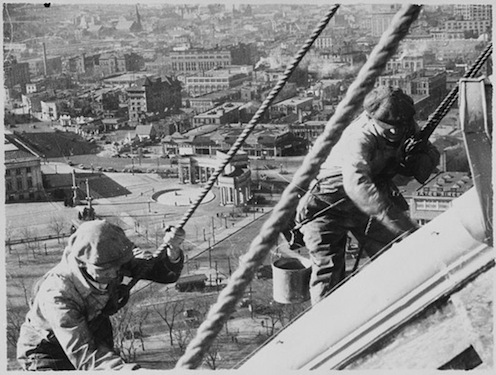
Photo: Workmen clean and paint the gold dome of Denver Capitol as part of the Civil Works Administration (U.S.

resource: peoplesworld.org

1967 – Carl Stokes was elected the first black mayor Cleveland, OH, becoming the first black mayor of a major city.


Image result for carl stokes first black mayor

In 1967, he became the first black elected mayor of a major American city.

Stokes was born in Cleveland, the son of Louise (Stone) and Charles Stokes, a laundryman who died when Carl was three years old. He and his brother, politician Louis Stokes, were raised by their mother in Cleveland’s first federally funded housing project for the poor, Outhwaite Homes.

Stokes was a good student but dropped out of high school in 1944. He worked briefly at Thompson Products (later TRW), then joined the U.S. Army at age 18. After his discharge in 1946, Stokes returned to Cleveland and earned his high school diploma in 1947. He attended several colleges before earning his bachelor’s degree from the University of Minnesota in 1954. He graduated from Cleveland-Marshall College of Law in 1956 and was admitted to the Ohio bar in 1957. While studying law he was a probation officer. For four years, he served as assistant prosecutor and became partner a law firm.
He was elected to the Ohio House of Representatives in 1962, where he served three terms. By the late 1960s, he was able to carve out a district that could elect him to Congress, but deferred to his brother Louis Stokes who represented Cleveland in the US House of Representatives for three decades. Stokes narrowly lost a bid for mayor of Cleveland in 1965. His victory two years later drew national attention, as he was the first black mayor of one of the ten biggest cities in the United States.

From 1983 to 1994, he served as municipal judge in Cleveland. President Bill Clinton then appointed him U.S. Ambassador to the Republic of Seychelles. Stokes was awarded 12 honorary degrees, numerous civic awards, and represented the United States on numerous goodwill trips abroad by request of the White House. In 1970, the National League of Cities voted him its first black president-elect.

He was diagnosed with cancer of the esophagus while serving as Ambassador to the Seychelles and placed on medical leave. He returned to Cleveland and died at the Cleveland Clinic.

resource: blackthen.com

Pensacola News Journal

1973 – The U.S. Congress over-rode President Nixon’s veto of the War Powers Act, which limits a chief executive’s power to wage war without congressional approval.


by The Editors of Encyclopaedia Britannica

War Powers Act, law passed by the U.S. Congress on November 7, 1973, over the veto of Pres. Richard Nixon. The joint measure was called the War Powers Resolution, though the title of the Senate-approved bill, War Powers Act, became widely used.

The act sought to restrain the president’s ability to commit U.S. forces overseas by requiring the executive branch to consult with and report to Congress before involving U.S. forces in foreign hostilities. Widely considered a measure for preventing “future Vietnams,” it was nonetheless generally resisted or ignored by subsequent presidents, many of whom regarded it as an unconstitutional usurpation of their executive authority. Since the passage of this joint resolution, presidents have tended to take actions that have been “consistent with” rather than “pursuant to” the provisions of the act—in some cases, seeking congressional approval for military action without invoking the law itself. Members of Congress have complained that they have not been given timely notification of or sufficient details regarding some military engagements. Some legislators have gone to court (unsuccessfully) to seek adjudication of what they believe to have been violations of the act. Increasingly, presidents have identified resolutions taken by the United Nations or the North Atlantic Treaty Organization as just

This article was most recently revised and updated by Amy Tikkanen, Corrections Managertification for military intervention.

resource:  britannica.com


1989 – David Dinkins was elected and become New York City’s first African-American mayor.


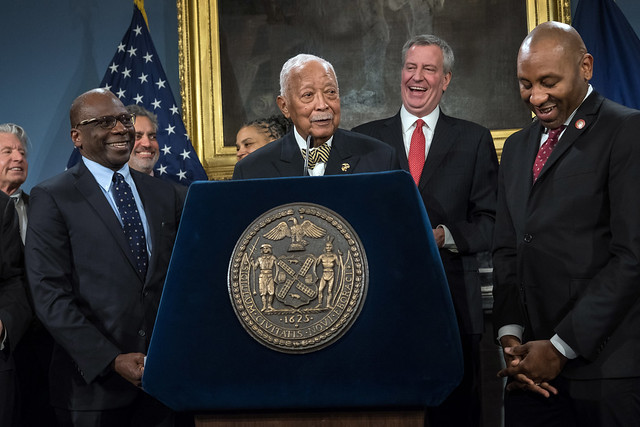
32392339708 d8626a56ce zFormer Mayor David Dinkins (photo: Ed Reed/Mayor’s Office)

On the night of November 7, 1989, then-Manhattan Borough President David Dinkins made history. With election night returns coming in, it became clear that Dinkins had narrowly defeated then-U.S. Attorney Rudy Giuliani and would become the first black mayor of New York City. It was the culmination of an arduous election cycle for Dinkins, having beaten incumbent Mayor Ed Koch in the Democratic primary two months earlier.

gothamgazette.com

politics,pollution,petitions,pop culture & purses