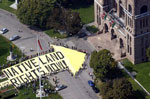
a google doodle worth reposting … google

 Henry Louis Gates Jr., being interviewed in his home in Cambridge, Mass., in 2008.
Credit
Josh Reynolds/Associated Press
So, we’re on day 9 of Black History Month. February, the shortest month has been filled with stories, documentaries, and information regarding the people experiencing life as African Americans. The ever-present and the unfortunate increase of incidences of living while Black happened to Professor Gates in 2009; the charges may have been dismissed and Professor Gates may have agreed to sign off on a piece of paper or some kind of waiver … but we all know the PR lady and her department made arrangements for a press conference and on national tv she stated that they firmly believed the actions the police took were justified… was an awful decision least we talk about what did take place
There were reports that 6 officers were dispatched to Professors Gates property … 6?
questions still abound … why didn’t they know who lives in their police district? his home is in an affluent college neighborhood and as an Affluent Professor, he should have privileges … was it a disgruntled neighbor or someone driving by? Whoever it was, the dispatch has an obligation and should have taken time to find out who lived there and told the police to act accordingly. Unfortunately, this behavior is historic and horrific especially when the person in question is Black … Professor Gates arrest was a way to show him who was in charge and in control.
First posted on Jun 7 2010, 12:21 PM ET |
Over the past 100 years, government record systems lost track of more than 40 million acres and who owns them. The records simply vanished. Meanwhile, documents were lost in fires and floods, buried in salt mines or found in an Albuquerque storage facility covered by rat feces and a deadly Hantavirus. Government officials exploited computer systems with no audit trails to turn Indian proceeds into slush funds but maintain plausible deniability.The lack of accountability is confirmed in the government’s own reports and testimony dating to the early 20th century. Conclusions of “fraud,” “corruption,” “institutional incompetence,” “deficiencies in accounting,” “the accounts lack credibility,” “multifaceted monster,” “organizational nightmare,” “dismal history of inaction,” “criminal negligence,” and “sorry history of department mismanagement,” are found regularly between 1915 and the present. Congress ordered an accounting in 1994 but interior secretaries in both the Clinton and George W. Bush administrations were held in civil contempt for not forking over records. District Judge Royce Lamberth, a Texas Republican nominated by President Reagan who oversaw the case for a decade, called the whole matter “government irresponsibility in its purest form.”I sat in Lamberth’s courtroom in 1999 when Interior Secretary Bruce Babbitt both lost his cool and conceded that the government couldn’t provide accurate cash balances of most accounts and that “the fiduciary obligation of the United States is not being fulfilled.” But the dispute would not end, as the Clinton and Bush administrations fought unceasing adverse rulings in a case inspiring 3,600 separate court filings and 80 published decisions. No single case, including the antitrust action against Microsoft, has been as heavily litigated and defended by the government, say lawyers.The government’s chief nemesis has been Elouise Cobell, a member of the Blackfeet Nation in Montana, the accountant-turned-banker who in 1987 started Blackfeet National Bank, the first national bank on a reservation. With a very small team of attorneys led by a Washington banking specialist, Dennis Gingold, her suit has inspired 3,600 court filings and 80 published decisions. Not even the antirust action against Microsoft was as heavily litigated by the government.The historic resistance melded with an unsympathetic appeals court often overruling the dispute’s two trial judges. It ordered removal of Lamberth, now the district court’s chief judge, due to harsh language toward the government. Last year, it threw out a ruling by District Judge James Robertson, Lamberth’s successor, that the Indians were owed $476 million, a pittance compared to the reduced, $48 billion they were seeking by then. Presidential candidates Barack Obama and John McCain both urged settlement during the 2008 campaign.
A resolute Judge Robertson then hauled Interior Secretary Ken Salazar and plaintiffs into his chambers last year. He made clear to one and all that, in light of the latest appeals court ruling, both sides had the choice between spending maybe another 10 years in court or trying to finally settle. The initial atmosphere was not necessarily conducive to harmony. Career government employees in the Interior, Justice and Treasury departments felt burned after years of being belittled by both the plaintiffs and Judge Lamberth. Meanwhile, the plaintiffs had minimal trust in the government. But political appointees in the Obama administration, including Salazar and Attorney General Eric Holder, took their cue from President Obama’s own support of a settlement. Dozens of meetings ensued, with the many prickly issues including how far back in time one would go to try to determine who should benefit.
Ultimately, Judge Robertson prodded what, given all the legal setbacks, is an impressive $3.4 billion deal announced in December. Ironically, before the recent congressional recess, the House approved the deal and Robertson announced his retirement, meaning District Judge Thomas Hogan becomes the third, and hopefully final, arbiter in the case. He would oversee a so-called “fairness hearing” in which objections can be raised.
There is inherent complexity in wrapping up. If the Senate approves, there will be a media campaign throughout Indian Country, including direct mail, newspaper and broadcast public service advertisements. Garden City Group of Melville, New York, which handled the major class action against Enron, will be claims administrator. It will get computer lists from the Interior Department, with the account information of perhaps 500,000 Indians and then doublecheck names and addresses. How good are the records? Nobody is really sure.
The $3.4 billion will be placed in a still-to-be-selected bank and $1.4 billion will go to individuals, mostly in the form of checks ranging from $500 to $1,500. A small group, such as members of the Osage tribe who benefit from huge Oklahoma oil revenues, will get far more, based on a formula incorporating their 10 highest years of income between 1985 and 2009. As important, $2 billion will be used to buy trust land from Indian owners at fair market prices, with the government finally returning the land to tribes. Nobody can be forced to sell. As for the winning lawyers, their take is capped at $100 million, actually low by class-action standards, though Republican Sen. John Barrasso of Wyoming, an orthopedic surgeon, has groused about the fees.
The fairness hearing will be interesting since many Indians have a hard time believing they’re not still being shafted. “This proposed settlement fixes nothing, the U.S. won by legal weaseling,” writes a member of the Upper Midwest’s Prairie Band Potawatomi tribe on a message board. He’s not alone. Like a family victimized by homicide, Indians may never experience enough healing to truly recover. But, finally, as hard as it is for them to believe, there really may be some justice.

A law that makes people suspects on the basis of their looks should outrage African Americans, even if they are worried about illegal immigration.
The immigration law passed in Arizona last week is the kind of reckless act that keeps us minorities paranoid in America. The new law compels local law enforcers to verify immigration status based on “reasonable suspicion”–whatever that is–and has created the potential for cops to stop brown people in the streets and demand to see their papers. Even the sheriff of Pima County, Ariz., (which borders Mexico) says the law is “stupid,” “racist,” and would force his officers to racially profile people. The scope of the law was narrowed after its passage in order to assure Hispanics, who make up 30 percent of the state’s population, that they would not be the victims of racial profiling.
But those assurances that people won’t be suspects because of the way they look have little credibility when the experience of black and brown people in America has been so contrary to those promises. Being stopped for Driving While Black (or Brown) is such a common phenomenon that comedians make jokes about it. And a city like New York, which operates a massive stop-and-frisk policy that probably violates a dozen constitutional principles, keeps trying to explain why black and brown citizens make up 80 to 90 percent of those questioned by police. The latest rationale: They fit the description of suspected perps when 98 percent of those stopped and questioned are innocent of any crime.
The reason people of color get worked up about such policies is America’s nasty habit of making everything racial in a panic. We have a long history of lynchings and runaway convictions that were triggered by fears that black people were getting out of hand in some fashion, whether it was interracial sex or talking back to massa. The roundup of Japanese Americans during World War II will forever stain this country’s history.
After 9/11, looking Arab or simply wearing a turban, whether you are Muslim or not, turned out to be a grave danger in some parts of the country and a constant annoyance in others. No Muslim American believes that the frequent “random” checks they endured at airports in the months after the tragedy were really a matter of chance. And last week, the front page of the Boston Herald illustrated a cover story about the crackdown on benefits for illegal immigrants with a photo of black, Hispanic and Asian models, their foreheads stamped with the following: “No Tuition, No Welfare, No Medicaid.” Ironically, the headline at above the newspaper’s logo announced a “workplace diversity job fair.”
Of course, the concept of white or blonde illegal aliens is apparently beyond the capacity of the people passing the laws or the editors at the Herald. But nearly 600,000 of those in the United States illegally were estimated to come from Europe or Canada in 2005; and while I knew many Irish, English and other Europeans who had overstayed their visas when I was growing up in New York, I never heard of a raid of an Irish bar, except when ATF or the FBI were trying to trap Irish Republican Army gun runners during the “troubles.”
Now Arizona, better known for resorts, retirees in golf carts, and college basketball teams whose players never graduate, is suddenly at the center of a debate that could shape U.S. politics for the next 10 years. The only surprise is that it took so long. All the great economies have been struggling with the immigration issue for years. Just last week, France was in tizzy about the burqa, the full-length outfit with only an eye-slit that conservative Muslim women wear. Nicolas Sarkozy’s government has considered banning the burqa on security grounds (you can’t identify the person), but the real reason behind this initiative, Arizona’s or any of the dozen being considered in other states or countries is fear of change.
No doubt, the Great Recession of the last three years has heightened American insecurity. Although the downturn has hit blue-collar workers the hardest, many people who thought they were solidly in the middle class have seen their savings, their safety net, even their homes evaporate in the financial collapse. The next step for many of them would be to step “down” into the blue-collar workforce. Suddenly, the Mexican, Salvadorian and African immigrants they hardly noticed during boom times are now potential competitors.
African Americans, who lost more than their fair share of blue-collar jobs in the downturn, have long been ambiguous about illegal immigration. As Cord Jefferson noted here a few months ago, a growing number of experts believe that blacks and Hispanic immigrants battle for unskilled jobs at the bottom of the labor pool. Black Americans have not turned out in large numbers at immigration rallies, despite the fact that many African-American politicians talk of the need for coalitions with Hispanics.
But a law that puts you in jeopardy for being has special resonance with black Americans. We already know the peril of living in a state where you are presumed guilty by the color of your skin. A law that makes a suspect of anyone who might look illegal should make us vigorously resist this encroachment.
Joel Dreyfuss is managing editor of The Root. Follow him on Twitter
first posted in 5/2010 …

Green building is no longer a thing of the future. Find out how architects and builders use solar panels, plastic bottles and straw bale insulation for ten environmentally friendly structures.

It’s a lot easier than you think to “go green” — many of these suggestions require little effort, yet can make a big difference for the environmental. Watch a video and read more about saving the earth.

Sure, the Emerald City looked green, but you won’t need green-tinted glasses to see how environmentally friendly the cities on this list are. What makes a city amazingly green?

Sustainable urbanism is no longer a futuristic dream. Welcome to five cities around the world that will be turning a radical shade of green in the coming decades.

We’re currently suspended between two ages: a time dependent on fossil fuels and a future dominated by renewable energy sources. Yet not everyone is sold on this vision, so a number of myths about renewable energy persist.

For those who reduce, reuse and recycle to the beat of their own drum, here are some of the wackier ways to help better the environment and lessen your carbon footprint.

What makes a city walkable? It’s not just sidewalks. You have to be able to access jobs, stores and places of entertainment while feeling comfortable and safe. What are five cities in the United States that have risen to the challenge?

It’s evident the debate over climate change is a heated one. Are skeptics clouding the public judgment for money? Are climate-change believers merely alarmists who risk the present for the future?

After sloughing off your dead skin, what happens to those plastic microbeads that wash down the drain? Some make it all the way to the ocean and linger until they become a very unhealthy supper.

They may seem like a fun water sport or a noisy nuisance, but whatever your stance on personal watercraft, there’s no denying they pollute. So how bad are they?

Everyone knows air pollution isn’t good for your lungs, but it turns out that it’s not doing your heart any favors either. Why do the particulates in the air we breathe interfere with our heart’s basic job: to keep things ticking?

One company’s SkyMine technology aims to capture industrial carbon dioxide emissions and turn them into an endlessly useful product: Baking soda. But how do pollutants become a household staple?

Electrifying dance moves might impress your friends, but they usually don’t help power the club you’re dancing in. What’s piezoelectricity, and how could it help twist the future of energy generation?

Earthquakes are “natural” disasters, right? Yes, but that doesn’t mean the shifting plates that cause them can’t be aggravated by human industry.

You’ve booked a safari with the environment in mind. There’s just one problem: Trans-Atlantic flights aren’t very green. Can green tags make your gas-guzzling trip carbon neutral?

Haunted by ideas of your body polluting the Earth after you’re gone? Microbial fuel cell technology could allow you to harness the energy of your own decomposition to power batteries.

Carbon dioxide released from burning fossil fuels is a prime suspect in global warming. Could we mitigate the problem by burying the CO2 deep within the ocean?

As alternative energy sources sputter to take off on Earth, scientists are turning an eye toward space. What are the most promising celestial options, and when could they be in use?

The ozone layer prevents much of the sun’s ultraviolet light from reaching the Earth. But there’s a problem: a gaping hole the size of Antarctica. What can we do about it?



 Be a Seed for Change
You must be logged in to post a comment.