
Tag Archives: Federal government of the United States

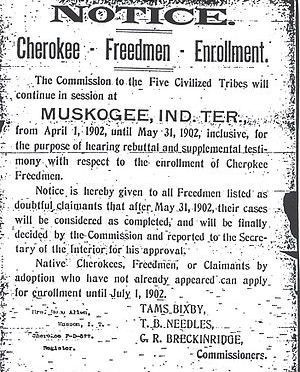
Cherokee Freedmen Facts – by Marilyn Vann – Black History


Cherokee Freedmen Facts – by Marilyn Vann – President – Descendants of Freedmen

www.freedmen5tribes.com

1) Who are Cherokee freedmen and their descendants?
Cherokee freedmen are people of African descent who have rights to Cherokee citizenship since 1866 (and in some cases
prior) based under a treaty between the US government and the Cherokee nation, the amended 1839 constitution and the
present 1976 constitution. The freedmen were either former slaves of the Cherokees or were free mixed black Cherokees who
generally did not have citizenship rights prior to 1866.

******
2) Who has the right to Cherokee citizenship now?
All persons who were listed on the Dawes Rolls and their descendants, during the early 1900s have the right to Cherokee
citizenship based on the 1976 constitution. The Dawes rolls of the Cherokee nation have several sections – Delaware,
Cherokee by blood, Cherokee Freedmen, etc.

******
3) Didn’t the Freedmen lose their tribal membership and voting rights for a few years?
In 1983, the freedmen people were voting against Chief Swimmer, the registrar sent out letters canceling their tribal
membership cards and the freedmen were blocked from voting at the polls. In 1988, under Chief Mankiller, the tribal council
approved the registration policy of requiring all tribal members to have a CDIB card to keep tribal membership. A tribal
court in 2006 ruled that the tribal council could not pass additional requirements to bar any segment of Dawes enrollees from
receiving tribal membership cards or voting.

******
4) If most of the freedmen have Cherokee blood, why cant they get a cdib card?
The current BIA policy is to only give the card based on the blood degree listed on the Dawes Rolls. The Dawes
Commissioners had the sole authority to place people on any part of the Dawes rolls they wanted to. Because Congress had
decided that people listed as Freedmen would have unrestricted allotments, Commissioners were encouraged to list as many
people as possible as Freedmen with no blood degrees listed rather than as Cherokees with blood degrees even if the person
was listed on previous rolls as blood Cherokee or received payments earlier from the US government as a Cherokee by
blood. An example was Perry Ross who had a Cherokee mother and black father. Perry Ross, was listed on the 1852 Drennan
Roll proving Cherokee by blood, received a 1908 Guion Miller payment for having Cherokee blood, but yet was listed as a
freedmen citizen on the Dawes Rolls. Some Freedmen did get CDIB cards in the past based on other records, but they
stopped giving them out. The tribe never kept degrees of blood records and anything on the Dawes Roll is just guesswork so
far as a true degree of blood. To determine blood degrees for freedmen one must look at Dawes testimony and other records.

******
5) Chief Smith and Councilman Jackie Bob Martin have called for a special election to see if the freedmen people
should keep their tribal membership rights. What’s wrong with that?
Whats right about it? There something wrong about trying to take away the rights of people who have had them for more than
100 years. The court held that the people had been wronged, and now, instead of accepting that, these people are to be more
wronged? Would you not fight a president who wanted to put the US citizenship rights of Cherokee people on a ballot to the
people? Whose next to lose rights? Also, the people who are being asked to vote on the freedmen citizenship rights are not
being told that the freedmen have had rights since at least 1866, have served on the tribal council, generally have Cherokee
blood, and voted between 1971 and 1983 (between 1907 and 1971 there were no elections at all). When did Cherokee people
ever kick people out of the tribe? And why kick out only freedmen who came before Delaware and Shawnee – all 3 have
treaty rights to citizenship? Does anyone sitting here wonder if the movement to kick out the freedmen is fear that they may
not vote for some people now serving in office? Hardly any freedmen will be able to vote in such election because of the
slow process to register tribal members and even freedmen people with old 1970s membership cards must reregister. Is this
justice? Is it right for Cherokee leaders to break the promises made to these people by previous chiefs such as Lewis
Downing and WP Ross – just as the whites have broken their word to the Cherokee people time after time? What if the white
people say, if the Cherokees can break their treaty at will, we will do so too and demand back the Arkansas Riverbed money?

******
6) Won’t the freedmen take away from the rest of the Cherokees so far as benefits?
The Chief and the tribal council can request additional funds from the US government and supposedly are working hard on
economic development. Stop and think – Would you want your US citizenship rights to be taken away because white people
don’t want you to have rental assistance or such the same as them? Freedmen wont cancel medical insurance to go to I H S.

******

7) Did Freedmen get the same rights as Cherokees by blood previously?
Yes, all citizens including freedmen received 110 acres of tribal land equivalent when tribal lands were allotted, they received
the 1912 payroll, and the per capita payment given out in 1962. Freedmen held office between 1866 and 1907 – One
freedman Frank Vann even served with Redbird Smith on the council. Another freedmen councilman was Stick Ross.

How … A Bill Becomes a Law


How a Bill Becomes a Law

When performing legislative research, it is important to understand the legislative process. The numerous steps that result in a bill becoming a law are described in this 24th edition of “How Our Laws Are Made.”

the original

the Senate ~~ CONGRESS ~~ the House


shutdownohnolook

The Senate stands adjourned until 10:00am on Tuesday, October 15, 2013.

Following the prayer and pledge, it is expected the Majority Leader will renew his motion to proceed to S.1569, a bill to ensure the complete and timely payment of the obligations of the United States Government until December 31, 2014. Senators will be permitted to speak for up to 10 minutes each.

 The Senate will recess from 12:30pm until 2:15pm to allow for the weekly caucus meetings.

WRAP UP

No ROLL CALL VOTES

LEGISLATIVE ITEMS

Began the Rule 14 process of H.J.Res.80, the Bureau of Indian Affairs, Bureau of Indian Education, and Indian Health Service Continuing Appropriations Resolution, 2014.

No EXECUTIVE ITEMS

The Senate stands in adjournment until 12:00 noon on Wednesday, October 16, 2013.  Following any Leader remarks, Senators will be permitted to speak for up 10 minutes each.

**********************************************

Last Floor Action:
7:35:44 P.M. – The House adjourned. The next meeting is scheduled for 10:00 a.m. on October 16, 2013.

Last Floor Action:
9:33:20 P.M. – The House adjourned.

The next meeting is scheduled for 10:00 a.m. on October 15, 2013.

====================================================================

Federal shutdown effects on Washington State


Washington State Convention Center
Washington State Convention Center (Photo credit: OZinOH)

NewsTribune.com

The federal government shutdown has prompted big cutbacks at the state Employment Security Department, which on Tuesday put half of its 1,669 staffers on furlough or reduced hours. About 833 workers are affected by the cutbacks, including about half who are working at 50 percent or 60 percent of full time and the other half who are furloughed…

SeattleTimes

OLYMPIA – More than 400 state workers were furloughed Tuesday and another 450 had their hours reduced because of the federal government shutdown, the state Employment Security Department said. The ESD, which processes unemployment claims, gets about 87 percent of its funding from the federal government, the Seattle Times said.

How does the federal shutdown affect Employment Security?

Employment Security is a state agency, but we get about 87 percent of our funding from the federal government – so our operations are closely tied to the fate of the federal budget.

Due to the federal shutdown, we’re no longer receiving federal funds to cover our unemployment-benefits and tax operations. In order to continue these critical services, we have laid off or reduced the hours of 50 percent of Employment Security staff who are not directly involved in processing benefit claims or collecting taxes. Only services that are funded, plus essential administrative support for the funded services, will be continued until a federal budget is approved.

Will unemployment benefits continue to be paid during the federal shutdown?

The federal government is continuing to provide money for unemployment benefits, but is not providing funds to cover the administrative cost of processing those claims. For the time being, we’ve decided to maintain these critical services using our limited state funds. Therefore, unemployment benefits will continue to be paid for at least a few more weeks.

Will WorkSource remain open?

WorkSource offices remain open for now, but with reduced capacity.

WorkSource is a partnership, where multiple state agencies and local organizations deliver a mix of employment and worker-training services throughout the state. The major partners are Employment Security and the 12 local workforce development councils. At this time:

  • Employment Security has federal funds available to maintain job-search services through next June, but some of our specialized funding streams are not available until Congress approves a budget (e.g., veterans employment services, labor-market information, etc.). Therefore, some of our capacity and expertise in the WorkSource centers was reduced beginning Oct. 8.
  • The workforce development councils also have lost access to much of their federal funding due to the federal shutdown. Contact them individually for information about their current status.

What isn’t getting done right now?

  • Unemployment-insurance fraud investigations are suspended.
  • Unemployment benefits overpayments and penalties aren’t being collected.
  • The second level of benefits appeals (Commissioner’s Review Office) is not available. Those appeals are on hold.
  • Claims staff can’t get assistance with benefits policy questions.
  • Labor-market data aren’t being updated, and reports aren’t being completed. (E.g., We won’t be able to release the September employment report next week.)
  • VISTA volunteers are still performing their community service, but they’re not getting their stipends.
  • Legislation isn’t getting implemented, including related communications and resources for employers and unemployed workers.
  • Most of our Lean improvement projects are inactive.
  • WorkSource employment services have been reduced by 15-25 percent in most WorkSource offices (with a few over 30%).
  • All veterans employment specialists have been furloughed.
  • Employer tax audits aren’t being conducted.
  • Only critical technology outages are being addressed. Technology improvements are on hold.
  • A wide range of federal reporting requirements aren’t being met, which could have repercussions down the line.
  • Technical assistance to workforce development councils is unavailable.
  • Unemployment-insurance orientation workshops have been suspended at WorkSource.

Please continue to monitor this website for updates.

the Senate considers S.1569 ~~ Congress 10/14 ~~ the House considers


WethePeople

SCHEDULE FOR MONDAY, OCTOBER 14, 2013

The Senate stands adjourned until 2:00pm on Monday, October 14.

When the Senate convenes, Senator Reid intends to renew the motion to proceed to S.1569, a bill to ensure the complete and timely payment of the obligations of the United States Government until December 31, 2014.

At 5:00pm, the Senate will proceed to Executive Session to consider Executive Calendar #206, the nomination of Andrea Wood, of Illinois, to be a United States District Judge for the Northern District of Illinois; and Executive Calendar #207, the nomination of Madeline Haikala, of Alabama, to be United States District Judge for the Northern District of Alabama. There will be 30 minutes for debate equally divided prior to a series of up 2 roll call votes on confirmation of the nominations

At approximately 5:30pm, the Senate will vote on confirmation of the following nominations:

–          Executive Calendar #206, the nomination of Andrea Wood, of Illinois, to be a United States District Judge for the Northern District of Illinois; and

–          Executive Calendar #207, the nomination of Madeline Haikala, of Alabama, to be United States District Judge for the Northern District of Alabama.

The Wood nomination is expected to be confirmed by voice vote and the Haikala nomination is expected to be confirmed by roll call vote.

Executive Calendar #206, the nomination of Andrea Wood, of Illinois, to be a United States District Judge for the Northern District of Illinois, was confirmed by voice vote.

5:31pm The Senate began a 15 minute roll call vote on confirmation of Executive Calendar #207, the nomination of Madeline Haikala, of Alabama, to be United States District Judge for the Northern District of Alabama.

Confirmed: 90-0

There will be no further roll call votes today.

WRAP UP

ROLL CALL VOTE

1)      Confirmation of Executive Calendar #207, the nomination of Madeline Haikala, of Alabama, to be United States District Judge for the Northern District of Alabama; Confirmed: 90-0

No LEGISLATIVE ITEMS

EXECUTIVE ITEMS

Confirmed Executive Calendar #206, the nomination of Andrea Wood, of Illinois, to be a United States District Judge for the Northern District of Illinois by voice vote.

********************************************************************

Last Floor Action:
12:37:54 P.M. – The House adjourned. 10/12

The next meeting is scheduled for 12:00 p.m. on October 14, 2013.

—————————————————————————-