
 |
|||||||||
 |
|
|
|
||||||
|
|
To get cheap palm oil, top snack food brands are doing business with companies that are driving the last 60,600 wild orangutans to extinction, committing human rights violations and destroying rainforests.
|
|||||||
Tag Archives: Indonesia


what happened after I signed the petition?
 Dear amazing community,
I often get asked by Avaazers, “what happens after I sign a petition?” And the truth is, a HECK of a lot! Every Avaaz campaign springs from a massive global mandate, and then zeroes in on the best way for our voices to win. Here’s just two of our victories from the last few weeks:
Remember when 2 million of us came together to stop the flogging of a 15-year old rape victim in the Maldives? Her sentence has been quashed! Here’s what our team did to win:
Ahmed Shaheed, former Foreign Minister of the Maldives said “The Avaaz contribution was the spearhead of the campaign to overturn the flogging sentence; a petition signed by millions, a country visit, a public opinion survey, and persistent follow-up all proved irresistible.” |

Another example: Remember how almost 2 million of us rallied to stop the Maasai tribe in Tanzania from being kicked off their land for a hunting reserve? Last week, the Prime Minister announced they could stay! The petition provided a powerful basis for what the team did next:
|

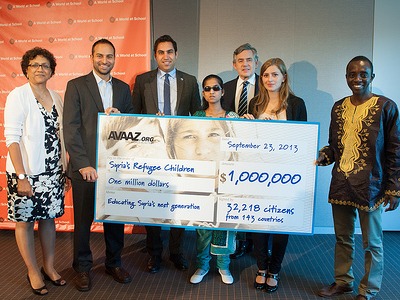
The victory belongs to the Maasai people, but our community helped them win by making this a global issue the government could no longer ignore. This hopefully ends a 20 year land battle!! Of course, our community does a LOT more than petitions. Last week, we raised a $1 million challenge grant in a few days to donor governments to put Syrian refugee kids in school. At a UN meeting, I was able to put a cheque on the table and issue the challenge on behalf of over 40,000 Avaaz donors. UN Education Envoy Gordon Brown, who chaired the meeting, called our community’s effort a “magnificent and impactful intervention” in getting other governments to give! And often it’s not the Avaaz team but our community that does the direct lobbying. For example in Brazil, we’re inches away from winning a massive fight to end the shady practice of ‘secret voting’ in the Congress. Our huge push helped win the vote in the lower house and right now, Senators’ telephones are ringing off the hook as Avaaz members across Brazil use our online calling tool to directly tell them to stop this corruption — experts say a win is likely in days! It’s this unique magic mix between a gigantic and spirited community of citizens able to speak out, donate, and lobby, and a small team of top notch advocates able to take smart, strategic actions at the highest level with democratic legitimacy, that makes our campaigns increasingly unstoppable. If we keep believing in each other, and growing in size and in commitment, there’s no limit to the good we can do in the world. Thank you so much for the honour and the joy to be part of and serve this community. It’s something truly precious we have here — let’s keep building Avaaz. With love and appreciation, Ricken and the team PS — You might not know that Avaaz is different from just about every other global organization in that we are 100% funded and guided by our community. Every campaign we run is first polled and tested to a random sample (you might think of it as a jury) of our community, that tells us exactly how the whole the community will react. I may be the CEO, but you’re my boss. If you don’t like something (and I don’t mean 51% like it, but 81% like it) then our team go back to the drawing board and come up with a better option for you. We have never, ever, broken this rule. So at the end of the day, it is your wisdom, the collective wisdom of our community, matched with the smartest suggestions the team hears from you and come up with ourselves and from our partners and experts, that determines what we do every single day. When you add to that the fact that 100% of our funding comes from small online donations (we strictly refuse any donations from corporations, governments, foundations, and even individual donations over 5000 Euros), I think Avaaz may be one of the purest organisational expressions of people-powered change in the world today. Make that an organisation served by a beautiful team of wonderfully talented and deeply committed people that I wish I could introduce you all to, and we’ve got a kind of magic that can build the world we dream of. PPS — If you want to chip in to help keep it all going, click here: https://secure.avaaz.org/en/october_reportback_a/?biEWLbb&v=29788 |

Share this:

Gemma Tillack, Rainforest Action Network
| Call out companies using “Conflict Palm Oil” |
 |
Today, I’m excited to announce Rainforest Action Network‘s ambitious new campaign to save some of the world’s most important rainforests and the last remaining wild orangutans from “Conflict Palm Oil.”
It’s called The Last Stand of the Orangutan, and it’s one of the biggest campaigns we’ve ever launched. We’re going after not one, not two, but 20 of the companies most responsible for putting Conflict Palm Oil into our food. We’ve dubbed these companies The Snack Food 20. They are the makers of some of the top name brands in the world, companies like PepsiCo, The Hershey Company and Kraft Foods Group, and they are using Conflict Palm Oil in their products. (See full list of companies below.)
We need your help right now to make sure this campaign starts with a bang that the Snack Food 20 can’t ignore.
Tell the Snack Food 20 that you demand they remove Conflict Palm Oil from our food.
Our campaign launched this morning in grand RAN style at the Chicago Board of Trade, the primary trading center for agricultural commodities, including palm oil. We publicly named the 20 snack food companies that RAN’s campaign will focus on and unfurled a 15-foot banner reading, “Cut Conflict Palm Oil, Not Rainforests.” Several RAN supporters wore orangutan masks and held signs displaying the logos of the Snack Food 20 companies.

Today’s demonstration was accompanied by the release of our new report, entitled Conflict Palm Oil: How US Snack Food Brands are Contributing to Orangutan Extinction, Climate Change and Human Rights Violations, which exposes the increasingly severe environmental and human rights problems caused by industrial palm oil production in Indonesia and Malaysia.
The demand for palm oil is skyrocketing—its use in the United States has grown nearly 500 percent in the past decade. And no wonder, since palm oil is in roughly half of all products on grocery store shelves. But this gives us, as consumers, incredible power to make change, too. If you speak up loudly enough, the Snack Food 20 will have to change the way they do business. The power is in your palm.
This really is the last stand for the world’s remaining wild orangutans. Only 60,600 orangutans remain in Sumatra and Borneo. Will you stand up with them?
After we convince the Snack Food 20 to cut Conflict Palm Oil from their products, it will have a cascade effect: The Snack Food 20 will have to demand truly responsible palm oil from their suppliers, and, in turn, palm oil suppliers like Cargill will have to demand that palm oil producers in Indonesia stop destroying rainforests, stop driving the orangutan to extinction, and stop trampling on human rights.
In the weeks ahead you can expect to hear a lot more from us about the ways you can plug in to The Last Stand of the Orangutan campaign both online and in the real world. We’re traveling across the US with our The Power Is In Your Palm Tour, visiting the hometowns of many of the Snack Food 20 companies and spreading the word about the critical problems with Conflict Palm Oil. We’re building a movement too loud to ignore.
Together, we will change the way palm oil is made and make sure no more orangutans are killed for snack foods. We have reached The Last Stand of the Orangutan, but it’s not too late. Stand with orangutans now by telling the Snack Food 20 to get Conflict Palm Oil out of their products.
 |
 |
For the great red ape, |
|
Gemma Tillack Senior Agribusiness Campaigner @ProbWithPalmOil
|
Introducing the Snack Food 20:
- Campbell Soup Company
- ConAgra Foods Inc.
- Dunkin Brands
- General Mills, Inc.
- Grupo Bimbo
- H.J. Heinz Company
- Hillshire Brands Company
- Hormel Foods Corp.
- Kellogg Company
- Kraft Foods Group
- Krispy Kreme Doughnuts
- Mars, Inc.
- Mondelez International, Inc.
- Nestlé
- Nissin Food Holdings
- PepsiCo
- The Hershey Company
- The JM Smucker Company
- Unilever
Share this:

Demand the snack food industry remove rainforest destruction from its products.

I stand with RAN in calling on the US snack food industry to help stop the destruction of Indonesia‘s rainforests for palm oil.
The rainforests of Indonesia are some of the most biodiverse forests in the world and home to a number of endangered species, like Sumatran orangutans, Sumatran tigers, pygmy elephants and rhinoceros. These rainforests continue to be destroyed to produce palm oil so it can be used in the manufacturing of food products, including in snack foods and sweets that are some of America’s favorite brand name products.
I would prefer my crackers, chocolate, cookies, peanut butter, and ice cream not to come with orangutan extinction. That is why I am standing with RAN in calling on snack food companies to protect Indonesia’s rainforests and all of the people and wildlife who depend on them by cutting palm oil tied to rainforest destruction and social conflict out of their supply chains.
We have reached the last stand for Sumatran orangutans, but it’s not too late to save them.
Many Americans are being made into unwitting accomplices in the destruction of Indonesia’s rainforests—which provide crucial habitat for a number of endangered species like the Sumatran orangutan—because palm oil is in half of all the products on their neighborhood grocery store‘s shelves. In the months ahead, we’re going to tackle this problem at its source.
RAN has just sent letters to 20 snack food companies—makers of some of the most popular brand name products in America—alerting them to the rainforest destruction and orangutan extinction in their supply chains.
Stand with us: Sign our petition and demand the snack food industry remove rainforest destruction from its products.
Share this:

Get the facts. Then share them
 |
||||||||
|
|
Gemma Tillack, Rainforest Action Network | |
|
||||
|
|
We’ve been writing to you about the deforestation in Indonesia caused by palm oil production for years now. But you might still be connected to the problem and not even know it.
|
||||||


You must be logged in to post a comment.