Tag Archives: Moon

Solar Eclipse May 20


Annular Solar Eclipse of May 20

The first solar eclipse of 2012 occurs at the Moon’s descending node in central Taurus. An annular eclipse will be visible from a 240 to 300 kilometre-wide track that traverses eastern Asia, the northern Pacific Ocean and the western United States. A partial eclipse is seen within the much broader path of the Moon’s penumbral shadow, that includes much of Asia, the Pacific and the western 2/3 of North America (Figure 1).

The annular path begins in southern China at 22:06 UT. Because the Moon passed through apogee one day earlier (May 19 at 16:14 UT), its large distance from Earth produces a wide path of annularity. Traveling eastward, the shadow quickly sweeps along the southern coast of Japan as the central line duration of annularity grows from 4.4 to 5.0 minutes.

Tokyo lies 10 kilometres north of the central line. For the over 10 million residents within the metropolitan area, the annular phase will last 5 minutes beginning at 22:32 UT (on May 21 local time). The annular ring is quite thick because the Moon’s apparent diameter is only 94% that of the Sun. Traveling with a velocity of 1.1 kilometres/second, the antumbral shadow leaves Japan and heads northeast across the Northern Pacific. The instant of greatest eclipse [1] occurs at 23:52:47 UT when the eclipse magnitude [2] reaches 0.9439. At that instant, the duration of annularity is 5 minutes 46 seconds, the path width is 237 kilometres and the Sun is 61° above the flat horizon formed by the open ocean.

The shadow passes just south of Alaska’s Aleutian Islands as the central track slowly curves to the southeast. After a 7000 kilometre-long ocean voyage lasting nearly 2 hours, the antumbra finally reaches land again along the rugged coastlines of southern Oregon and northern California (Figure 2) at 01:23 UT (May 20 local time).

Redding, CA lies 30 kilometres south of the central line. Nevertheless, it still experiences an annular phase lasting 4 1/2 minutes beginning at 01:26 UT. It is already late afternoon along this section of the eclipse path. The Sun’s altitude is 20° during the annular phase and decreasing as the track heads southeast. Central Nevada, southern Utah, and northern Arizona are all within the annular path.

By the time the antumbra reaches Albuquerque, NM (01:34 UT), the central duration is still 4 1/2 minutes, but the Sun’s altitude has dropped to 5°. As its leading edge reaches the Texas Panhandle, the shadow is now an elongated ellipse extending all the way to Nevada. Seconds later, the antumbra begins its rise back into space above western Texas as the track and the annular eclipse end.

During the course of its 3.5-hour trajectory, the antumbra’s track is approximately 13,600 kilometres long and covers 0.74% of Earth’s surface area. Path coordinates and central line circumstances are presented in Table 1.

Partial phases of the eclipse are visible primarily from the USA, Canada, the Pacific and East Asia. Local circumstances for a number of cities are found in Table 2 (Canada, Mexico and Asia) and Table 3 (USA). All times are given in Universal Time. The Sun’s altitude and azimuth, the eclipse magnitude and obscuration are all given at the instant of maximum eclipse.

The NASA JavaScript Solar Eclipse Explorer is an interactive web page that can quickly calculate the local circumstances of the eclipse from any geographic location not included in Table 1:

eclipse.gsfc.nasa.gov/JSEX/JSEX-index.html

This is the 33rd eclipse of Saros 128 (Espenak and Meeus, 2006). The family began with a series of 24 partial eclipses starting on 0984 Aug 29. The first central eclipse was total and took place on 1417 May 16. After three more totals and four hybrid eclipses, the series changed to annular on 1561 Aug 11. Subsequent members of Saros 128 were all annular eclipses with increasing durations, the maximum of which was reached on 1832 Feb 01 and lasted 08 minutes 35 seconds. The duration of annularity of each succeeding eclipse is now dropping and will reach 4 minutes with the last annular eclipse of the series on 2120 Jul 25. Saros 128 terminates on 2282 Nov 01 after a string of 9 partial eclipses. Complete details for the 73 eclipses in the series (in the sequence of 24 partial, 4 total, 4 hybrid, 32 annular, and 9 partial) may be found at:

eclipse.gsfc.nasa.gov/SEsaros/SEsaros128.html

Additional details for the 2012 annular solar eclipse (including tables, maps and weather prospects) can be found at:

eclipse.gsfc.nasa.gov/SEmono/ASE2012/ASE2012.html

Office Google blog …Gone fishin’


Gone fishin’—piloting community supported fisheries at Google

Posted: 29 Jul 2011 09:44 AM PDT

(Cross-posted on the Google Green Blog)I’ve always loved the ocean—I was born in Shanghai, which means “upon the sea.” And as a chef, I’m always drawn to food that claims a spirit of place. After moving to California, near Half Moon Bay, I began visiting the docks to buy seafood, and got to know the fishermen.Over time, it became evident to me that this part of our food supply is broken: many consumers purchase stale, unsustainably-raised fish from chain grocers. Meanwhile, fishermen often sell their diminishing catch to wholesalers at a very low profit, meaning their livelihoods are no longer sustained by their catch. There’s also the environmental factor to consider: Overfishing and illegal practices cause worldwide decline in ocean wildlife populations and wreak havoc on underwater habitats—not to mention the carbon footprint of transporting seafood far from its origin.Google’s chefs have long been committed to sourcing food for our cafes as locally, seasonally and organically as possible. And in our Mountain View headquarters, many employees cook with the same ingredients at home thanks to on-site Community Supported Agriculture (CSA) programs. When I joined the team as an executive chef in Mountain View, I wanted to make a difference in our purchasing program for seafood. For the five years leading up to then, I wrote a column for the San Francisco Chronicle called “Seafood by the Season,” and I knew it could be done. In early 2010, we began a push to apply the most rigorous standards to our seafood-buying practices, and respond to the in-the-moment fluctuations of the catch from small, independent fishermen.

Things took off from there. My colleague Quentin Topping dreamed of providing the same high-quality seafood we serve in our cafes for Googlers to take home to their families. That idea became the Google Community Supported Fishery (CSF), which we launched in May 2011. In this program, Googlers sign up to purchase a weekly supply of local, sustainable seafood, supplied through a partnership with the Half Moon Bay (HMB) Fisherman’s Association.

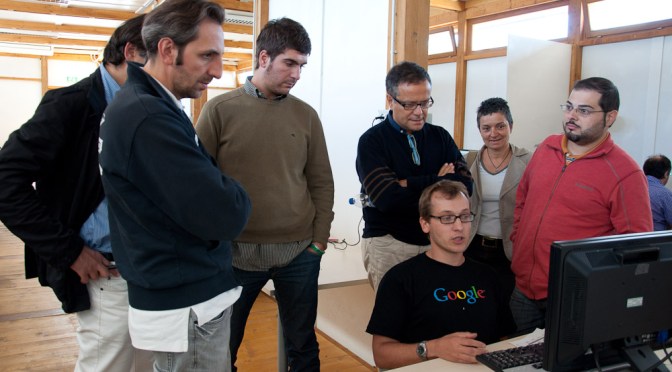
The Google Culinary team on a visit with fishermen in Half Moon Bay, Calif.—Quentin and I are the second and third from the left, in black.

We tend to think on a massive scale at Google—whether it’s how to deliver instant search results around the globe or help thousands of small businesses get online—but when it comes to feeding our employees at work and at home, it really comes down to a local touch. Knowing where our seafood, meat and produce come from, as well as knowing how they’re raised, farmed or harvested, makes all the difference in the on-the-ground work of sustainability. We see many bright spots ahead for our Community Supported Agriculture and Fishery programs, such as expansion to other offices and adding a grass-fed beef and pasture-raised poultry program. It’s exciting to work someplace where we can think big and local.

We know of two CSFs in the Bay Area. The Half Moon Bay Fishermen’s Association supplies only Google at the moment, but will soon add public drop-off sites—keep posted by visiting Farmigo.com. The other is CSea out of Bodega Bay. If you live elsewhere, we hope you’ll consider stepping up to create one in your area.

And even if you don’t live near the ocean or have direct access to fresh-caught seafood, the choices you make about what fish to purchase or order in restaurants can make a real difference. You may want to consider following the guidelines that we used for our Google Green Seafood policy: Whenever possible, purchase species caught locally and in-season, by small, independent fisher-families, using environmentally-responsible methods. We think it’s important to be responsive to the fluctuations of catch too, and source from fisheries that enforce catch limits or are guided by ecosystem-based management programs. As for us, we’ll continue to research and source responsibly managed farmed seafood, and always keep transparency and Googler health at the center of our program.

Posted by Liv Wu, Executive Chef

Was race a factor in Bears nightclub incident?


Thursday, Oct. 28, 2010
4:09 PM

By John Mullin
CSNChicago.com

Bears veterans took the rookies out Monday night for their traditional dinner but it didn’t all go well. The moveable feast went to a number of establishments but one, Angels & Kings in Chicago, turned away the group, according to some reports because of the presence of so many black players.

Defensive end Israel Idonije did not view the incident as racial in nature. “No, absolutely not,” Idonije said.

Lance Briggs was less certain. “I’m not to sure about all of that so I can only speculate on what happened,” Briggs said. “It sounded along those lines, that maybe the crowd was ‘too dark.’ But that’s just hearsay for me.”

copy and paste the address below and watch the video !

http://www.csnchicago.com/pages/video?PID=A5K6uRT17PNnS_zzGtG4z4S95_HhKhHP

As far as going back, “probably not,” Briggs said. “No, not at all. You’re not going to see me in Angels and Kings.” Informed that people involved in the turn-away were fired, “then maybe we can think about going back,” Briggs said.

The club released the following statement:

“Every Monday night, operations of the bar are turned over to an outside vendor who hosts special events. We understand that this Monday night, members of the Chicago Bears were not admitted to the venue. We have terminated our relationship with the outside vendor. We will continue to investigate the facts and have started to reach out and apologize to the various Bears players who were involved.”

Click here for an in-depth report on the story from the Chicago Tribune.

John “Moon” Mullin is CSNChicago.com’s Bears Insider, and appears regularly on Bears Postgame Live and Chicago Tribune Live. Follow Moon on Twitter for up-to-the-minute Bears information.