Tag Archives: Police

MLK jr. speech 5/17/1957 ~ Give Us the Ballot ~ In Memory


“Give Us the Ballot, We Will Transform the South”
giveustheballot

by Martin Luther King, Jr.
Speech given before the Lincoln Memorial at the March on Washington, May 17, 1957

Three years ago the Supreme Court of this nation rendered in simple, eloquent and unequivocal language a decision which will long be stenciled on the mental sheets of succeeding generations. For all men of good will, this May 17 decision came as a joyous daybreak to end the long night of segregation. It came as a great beacon light of hope to millions of distinguished people throughout the world who had dared only to dream of freedom. It came as a legal and sociological deathblow to the old Plessy doctrine of “separate-but-equal.” It came as a reaffirmation of the good old American doctrine of freedom and equality for all people.

Unfortunately, this noble and sublime decision has not gone without opposition. This opposition has often risen to ominous proportions. Many states have risen up in open defiance. The legislative halls of the South ring loud with such words as “interposition” and “nullification.” Methods of defiance range from crippling economic reprisals to the tragic reign of violence and terror. All of these forces have conjoined to make for massive resistance.

But, even more, all types of conniving methods are still being used to prevent Negroes from becoming registered voters. The denial of this sacred right is a tragic betrayal of the highest mandates of our democratic traditions and its is democracy turned upside down.

So long as I do not firmly and irrevocably possess the right to vote I do not possess myself. I cannot make up my mind — it is made up for me. I cannot live as a democratic citizen, observing the laws I have helped to enact — I can only submit to the edict of others.

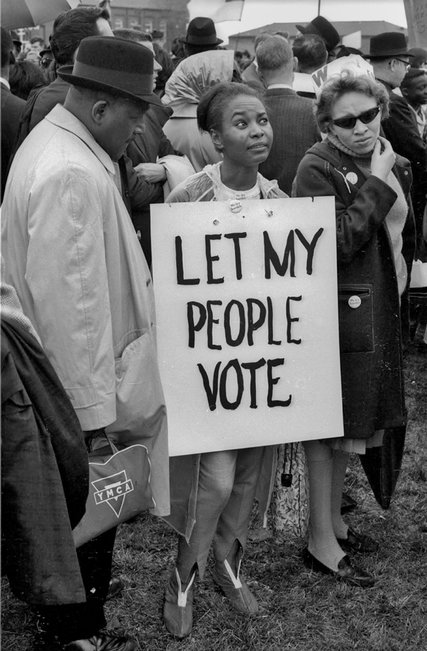
So our most urgent request to the president of the United States and every member of Congress is to give us the right to vote. Give us the ballot and we will no longer have to worry the federal government about our basic rights. Give us the ballot and we will no longer plead to the federal government for passage of an anti-lynching law; we will by the power of our vote write the law on the statute books of the southern states and bring an end to the dastardly acts of the hooded perpetrators of violence. Give us the ballot and we will transform the salient misdeeds of blood-thirsty mobs into calculated good deeds of orderly citizens. Give us the ballot and we will fill our legislative halls with men of good will, and send to the sacred halls of Congressmen who will not sign a Southern Manifesto, because of their devotion to the manifesto of justice. Give us the ballot and we will place judges on the benches of the South who will “do justly and love mercy,” and we will place at the head of the southern states governors who have felt not only the tang of the human, but the glow of the divine. Give us the ballot and we will quietly and nonviolently, without rancor or bitterness, implement the Supreme Court’s decision of May 17, 1954.

<!–Read about recent allegations of voter disenfranchisement in Florida
and other states across the country in these articles.

17

–>

Learn more about Martin Luther King, Jr. and read more of his speeches and writings at The Martin Luther King, Jr. Papers Project at Stanford University.

Resources: pbs.org

VIDEO: Houston police beat helpless 15-year old … Black History


A shocking video released last week shows four Houston police officers mercilessly beating a 15-year old burglary suspect while at least eight other officers looked on. Some kicked him repeatedly in the head and legs, others punched his torso — all while young Chad Holley was lying face down with his hands behind his head in surrender.

The officers who beat Holley have only been charged with misdemeanors, and many of the officers on the scene that day are still working as police officers in Houston.

It’s time to demand real accountability for the Houston Police Department — and when we do, it’ll send a clear message to other departments with a similar problem. It starts with the four officers who brutalized Holley, but it can’t stop there. What happened to Chad Holley isn’t merely an isolated incident — it’s the result of a police culture in Houston (and in police departments across the nation) that places little value on Black lives.

Your voice can help change that. Please join us in calling on Attorney General Eric Holder to investigate Chad Holley’s brutal beating, and the culture that led to it. And please ask your friends and family to do the same — it’s the first step for reform in Houston and can help shine a light on police brutality in other parts of the country:

Chad Holley ran from Houston police following a burglary — but as soon as he was captured, he immediately stretched out on the ground and put his hands behind his head. But before arresting him, a pack of officers descended on him, stomping, kicking and punching the young man until he blacked out, and leaving him with a broken nose.1,2

Despite this, the officers who beat Holley have only been charged with misdemeanors. All four were charged with “official oppression,” while two of them face an additional misdemeanor charge of violating Holley’s civil rights.3 Each charge carries a maximum of a year in prison — a light penalty for such a clear abuse of power and violation of the public’s trust.

But this is bigger than just the actions of these four officers — Houston Police Department (HPD) has a problem. Misbehavior is rampant among Houston police, with more than 14,000 complaints against HPD officers over the last six years — half of which were upheld. But the real amount of misconduct is likely to be much greater, with much of it not being investigated. Because Black residents distrust the process — and even fear retaliation due to holes in the process — many don’t ever file complaints against police officers.4,5

HPD has painted Holley’s beating as an isolated incident of misconduct, but that’s hard to believe if you watch the video of the incident. Officers attacked Holley simultaneously and without hesitation, as if this kind of violence is routine. There were no fewer than a dozen officers on the scene during the beating, yet HPD leaders didn’t learn of the assault until the security video was mailed to the chief of police and District Attorney — all the officers on the scene were silent until then, willing participants in a cover-up.

This speaks to an important reality: Chad Holley’s beating appears to be the product of a problematic culture within the Houston Police Department — one where officers don’t fear punishment, and where they stick together to hide serious incidents of misconduct. Most recently, this led Houston activist Quanell X, who released the Chad Holley tapes to the public, to announce the release of several more videos of unwarranted police violence.6

The Department of Justice’s Civil Rights Division can help. They have the power to bring charges with penalties that accurately reflect the heinousness of the Holley incident. This is not just important for justice in Holley’s case or for reform in Houston — but for helping to send a signal to other departments across the country. The Department of Justice can also investigate the entire police force, and force changes to the culture that allowed this happen.

If there’s enough public outcry, we can push the DOJ to take a hard look at Chad Holley’s case. That’s why it’s important that as many of us speak up as possible. And after you do, please, urge your friends and family to do the same. It takes just a moment:

Thanks and Peace

— James, Gabriel, William, Dani, Natasha, and the rest of the ColorOfChange.org team

February 16th, 2011

Help support our work. ColorOfChange.org is powered by YOU — your energy and dollars. We take no money from lobbyists or large corporations that don’t share our values, and our tiny staff ensures your contributions go a long way. You can contribute here:

http://www.colorofchange.org/donate

11 yr old to police: rape is a crime


Kaia* was eleven years old when she was assaulted and raped on the way to school. A teacher took her to the hospital, but the police demanded bribes for even taking down a statement.
So Kaia did something incredibly brave. She sued the police for failing to protect her. What’s even more incredible is what happened next.
In Kenya where Kaia lives, a woman or girl is raped every 30 minutes. Police there routinely turn a blind eye, further isolating terrified young survivors and reinforcing the notion that rape is ok.
Kaia and ten other young survivors challenged that. On the day of the case, ignoring threats to their safety and a blockade from court security, they marched from their shelter to the courthouse, chanting “Haki yangu” — Kiswahili for “I demand my rights.” And then the judge issued his ruling: The girls had won!
The amazing advocates and human rights lawyers that worked with Kaia are ready to bring similar lawsuits against police forces across Africa and beyond, but they need funding to do it. We won’t process pledges  until we reach our goal, but if just 30,000 of us pledge a small amount now, we can repeat this game-changing victory in other countries, remind police that rape is a crime, and take a powerful step forward against the global war on wom

When Kaia’s story began, she looked set to become just another of the countless victims of child rape ignored by the police. But Kenyan child rights advocate Mercy Chidi and Canadian human rights lawyer Fiona Sampson joined forces to challenge this injustice in the courts.
The plan was hatched in Kenya by a group of colleagues from Canada,  Kenya, Malawi and Ghana — it seemed like a long shot to sue the police  force for failing to act, but they stuck with it and took risks… and  made legal history. The work has just begun: like any win, it takes  time, effort and money to make sure the ruling sticks, and to use it as a springboard to wipe out violence against women.
If we raise enough, here’s how we could turn a huge victory for Kenya into a win for countries across Africa and even the rest of  the world:

  • help fund more cases like this, across Africa and around the world
  • use hard-hitting campaign strategies to make sure these groundbreaking judgments are enforced
  • push for massive, effective public education campaigns that strike at the root of sexual violence and help erase it for good
  • respond to more campaign opportunities like this case — with super smart strategies that turn the tide in the war on women.

As citizens, we often appeal to political leaders and other officials to get serious about protecting women’s rights. It’s important to keep doing that, but when they fail to hear their consciences, we need to appeal to their interests, and take them to court. That sends a powerful message: not only that there are new consequences for their crimes, but that the era of unchallenged misogyny in the culture of our societies is coming to end.
With hope,
Ricken, Maria Paz, Emma, Oli, Nick, Allison, Luca and the rest of the Avaaz team
* Kaia is a pseudonym, but her story is real. She is not pictured here.

PS – To pledge an amount other than the ones listed above, click here.
MORE INFORMATION:
In Kenya, a Victory for girls and rights (The New York Times) http://www.nytimes.com/2013/06/05/opinion/global/in-kenya-a-victory-for-girls-and-rights.html Canadians force Kenyan police to answer for ‘inexcusably’ neglecting reports of sexual abuse against girls (National Post) http://news.nationalpost.com/2013/05/31/kenyan-police-forced-to-answer-for-neglecting-reports-of-sexual-abuse/ Chance meeting led to justice for rape victims (Toronto Star) http://www.thestar.com/news/insight/2013/06/13/chance_meeting_led_to_justice_for_rape_victims_porter.html African women the worst off – report (iOl News) http://www.iol.co.za/news/africa/african-women-the-worst-off-report-1.1537277#.UcqVaOthpFR Africa: Violence Against Women Is Epidemic (AllAfrica) http://allafrica.com/stories/201307160410.html India’s Rape Crisis Undermines the Country (The Daily Beast) http://www.thedailybeast.com/articles/2013/06/07/india-s-rape-crisis-undermines-the-country.html Malawi country report (UNICEF) http://www.unicef.org/infobycountry/malawi.html

Workers share fast food items you should never eat


by Desair Brown, USA TODAY

Posted on March 11, 2014 at 6:48 AM

Updated Tuesday, Mar 11 at 6:48 AM

mcDonald's


Fast-food workers are fessing up on the menu items you should probably avoid.

Several days ago, Reddit posed this question on its site: “Fast food workers of Reddit, what should we NOT order at your restaurant? Why not?” And the responses keep coming.

Here are a few items that, according to Redditors, you should never order at their fast-food restaurants.

1. McDonald’s chicken nuggets and any McCafe drink. You can ask for fresh nuggets, but avoid the fancy beverages. Apparently, the machines are hard to clean.

2. Subway egg and tuna salad sandwiches. The salads come from a bag and are heavily mixed with mayonnaise. The cold cuts are kept in a smelly syrup.

3. Pizza Hut pizza. Chances are the dough is old, oily and handled without gloves.

4. KFC’s BBQ sandwich. The chicken is too old to even give away. It’s soaked in barbecue sauce until it can be pulled apart.

5. Wendy’s chili. The beef comes from old, dried-up meat on the grill that’s re-heated.

Watch the video for more fast-food items workers say you shouldn’t order.

Follow @desairbrown on Twitter

Ferguson Decision in Context


By

The Disturbing Facts Surrounding The Case And Where We Go From Here

By now the world knows about the grand jury decision announced last night to not indict Officer Darren Wilson for the fatal shooting of Michael Brown, an unarmed black 18-year-old, on August 9. What you may not know, however, is the context surrounding the case: how remarkably rare it is for a grand jury not to indict, but how remarkably common it is for tragedies like this one to occur; a prosecutor asked to step down before presenting the case, and then slammed by experts afterward for how he handled it. These circumstances have amounted to a situation that has left many people, paradoxically, shocked yet unsurprised at how it unfolded, and searching for accountability and answers about how to prevent more tragedies like this in the future.

A decision by the grand jury not to indict is very rare. According to statistics from the Justice Department, grand juries declined to return and indictment in just 11 of 162,000 federal cases prosecuted by U.S. attorneys in 2010, the most recent year for which we have data. While Wilson’s case was heard in state court, not federal, legal experts agree that it is extremely rare for prosecutors at any level to fail to win an indictment.

The prosecutor’s tactics made a charge much less likely. According to legal experts, county prosecutor Robert McCollough approached the case in a way that could have made an indictment less likely. He decided to let the grand jury hear “every scrap of evidence,” as he put it. Typically, prosecutors present to the grand jury only the evidence necessary to establish probable cause – a grand jury does not determine guilt or innocence but only if a reasonable jury could find the defendant guilty. Watch this video to learn more.

The prosecutor faced widespread criticism leading up to the decision, and after it. As the case began, civil rights groups called for McCollough to step down, citing his previous support for police officers in another police misconduct case, and a family history that includes many family members on the police force including his father, who was killed by a black man with a gun. After the decision last night, many decried McCoullough’s choice to make the announcement late at night, his long-winded explanation pointing fingers at the media, and his defiant tone that reinforced prior frustration with how he handled the case.

In the wake of the decision, community activists are taking the long view. ThinkProgress reporter Carimah Townes reports from Ferguson: “The death of Michael Brown was just the straw that broke the camel’s back, adding to a longer list of grievances in the community, such as income inequality and the need for a $15 minimum wage. And activist groups, professional associations, and individuals in and around the city are already looking — and planning — beyond the verdict, in the hopes of seeking justice for individuals who die at the hands of police.”

Lives cut short by police violence happen all too often. A 22-year-old carrying a sword his mother said was a toy. A 12-year-old gunned down by police while carrying a toy gun at a playground. Another 22-year-old who had just picked up a BB gun stocked on the shelf of a WalMart. A young man walking down a darkened stairwell in an apartment complex after he and his girlfriend got tired of waiting for the elevator. These are just a few of the numerous examples of lives cut short by police since Michael Brown was killed in August.

BOTTOM LINE: The context surrounding the decision not to indict Darren Wilson in the shooting of Michael Brown only increases the immensely troubling and tragic nature of the incident. While we respect the work and the decision of the grand jury, days like yesterday are a clear reminder about how much work we still have left to do to ensure that treatment by the criminal justice system is not determined by one’s race, and that the opportunity to prosper is not based on one’s ZIP code.