Tag Archives: Republican

This is what segregation looks like ~~ Alabama – an ugly reminder


Right-wing attacks on voting and equal representation are pushing Black Alabamians out of the picture.

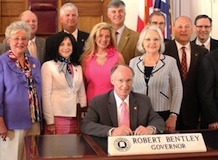
Gov. Bentley bill signing

Now the state’s unaccountable government is taking it to the next level. Help stop extreme legislation that mocks and vilifies our history:

Take Action

Aggressive gerrymandering efforts designed to dilute Black Alabamians’ votes have delivered supermajority control of the state’s legislature — and Alabama’s entire executive branch — to the extreme right wing. With Black voters largely blocked from electing their candidates of choice, Alabama’s unaccountable politicians are hard at work shredding the social safety net and attacking federal laws that protect our health.

Demonstrating just how reckless Alabama’s political leadership has become, the GOP is actually invoking Brown v. Board of Education in its latest campaign to harass and vilify Black women and families. Comparing herself to civil rights champions fighting to end school segregation, Rep. Mary McClurkin (R-Indian Springs) just pushed a package of bills through the House that would force women to carry pregnancies to term even where pregnancy results from rape.1

The GOP is appropriating the civil rights struggle to ram through its extreme, unconstitutional policy agenda,2 while depending on massive civil rights violations to win and hold office. And with November’s election already heating up, we can expect the hypocrisy will only get worse — unless national attention makes Alabama’s government’s predatory behavior toward its own Black constituents too difficult to publicly justify.

It’s time to take a stand: Demand Alabama’s Senate leadership and Gov. Robert Bentley recognize the House is committing a repugnant, costly overreach and reject HB 489, HB 490, HB 493, HB 494, and HB 31 now.

While Alabama’s white political bosses mock both the civil rights movement and Deep South’s continuing legacy of chattel slavery to the faces of their few remaining Black colleagues in Montgomery,3 everyday Alabamians are struggling to survive. Federal Temporary Assistance for Needy Families dollars are consistently diverted to projects that have nothing to do with fighting Alabama’s staggering poverty rates, and the state has flirted with becoming the first to end TANF entirely.4,5

Alabama insists single adults making just $1,332 a year are too wealthy to qualify for Medicaid,6 blocking access to basic medical care for hundreds of thousands of residents. Gov. Bentley could easily expand Medicaid coverage with funding from President Obama’s Affordable Care Act — creating 30,000 much-needed jobs, growing wages, and generating nearly $1 billion in new revenue — but he’s refused.7,8 Alabama’s already low abortion rate could be further reduced under the ACA’s expanded access to contraception, but Attorney General Luther Strange is suing to keep that from happening.9,10

It’s clear the right wing’s retrograde agenda has nothing to do with standing up for families or protecting the vulnerable — it’s about foreclosing opportunity for Black communities and suppressing Black political power. Despite our growing numbers — over 26% of Alabamians identify as Black — and record levels of voter registration, Black voters and elected officials now have less influence than at any time since the civil rights era.

The GOP strategy is to “pack” Black constituents into fewer districts, “crack” up influential communities in non-majority Black districts, and otherwise “bleach” formerly diverse districts prone to cross-racial coalition building. The resulting, unearned Republican wins have stripped formerly influential Black legislators of leadership positions and the ability to move policy or conduct oversight,11 making Alabama’s government increasingly indifferent to Black constituents’ interests. Even before last year’s Shelby County Supreme Court ruling validated Alabama’s “unbroken chain of repetitive discrimination” dating to the early days of the Voting Rights Act,12 this ruthless redistricting push has sought to reinstate the bad old days of political apartheid, when representing Black folks was simply not required of white officials.13

What’s happening in Alabama should be a national scandal. Tell the state Senate and governor to do their jobs representing all Alabamians — and ensuring the state doesn’t fall farther behind — instead of finding new ways to victimize Black families and communities.

Thanks and Peace,

–Arisha, Rashad, Matt, Kim, Johnny, Hannah and the rest of the ColorOfChange team
April 1st, 2014

Help support our work. ColorOfChange.org is powered by YOU—your energy and dollars. We take no money from lobbyists or large corporations that don’t share our values, and our tiny staff ensures your contributions go a long way.

Facebook icon Twitter icon

References

1. “Alabama House Passes Extreme ‘Heartbeat’ Abortion Ban, Three Other Anti-Choice Bills,” RH Reality Check, 03-05-2014
http://act.colorofchange.org/go/3386?t=9&akid=3341.1689899.mOw4eJ

2. “Alabama Lawmakers Propose Near-Total Abortion Ban, Other Severe Restrictions,” RH Reality Check, 02-20-2014
http://act.colorofchange.org/go/3398?t=11&akid=3341.1689899.mOw4eJ

3. “Equating Slavery and Abortion: Where are the Women in this story?” Feministing, 01-24-2011
http://act.colorofchange.org/go/3387?t=13&akid=3341.1689899.mOw4eJ

4. “Alabama Voters to Decide Whether to Save Poor Kids,” Mother Jones, 09-18-2012
http://act.colorofchange.org/go/3389?t=15&akid=3341.1689899.mOw4eJ

5. “Alabama: The sixth poorest state in America,” AL.com, 01-16-2014
http://act.colorofchange.org/go/3390?t=17&akid=3341.1689899.mOw4eJ

6. “As Alabama Cuts Benefits, Desperate Man ‘Robs’ Bank To Get Food, Shelter In Jail,” ThinkProgress, 07-11-2013
http://act.colorofchange.org/go/3388?t=19&akid=3341.1689899.mOw4eJ

7. “Study: Expanding Medicaid would create 30,700 jobs,” AL.com, 10-09-2013
blog.al.com/wire/2013/10/study_expanding_medicaid_would.html

8. “Senate Democrats Remind Governor Bentley that Alabama Must Expand Medicaid,” Alabama Political Reporter, 10-12-2013
http://act.colorofchange.org/go/3391?t=21&akid=3341.1689899.mOw4eJ

9. “Alabama joins EWTN in new lawsuit against Obamacare contraception mandate,” AL.com, 10-28-2013
http://act.colorofchange.org/go/3392?t=23&akid=3341.1689899.mOw4eJ

10. “Study: Abortion rate at lowest point since 1973,” Washington Post, 02-02-2014
http://act.colorofchange.org/go/3393?t=25&akid=3341.1689899.mOw4eJ

11. “The Decline of Black Power in the South,” New York Times, 07-10-2013
http://act.colorofchange.org/go/3394?t=27&akid=3341.1689899.mOw4eJ

12. “What Is Alabama’s Problem With the Voting Rights Act?” The Nation, 02-26-2013
http://act.colorofchange.org/go/3395?t=29&akid=3341.1689899.mOw4eJ

13. “Keeping Black Voters in Their Place,” New York Times, 11-05-2013
http://act.colorofchange.org/go/3396?t=31&akid=3341.1689899.mOw4eJ


Lupita Nyong’o and skin whitener ~repost reminder …a lifeline


Wethepeople

So, this speech given by Lupita Nyong’o was at the Essence Magazine 7th Annual Black Women in Hollywood Luncheon in Beverly Hills, California, USA, she was honoured with the Breakthrough Performance Award. It was 2014

I had to read and re-read the speech below because she addressed my own call for People of Colour to STOP the practice of skin whitening. This practice is far from new, it has unfortunately become a billion dollar snake that needs its head cut off, a severe reprimand of those who push white is right, begin to provide services that help those who hate themselves and the skin they live in. The speech is beyond illuminating lest we say eloquent and she addressed a letter, in which she talked about a fan who wrote to her about hating her dark skin so much she had bought the controversial skin lightening cream by Dencia called Whitenicious …Lupita spoke about Dencia’s skin bleaching cream, her own issues with hating her dark skin as a teenager & more … below

Lupita’s speech:

I wrote down this speech, I had no time to practice so this will be the practicing session.

Thank you Alfre, for such an amazing, amazing introduction and celebration of my work. And thank you very much for inviting me to be a part of such an extraordinary community.

I am surrounded by people who have inspired me, women in particular whose presence on screen made me feel a little more seen and heard and understood. That it is ESSENCE that holds this event celebrating our professional gains of the year is significant, a beauty magazine that recognizes the beauty that we not just possess but also produce.

I want to take this opportunity to talk about beauty, Black beauty, dark beauty. I received a letter from a girl and I’d like to share just a small part of it with you: “Dear Lupita,” it reads, “I think you’re really lucky to be this Black but yet this successful in Hollywood overnight. I was just about to buy Dencia’s Whitenicious cream to lighten my skin when you appeared on the world map and saved me.”

My heart bled a little when I read those words, I could never have guessed that my first job out of school would be so powerful in and of itself and that it would propel me to be such an image of hope in the same way that the women of The Color Purple were to me.

I remember a time when I too felt unbeautiful. I put on the TV and only saw pale skin, I got teased and taunted about my night-shaded skin. And my one prayer to God, the miracle worker, was that I would wake up lighter-skinned. The morning would come and I would be so excited about seeing my new skin that I would refuse to look down at myself until I was in front of a mirror because I wanted to see my fair face first. And every day I experienced the same disappointment of being just as dark as I was the day before. I tried to negotiate with God, I told him I would stop stealing sugar cubes at night if he gave me what I wanted, I would listen to my mother’s every word and never lose my school sweater again if he just made me a little lighter. But I guess God was unimpressed with my bargaining chips because He never listened.

And when I was a teenager my self-hate grew worse, as you can imagine happens with adolescence. My mother reminded me often that she thought that I was beautiful but that was no conservation, she’s my mother, of course she’s supposed to think I am beautiful. And then…Alek Wek. A celebrated model, she was dark as night, she was on all of the runways and in every magazine and everyone was talking about how beautiful she was. Even Oprah called her beautiful and that made it a fact. I couldn’t believe that people were embracing a woman who looked so much like me, as beautiful. My complexion had always been an obstacle to overcome and all of a sudden Oprah was telling me it wasn’t. It was perplexing and I wanted to reject it because I had begun to enjoy the seduction of inadequacy. But a flower couldn’t help but bloom inside of me, when I saw Alek I inadvertently saw a reflection of myself that I could not deny.

Now, I had a spring in my step because I felt more seen, more appreciated by the far away gatekeepers of beauty. But around me the preference for my skin prevailed, to the courters that I thought mattered I was still unbeautiful. And my mother again would say to me you can’t eat beauty, it doesn’t feed you and these words plagued and bothered me; I didn’t really understand them until finally I realized that beauty was not a thing that I could acquire or consume, it was something that I just had to be.

And what my mother meant when she said you can’t eat beauty was that you can’t rely on how you look to sustain you. What is fundamentally beautiful is compassion for yourself and for those around you. That kind of beauty enflames the heart and enchants the soul. It is what got Patsey in so much trouble with her master, but it is also what has kept her story alive to this day. We remember the beauty of her spirit even after the beauty of her body has faded away.

And so I hope that my presence on your screens and in the magazines may lead you, young girl, on a similar journey. That you will feel the validation of your external beauty but also get to the deeper business of being beautiful inside.

There is no shame in Black beauty.

 Lupita’s  speech  is a letter filled with humor , love and a lot of wisdom for little girls of colour from 1 – 98 who need to be taught self-love while the entertainment business needs to accept that POC come in all colours shapes sizes, speak differently and some of us don’t sing or dance, but plenty of us have great talent that should be accepted without having to make drastic changes to our features like skin whitening to get a part or a job …crossover

~~ Nativegrl77

the bleaching continues … ugh


 This is a repost.

why? because it’s 2018 and a picture of sammy sosa was in the news and while the practice of lightening skin is as old as passing for white. Who doesn’t wonder how safe it is and what mental place takes a person to do such a thing.

It was the year 2015, and yet another article about skin whitener is in the news! given the 2014 articles on Lupita Nyong’o mentioning Dencia in her 2/27/2014 speech regarding her dark skin and how our society has … on numerous occasion been cruel enough to consider skin whitening and to hate being black it’s important to keep updating this post. Thing is dencia didn’t see it for the ugly practice that most see it, but as free advertising and used the opportunity to admonish Lupita,  calling her a slave while claiming not to know her.

Bleaching In 2014: African Singer Dencia Blasted For Pushing Skin Lightening Cream, “Whitenicious”

So, here we are again ..  I don’t have to say reports are or tabloids said, though some of the 207+ that had to comment felt that filters were used and the pigment change could be temporary. Well, my question is why do this to begin with.  I can’t lie , I was hoping this was just a fad, but MadameNoire.com has a couple of articles about skin whitening recounting sales being up by 1000%, then up pops out an article by Thelma who says she is light to begin with and because she does a lot of different kinds of shoots her coloring looks different ~~ the internet blew up! sure it looks different

According to the World Health Organization, about 77 percent of Nigerian women regularly use skin lightening products, and with famous people who should know better pushing such foolishness, I can see why the numbers might be so high. Do what you want to yourself, but don’t peddle that s**t to your people and try to pretend like it’s solely for cleaning up dark spots here and there when people’s body parts are turning a completely different color (see below). Photos from MadameNoire

It’s 2014, when will we stop with this?

…After…Whitenicious.com

Whitenicious.com

Whitenicious.com  Check out Dencia in action above

O’khaz said that while she is naturally lighter skinned, she is not Casper-white as we see in the picture. She also emphatically denies ever bleaching her skin. Instead, she says that the ghostly white image making its way around the Internet is photo-shopped.

“I take a lot of pictures for different purposes, some for movie posters. And this one is for a movie so when its out I’ll let u know,’ she writes.

O’khaz, who has appeared in dozens of Nollywood films including Costly Mistakes, White Hunters and Return of the White Hunters (the latter two are available for free streaming), couldn’t go into much detail about the yet to be titled film for which the photos were taken. However, O’khaz can be seen in the upcoming films projects: Street Money: Occultic Sister and 89 Years in Bondage, which are due out next month. Also a much more natural skin toned O’khaz can be seen in her new video for the song, “I Like the Way,” which from her debut album Ready For You.

I see this practice as self-hate… what say you? ~~ Nativegrl77

and if there are errors, misinformation and or lies … please advise

Resource: the internet

Madame Noir

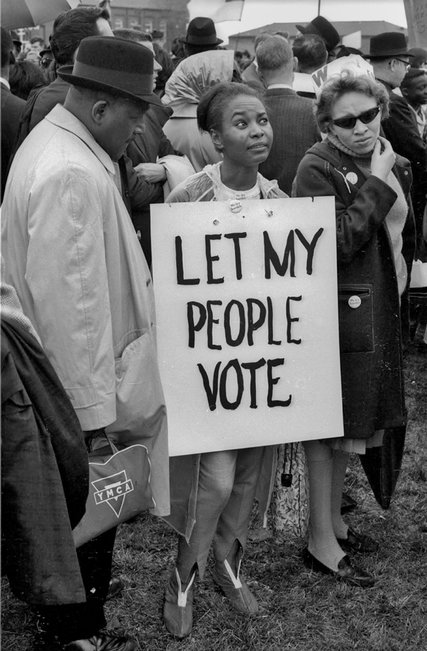
MLK jr. speech 5/17/1957 ~ Give Us the Ballot ~ In Memory


“Give Us the Ballot, We Will Transform the South”

giveustheballot

by Martin Luther King, Jr.
Speech given before the Lincoln Memorial at the March on Washington, May 17, 1957

Three years ago the Supreme Court of this nation rendered in simple, eloquent and unequivocal language a decision which will long be stenciled on the mental sheets of succeeding generations. For all men of good will, this May 17 decision came as a joyous daybreak to end the long night of segregation. It came as a great beacon light of hope to millions of distinguished people throughout the world who had dared only to dream of freedom. It came as a legal and sociological deathblow to the old Plessy doctrine of “separate-but-equal.” It came as a reaffirmation of the good old American doctrine of freedom and equality for all people.

Unfortunately, this noble and sublime decision has not gone without opposition. This opposition has often risen to ominous proportions. Many states have risen up in open defiance. The legislative halls of the South ring loud with such words as “interposition” and “nullification.” Methods of defiance range from crippling economic reprisals to the tragic reign of violence and terror. All of these forces have conjoined to make for massive resistance.

But, even more, all types of conniving methods are still being used to prevent Negroes from becoming registered voters. The denial of this sacred right is a tragic betrayal of the highest mandates of our democratic traditions and its is democracy turned upside down.

So long as I do not firmly and irrevocably possess the right to vote I do not possess myself. I cannot make up my mind — it is made up for me. I cannot live as a democratic citizen, observing the laws I have helped to enact — I can only submit to the edict of others.

So our most urgent request to the president of the United States and every member of Congress is to give us the right to vote. Give us the ballot and we will no longer have to worry the federal government about our basic rights. Give us the ballot and we will no longer plead to the federal government for passage of an anti-lynching law; we will by the power of our vote write the law on the statute books of the southern states and bring an end to the dastardly acts of the hooded perpetrators of violence. Give us the ballot and we will transform the salient misdeeds of blood-thirsty mobs into calculated good deeds of orderly citizens. Give us the ballot and we will fill our legislative halls with men of good will, and send to the sacred halls of Congressmen who will not sign a Southern Manifesto, because of their devotion to the manifesto of justice. Give us the ballot and we will place judges on the benches of the South who will “do justly and love mercy,” and we will place at the head of the southern states governors who have felt not only the tang of the human, but the glow of the divine. Give us the ballot and we will quietly and nonviolently, without rancor or bitterness, implement the Supreme Court’s decision of May 17, 1954.

<!–Read about recent allegations of voter disenfranchisement in Florida
and other states across the country in these articles.

17

–>

Learn more about Martin Luther King, Jr. and read more of his speeches and writings at The Martin Luther King, Jr. Papers Project at Stanford University.

Resources: pbs.org

Justice For Some … things to remember in this 21st Century, a repost from 2015


By CAP Action War Room

The Cleveland Police Department Reaches a Settlement with the Department of Justice

Memorial Day weekend has hosted several important developments in the world of criminal justice. Today, the Cleveland Police department—which has come under fire in recent months in the nationwide debate over police tactics—agreed to follow some of the strictest standards in the nation over its officers’ use of force. Cleveland agreed to the terms as part of a settlement reached with the Department of Justice over what justice officials called a “pattern of unconstitutional policing and excessive use of force.”

According to the Justice Department’s report, the Cleveland police department used stun guns inappropriately, punched and kicked unarmed people, shot at people who did not pose a threat, and failed to report or investigate most of these incidents. As a part of the settlement, Cleveland agreed to some of the most rigorous policing standards in the nation. These include:

  • Prohibiting officers from unholstering a firearm “unless the circumstances create a reasonable belief that lethal force may become necessary,” and documenting every time that occurs.
  • Banning pistol whipping, the firing of warning shots, and the use of neck holds (that pistol whipping had to be explicitly barred says enough).
  • Creating a community police commission, made up of ten representatives from around the community.
  • Allowing an independent monitor to track its progress.

The settlement comes just two days after a white Cleveland officer who fired at least 49 shots at two unarmed African Americans was acquitted of manslaughter by an Ohio judge. Officer Brelo’s acquittal—as the latest in a series of troubling racially charged incidents across the US in places like Baltimore, Staten Island, and Ferguson, MO—prompted protests that remained largely peaceful but still resulted in the arrest of 71 people.

Some bad news also came out of the criminal justice sphere this weekend. On Friday, Maryland Governor Larry Hogan vetoed three important criminal justice reform bills. In addition to vetoing a bill to limit civil asset forfeiture, and a bill to remove the penalty for marijuana paraphernalia, Hogan also vetoed a felon re-enfranchisement bill that would have restored voting rights to 60,000 ex-felons. Restoring access to the ballot for ex-felons is a priority in the criminal justice reform community and Hogan’s veto will serve as an important test to see whether reform advocates will show that choices like Hogan’s can have political repercussions.

BOTTOM LINE: Agreements like the one made between Cleveland and the Department of Justice have the potential to create meaningful change to a flawed system. But as Gov. Hogan’s vetoes remind us, there is much more work to be done to convince some elected officials to do their part.