Tag Archives: San Francisco

Proof that we’ll do just about anything for you… a Video from -Rainforest Action Network


Rainforest Action Network

The Wall Street Journal calls us “some of the savviest environmental agitators in the business.” For the debut of this video, we call ourselves “shamelessly grateful to all the people who make our work possible.” Please enjoy this RAN-tastic dancefest as a priceless little thank you gift from us to you.

Thank You Video from RAN

Rebecca Tarbotton Enjoy!
Rebecca Tarbotton
Executive Director
Rainforest Action Network
Twitter: @BeckyTarbotton

Google -official blog


This week in search 10/22/10 

Posted: 22 Oct 2010 04:59 PM PDT

This is one of a regular series of posts on search experience updates. Look for the label This week in search and subscribe to the series. – Ed. 

One of our core philosophies has always been launch and iterate. We’ll bring you a useful new feature or product, and then use both data and your feedback to continuously make it better. This week, we’re excited to announce three enhancements to some of the Google tools that have been around a while. So the next time you’re searching for the latest news, traveling abroad or looking for daily updates on a topic of interest—we’ve got you covered. Here are this week’s updates:

Realtime counter in search results
Since Realtime Search launched in December of last year, we’ve steadily updated the feature making it more comprehensive and easier to use. This week we added a Realtime counter underneath the News section of your search results. Now, when people on your favorite social networks are commenting on a particular topic you’ve searched for, you can easily see how many updates have been shared, all in real-time. This makes it easy to see when a news story is popular on the social web. Click the link to see the full Realtime Search results page.


Local flavor of Autocomplete, now international
It’s been more than a year since we launched localized versions of Google Autocomplete (formerly Google Suggest) that offer relevant search predictions tailored for different regions (we’re at 155 domains and growing!) More recently, we took these tailored predictions to a new level in the U.S. by targeting to specific metro areas like San Francisco and Chicago. This week, we extended these hyper-local predictions around the globe to every country that has Autocomplete. This means that the list of predictions beneath the search box will seem more locally relevant than ever.

For example, when you’re in Barcelona, Spain and you start typing [rest] there’s a good chance you’re actually looking for restaurants in Barcelona:

However, if you’re in Madrid, you’ll probably want to check the restaurants there: 


Better support for news-lovers in Google Alerts
It might be hard to believe, but Google Alerts have been providing email updates on your topic or query of interest since all the way back in 2003. Over the course of the past few years, we’ve spent a lot of time improving the way Google Alerts works to handle very specific queries (like a business or hobby), and while we’ve still got a lot of work to do, we’ve made steady improvements in the quantity, freshness and relevance of the content that we send you.

However, we’ve found many people are specifying general topics like “finance,” “entertainment” or even simply “news.” Up until this week, Google Alerts would return a long list of content from across the web about these very broad topics. This worked, but we realized it’s probably much more helpful to send you the corresponding section from Google News, since it seems like you’re looking for a digest of the big topics of the day. So we’re now including News sections in Alerts if you enter one of the following terms like: news, world news, business, entertainment, finance, health, science, sports or technology. This allows you to have your favorite part of Google News delivered to your inbox every morning.

The week in searches
In addition to all of these enhancements, are you curious to know what Google searches shot off the charts this week? The Google Beat gives you an inside look into the pulse of U.S. searches. In this week’s edition, we cover everything from BCS Football to Snooki.

We hope you find these updates useful!

Posted by Amit Singhal, Google Fellow

Creating stronger privacy controls inside Google 

Posted: 22 Oct 2010 12:13 PM PDT

(Cross-posted on the Public Policy and European Public Policy Blogs)

In May we announced that we had mistakenly collected unencrypted WiFi payload data (information sent over networks) using our Street View cars. We work hard at Google to earn your trust, and we’re acutely aware that we failed badly here. So we’ve spent the past several months looking at how to strengthen our internal privacy and security practices, as well as talking to external regulators globally about possible improvements to our policies. Here’s a summary of the changes we’re now making.

  • First, people: we have appointed Alma Whitten as our director of privacy across both engineering and product management. Her focus will be to ensure that we build effective privacy controls into our products and internal practices. Alma is an internationally recognized expert in the computer science field of privacy and security. She has been our engineering lead on privacy for the last two years, and we will significantly increase the number of engineers and product managers working with her in this new role.
  • Second, training: All our employees already receive orientation training on Google’s privacy principles and are required to sign Google’s Code of Conduct, which includes sections on privacy and the protection of user data. However, to ensure we do an even better job, we’re enhancing our core training for engineers and other important groups (such as product management and legal) with a particular focus on the responsible collection, use and handling of data. In addition, starting in December, all our employees will also be required to undertake a new information security awareness program, which will include clear guidance on both security and privacy.
  • Third, compliance: While we’ve made important changes to our internal compliance procedures in the last few years, we need to make further changes to reflect the fact that we are now a larger company. So we’re adding a new process to our existing review system, in which every engineering project leader will be required to maintain a privacy design document for each initiative they are working on. This document will record how user data is handled and will be reviewed regularly by managers, as well as by an independent internal audit team.

We believe these changes will significantly improve our internal practices (though no system can of course entirely eliminate human error), and we look forward to seeing the innovative new security and privacy features that Alma and her team develop. That said, we’ll be constantly on the lookout for additional improvements to our procedures as Google grows, and as we branch out into new fields of computer science.

Finally, I would like to take this opportunity to update one point in my May blog post. When I wrote it, no one inside Google had analyzed in detail the data we had mistakenly collected, so we did not know for sure what the disks contained. Since then a number of external regulators have inspected the data as part of their investigations (seven of which have now been concluded). It’s clear from those inspections that while most of the data is fragmentary, in some instances entire emails and URLs were captured, as well as passwords. We want to delete this data as soon as possible, and I would like to apologize again for the fact that we collected it in the first place. We are mortified by what happened, but confident that these changes to our processes and structure will significantly improve our internal privacy and security practices for the benefit of all our users.

Posted by Alan Eustace, Senior VP, Engineering & Research

Working to stop bullying, National Ally Week and navigating online LGBTQ resources 

Posted: 22 Oct 2010 04:13 PM PDT

We’ve all been saddened by the recent suicides of gay youth, especially as tragedy has piled atop tragedy. Each of them is a signal that we need to do more to put an end to these incidents that destroy the lives of both the children being bullied and children who bully. 

We believe the Internet can provide a safe space and resources for youth who are struggling with their identity and looking for help. And we’ve been happy to see products like YouTube being used to deliver messages of hope. There are many organizations out there doing an extraordinary job providing resources for LGBTQ youth, and we wanted to highlight a few as part of GLSEN’s National Ally Week: Trevor Project, GroundSpark’s Respect for All Project, the YouTube “It Gets Better” project and the Gay Lesbian Straight Education Network. GLSEN’s Safe Space campaign page provides resources and support for educators, policy makers, community leaders and students to take action to make a positive difference. We recently made a $50,000 donation to the Trevor Project, in support of the Levi’s Challenge Grant announced on The Ellen DeGeneres Show—they will be matching up to $50,000 dollars in donations to the Trevor Project. We’ve also donated to GroundSpark and GLSEN. We hope that other companies and individuals will consider doing the same.

We also wanted to share a video some of our own Googlers made for the “It Gets Better” project documenting their own experiences and sending messages of encouragement to LGBTQ youth.

Finally, the Matthew Shepard Foundation has been in the forefront of LGBTQ issues educating the world and sharing the tragic story of Matthew Shepard. We asked Judy Shepard, Matthew’s mother, to share her thoughts with us on the recent tragedies and what we can do to help. Here’s what she said:

It’s been devastating lately to see so many families losing their LGBT kids to suicide and frankly, incredibly frustrating to see so many cases that seem to be linked in some way to bullying. My husband Dennis and I started the Matthew Shepard Foundation in the hope that by helping youth connect with resources, supportive allies and positive messages about their future, that it might prevent tragic outcomes like suicides or hate crimes. We’re just one part of a huge community of allies. And we are allies for all youth, whether they’re being singled out for their sexuality, or their race, or something else that makes them different. But if we can’t get the word out to the young people who really need to hear from us, and can’t make them more comfortable reaching out for help when they’re in crisis, then we’ll continue to struggle to protect them.

I’ve been out speaking at schools for the last 12 years to give these students a little hope and show them there are people they can turn to even if their own families aren’t accepting. I’ve also tried to open the eyes of the kids who are doing the bullying too—to show them the pain a victim’s family suffers. We lost a son, but the young men who killed Matthew are a sad example of how you can basically lose your life by victimizing people, too, almost as much as by being the victim.

-Judy Shepard

We honor the memory of Matthew and of the children who lost their lives this fall, and our hearts go out to their families. We thank Judy for her words and encourage everyone to work to help our youth to find safety and a better way to engage in the world—including using the Internet for the amazing good it brings, and not to bully others.

Posted by Megan Smith, Vice President, New Business Development Google Inc. and General Manager, Google.org and Laszlo Bock, VP of People Operations

Google -Official blog


More transparency and control over location 

Posted: 18 Oct 2010 11:10 AM PDT

We’ve always focused on offering people the most relevant results. Location is one important factor we’ve used for many years to customize the information that you find. For example, if you’re searching for great restaurants, you probably want to find ones near you, so we use location information to show you places nearby. 

Today we’re moving your location setting to the left-hand panel of the results page to make it easier for you to see and control your preferences. With this new display you’re still getting the same locally relevant results as before, but now it’s much easier for you to see your location setting and make changes to it.

Your location setting is now always visible on the left side of the search results page.

We do our best to automatically detect the most useful location, but we don’t always get it right—so in some cases you’ll want to change the setting. At other times, you may want to change your location to explore information relevant to another area. For example, let’s say you’re at work in Mountain View and you’re making plans to see a movie in San Francisco (a common occurrence here at Google). You can change your location to “San Francisco” and search for [showtimes] to find movie listings in San Francisco or search for [restaurants] to find places to eat before the show. Similarly, if you’re planning a trip to Hawaii, you can change the location to “Honolulu” and start exploring the [weather], [hotels] and of course the [beaches]. The location you set can be as specific as a particular zip code or as general as an entire country, but more specific settings generally lead to better search results.

Click “Change location” to specify your location preference.

You used to be able to see and control your location settings, but it was a little clunky. To see your settings, you could click “View customizations” on the results page and to modify them you could click “Change location” next to a variety of search results, such as maps and movie listings. As time has gone by, more and more locally relevant information has come online, whether it’s local business listings or a blog from your hometown. Meanwhile, Google has become much better at presenting this locally relevant content—so it felt like the right time to make this setting easier to find.

The new interface is rolling out now and will be available in more than 40 languages soon. We’re not changing anything about how we use location information to improve search, so it doesn’t change our existing privacy policies. To learn more about our new interface and how we use location in search, check out our help center.

Posted by Mack Lu, Associate Product Manager

GreenPeace September newsletter


Greenpeace
monthly newsletter, September

Action needed to help save sea lions!

You can help protect the world’s largest sea lion, the Steller sea lion of the North Pacific, by telling the National Marine Fisheries Service to adopt the protective measures they have identified as needed for the species to survive. After years of delays and undue industry influence, NMFS released a Draft Biological Opinion (BiOP) on Steller sea lions on August 2nd.

This new BiOp finds that commercial fishing is the most likely cause of sea lion declines in the western Aleutian Islands and their failure to recover in other areas. Fishing fleets are catching too much of the fish Steller sea lions need to eat for their survival. Take action and let the agency know you support their own conclusions and urge them to move forward and give Steller sea lions the protection they need.


Be the Change!

GOTThe Greenpeace Organizing Term is our semester-long program for students between the ages of 18-24. Through our exciting combination of classroom workshops, group work, one-on-one feedback from staff, and campaign-related travel, students are prepared to make an impact. We want smart, visionary, passionate, and community-minded students who are ready to be change-makers on their campuses.

For more information, to share this with your favorite students, or to apply TODAY for our Spring 2011 semester in San Francisco, check out the application page or email us at: got@wdc.greenpeace.org. The Spring 2011 deadline is October 15th, so apply or forward this to a student you know today!

10.10.10

Greenpeace is teaming up with 350.org, 10:10, and a global coalition of folks doing something about climate change to create a global day of action: the 10/10/10 Work Party. Help us make October 10th the biggest single day of action against global warming that the world has ever seen by signing up today!

Over 1,000 Work Parties are already planned. Find one in your area and RSVP today or add an event of your own. Don’t wait.


Ship Expedition

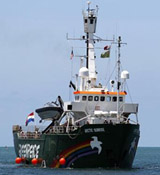
Arctic Sunrise

We’re nearly a month into our Gulf Oil Spill Impacts Expedition. See where we’ve been and follow along as we continue to support independent research into the effects of the BP Deepwater Horizon disaster.