
1989 Tiananmen Square massacre takes place
1934 FDR asks for drought-relief funds
1919 Congress passes the 19th Amendment
1876 Express train crosses the nation in 83 hours
1862 Confederates evacuate Fort Pillow

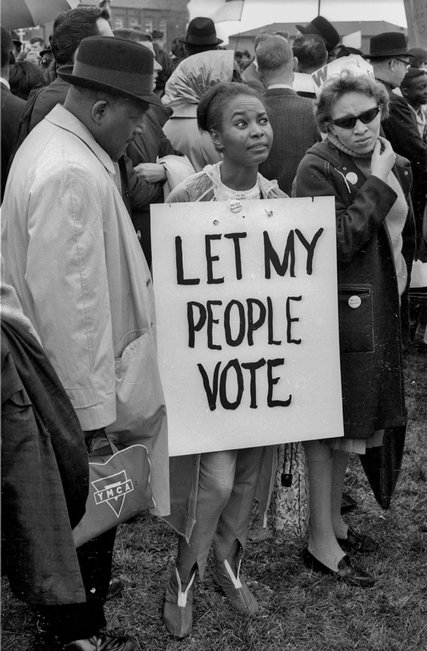
by Martin Luther King, Jr.
Speech given before the Lincoln Memorial at the March on Washington, May 17, 1957
Three years ago the Supreme Court of this nation rendered in simple, eloquent and unequivocal language a decision which will long be stenciled on the mental sheets of succeeding generations. For all men of good will, this May 17 decision came as a joyous daybreak to end the long night of segregation. It came as a great beacon light of hope to millions of distinguished people throughout the world who had dared only to dream of freedom. It came as a legal and sociological deathblow to the old Plessy doctrine of “separate-but-equal.” It came as a reaffirmation of the good old American doctrine of freedom and equality for all people.
Unfortunately, this noble and sublime decision has not gone without opposition. This opposition has often risen to ominous proportions. Many states have risen up in open defiance. The legislative halls of the South ring loud with such words as “interposition” and “nullification.” Methods of defiance range from crippling economic reprisals to the tragic reign of violence and terror. All of these forces have conjoined to make for massive resistance.
But, even more, all types of conniving methods are still being used to prevent Negroes from becoming registered voters. The denial of this sacred right is a tragic betrayal of the highest mandates of our democratic traditions and its is democracy turned upside down.
So long as I do not firmly and irrevocably possess the right to vote I do not possess myself. I cannot make up my mind — it is made up for me. I cannot live as a democratic citizen, observing the laws I have helped to enact — I can only submit to the edict of others.
So our most urgent request to the president of the United States and every member of Congress is to give us the right to vote. Give us the ballot and we will no longer have to worry the federal government about our basic rights. Give us the ballot and we will no longer plead to the federal government for passage of an anti-lynching law; we will by the power of our vote write the law on the statute books of the southern states and bring an end to the dastardly acts of the hooded perpetrators of violence. Give us the ballot and we will transform the salient misdeeds of blood-thirsty mobs into calculated good deeds of orderly citizens. Give us the ballot and we will fill our legislative halls with men of good will, and send to the sacred halls of Congressmen who will not sign a Southern Manifesto, because of their devotion to the manifesto of justice. Give us the ballot and we will place judges on the benches of the South who will “do justly and love mercy,” and we will place at the head of the southern states governors who have felt not only the tang of the human, but the glow of the divine. Give us the ballot and we will quietly and nonviolently, without rancor or bitterness, implement the Supreme Court’s decision of May 17, 1954.
<!–Read about recent allegations of voter disenfranchisement in Florida
and other states across the country in these articles.
17
–>
Learn more about Martin Luther King, Jr. and read more of his speeches and writings at The Martin Luther King, Jr. Papers Project at Stanford University.
Resources: pbs.org
Talk about poppin’ tags.
Goodwill in Tacoma is beginning to sell African artifacts valued at more than $11,000.
The 55 artifacts, from the mid-19th to mid-20th century, were used in tribal life and for tribal ceremonies. An anonymous donor left the 55 artifacts at the Port Townsend Goodwill store last month.
The items will be sold online at Shopgoodwill.com, a site used to produce the highest prices for items. The site uses competitive bidding to sell high-end fashion, jewelry, art and other items.
Go to the search portion of the site, pick Tacoma in the drop-down menu of sellers, then search for the items.
Goodwill wants the public to know about the online sales. Officials figure if people know valuable goods can fetch a good price, they might be more willing to donate.
“Many people hesitate to donate their high-end furniture, jewelry, clothing, art and collectibles because they assume their treasures will end up for $4 in our thrift stores,” said Dylan Lipert, manager of online sales, in a news release. “My job is to make sure that doesn’t happen.”
(The gallery above shows some of the artifacts, as well as other items that have or will be sold online.)
More than 140 Goodwill agencies provide items for sale online. In the past six years, Tacoma online operations have more than doubled in size and sales from $2.1 million in FY 2008 to $4.5 million in FY 2013.
**************************************************

SEATTLE — Someone recently donated an old vest to Goodwill, and while that could happen everyday, this one was unusual.
By old, we mean a century old. It’s a beaded Native American vest that’s so valuable, Goodwill couldn’t bear to sell it.
Instead, the non-profit decided to make its own donation. Now, curators from the Burke Museum are analyzing the vest.
It’s an exquisitely detailed piece from the early 1900s. Everything from the color of the beads to the geometric designs to the velvet lining is a clue pointing to the vest’s history.
“Whoever gave it to Goodwill probably knew more about it. They probably knew their grandfather got it while on a train ride through Glacier. That’s the kind of information we’d love to have,” said Robin Wright, Curator of Native American Art.
The vest was inside a trunk, donated to Goodwill in 2006. Someone recognized its value, and instead of going up for sale, the vest went into storage.
Katherine Boury of Goodwill explained, “We have to make the decision, what’s the best use of the donation. In this case because it’s of cultural significance, it seems it would be best to be accessible to everyone.”
Assessors pinpointed it as Native American work from the northern plains.
“There’s been some discussion with various experts about which particular tribe and we’re not able to say precisely which tribe it might be,” said Wright.
It might have been regalia for a pow wow, but at some point, it seems it was sold to a tourist.
Written on the lining – a price tag of $18 – for a vest that probably took several months to make. There is no price on the vest now, and while there are still questions about where it came from, there’s no question where it’s going.
The museum will keep the vest in its collection for the public to see and treasure.
Do you think you have an artifact in your home? Take up to three objects to the annual Artifact ID Day at the Burke on Feb. 9.
********************************************************

Face it, says auctioneer, not every mask is sacred

Hopi masks snapped up after French court allows auction
Hopi masks auctioned in Paris amid outrage and legal objections
wonder if there are updates on any of these stories and hopefully progress on stopping this from happening… return them to their place of origin
Ahead of Florida’s first gubernatorial debate on Friday, Governor Rick Scott is on the hot seat.
From failing to expand Medicaid and opposing an increase to the minimum wage, to ignoring climate change as a central threat to his state, Scott has hurt the lives and livelihoods of millions of Floridians—many of whom are from communities of color. A new Center for American Progress Action Fund report details Scott’s failure to act on behalf of his state’s residents. Accompanying the report, a new survey shows how Floridians disagree with his harmful positions.
The CAP Action report highlights several ways that Gov. Scott is failing Floridians:
Floridians are recognizing these failures. By a 12-point margin in the latest survey, voters are less likely to vote to for Scott because of his position opposing a minimum wage increase. Voters are less likely to support Scott by an 11-point margin based on his refusal to expand Medicaid to cover the state’s 1 million low- and moderate-income Floridians. And by a 16-point margin, Florida voters are less likely to vote for a candidate — like Scott — who denies that man-made climate change is real.
BOTTOM LINE: Florida Governor Rick Scott’s policies on the minimum wage, Medicaid expansion, and climate change are failing to create an economy that works for every Floridian, not just the wealthiest. Voters in the state disagree with these positions, and they are taking notice.
Like CAP Action on Facebook and follow us on Twitter!

Some companies are marketing untested, unproven, and possibly dangerous products that claim to prevent, treat, or cure concussions and other traumatic brain injuries.
Learn why dietary supplements can’t treat concussions and why using them for this purpose can be dangerous. Read the Consumer Update to learn more.


You must be logged in to post a comment.