Tag Archives: United States

A Benefit To Businesses


By

Health Insurance Giant Aetna Is Raising Wages For Its Lowest Paid Workers

A common refrain from some in the business community who oppose a minimum wage increase is that higher wages for low-income workers will be costly enough to either force businesses to raise prices for consumers or cause them to lay off workers. Aetna, a Fortune 100 company with nearly 50,000 employees, just made a decision that sharply rebukes that argument. The health insurance giant has announced it is raising the minimum wage for its workers to $16 per hour. In doing so, the company specifically cited the business benefits, not the costs, of the move.

The raises, which comes on the heels of similar wage increases by big name companies like Starbucks and Gap, are significant. An estimated 5,700 Aetna employees will get a pay bump — an 11 percent increase on average and up to 33 percent for some workers. And it won’t be free: the company expects the move to cost an estimated $14 million this year, and $25.5 million in 2016.

Nonetheless, Aetna CEO Mark T. Bertolini laid out the business case for raising the wages of low-income employees. Here are a few of the reasons he cited, in an interview to the Wall Street Journal:

  • Adapting the company for the future: “We’re preparing our company for a future where we’re going to have a much more consumer-oriented business.”
  • Workforce development: “[Aetna wants] a better and more informed work force.”
  • Reducing turnover costs: According to the Wall Street Journal, “Mr. Bertolini said Aetna hopes to reduce its turnover costs of around $120 million a year and improve the quality of job prospects and the engagement of workers who interact with consumers and health-care providers.”

And then there is a broader reason that factored into Mr. Bertolini’s decision: “It’s not just about paying people, it’s about the whole social compact,” Mr. Bertolini said, adding, “Why can’t private industry step forward and make the innovative decisions on how to do this?”

BOTTOM LINE: The decision by Aetna to raise wages for their low-income employees demonstrates one of the business imperatives for raising wages. Simply put, investing in workers pays off for companies in more ways than one. We’d thank Aetna for it’s decision, but we know that the company didn’t made this move because of groups like ours. It made the move because it cares about its workers, and it cares about its bottom line.

Dead hens left to rot in cages


Tell Egg Producers to Get Hens Out of Cruel Cages Nationwide

Emily Deschanel and Mercy For Animals

ACA 101


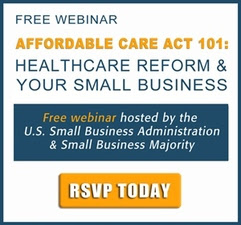
Affordable Care Act 101 Webinars

SBA and Small Business Majority will host a free Affordable Care Act 101 webinar so small business owners can learn the basics of the Affordable Care Act and how they can enroll in health insurance marketplaces.

Free Affordable Care Act 101 webinar covering healthcare reform and your small business hosted by SBA and Small Business Majority. Click to RSVP today

Tell the Senate: Pass the bill to reverse the Supreme Court’s attack on Black women’s healthcare


Arisha Michelle Hatch, ColorOfChange.org
The Supreme Court gutted Obamacare’s protections for Black women’s health but now there’s something we can do:
The Supreme Court gutted Obamacare’s contraception coverage. We have a plan to fix it.

Supreme Court Building

Take Action

Last week, the Supreme Court sided with the far-right and gutted a key part of Obamacare’s protections for women’s health.

Black women are getting caught in the middle as the right-wing tries to chip away at the Affordable Care Act. Affordable access to contraception is a matter of life and death for Black women who are 3 times more likely to die from pregnancy-related issues than white women. Many of us regularly use contraception to treat endometriosis, manage uterine fibroids and alleviate PMS symptoms.1 The far-right is more concerned with tarnishing President Obama’s legacy than ensuring we have access to affordable healthcare.

But, we have a way to fight back!

The Protect Women’s Health From Corporate Interference Act was just introduced in Congress to reverse the Supreme Court’s decision gutting a woman’s right to birth control coverage. The bill states that federal laws, including the Religious Freedom Restoration Act used by Hobby Lobby’s right-wing lawyers, do not allow employers to refuse to cover health care — including birth control — guaranteed by Obamacare. It would ensure women at corporations like Hobby Lobby could make important health decisions with their doctors, not their bosses.

Tell the Senate: Pass the bill to reverse the Supreme Court’s attack on Black women’s healthcare.

Black women overall are at a higher risk for unintended pregnancy but have less access to insurance and preventative care.2 The contraception mandate in Obamacare would go a long way towards reducing cost barriers for our access to birth control and help close the gap in contraceptive use between Black women and our white and Latina peers — but we need Congress to reverse the Supreme Court’s damage. Politicians with an eye on November elections need to know that if they count on Black people to vote for them at the polls, they need to vote for the needs of Black women in Congress and pass this bill.

That’s why we’re teaming up with our friends at UltraViolet. If we shine a spotlight on this bill and bring it to a vote, we’ll know which members of Congress support Black women’s healthcare — and which side with 5 men on the Supreme Court. Will you sign?

Tell the your Senators: Reverse the Supreme Court’s attack our healthcare.

Thanks and Peace,

–Arisha, Rashad, Matt, Aimée, Johnny and the rest of the ColorOfChange team.
July 10, 2014

Help support our work. ColorOfChange.org is powered by YOU—your energy and dollars. We take no money from lobbyists or large corporations that don’t share our values, and our tiny staff ensures your contributions go a long way.

References

1. “How the Hobby Lobby Decision Impacts Black Women,” EBONY, 6-30-14
http://act.colorofchange.org/go/3645?t=7&akid=3473.1174326.0t4Dbp

2. “Hobby Lobby Ruling Opens the Door to ‘Method Discrimination’ for Black Women,” The Root, 7-3-14
http://act.colorofchange.org/go/3646?t=9&akid=3473.1174326.0t4Dbp

Low Wages? Low Sales.


By

The Middle Class Squeeze Is Worrying Big Retailers, Too

Earlier this month, CAP released a report highlighting how squeezed middle-class Americans have become. That report showed that while the cost of attaining middle class security has increased by over $10,000 since 2000, wages for most Americans have remained stagnant.

The cycle of economic stagnation—low wages, leading to weak demand, leading to slow growth, leading again to low wages—is not only hurting America’s hard-working citizens, but it is also hurting businesses where those workers might spend their money and in turn boost the entire US economy. Wall Street is finally starting to get it: Standard & Poor’s has issued a report saying that inequality is holding back economic growth and Morgan Stanley has warned investors that stronger wage growth is critical to our economic growth.

A new CAP report released today provides further evidence that this squeezed middle class weakens our entire economy, hurting both businesses and the consumers who support them. The report, ”Retailer Revelations,” looked at the financial reports of the top 100 retailers in America and statements of Wall Street’s top economists about the outlook for the country’s biggest retailers. The consensus: trickledown economics is not working.

It has taken more than five years for retail spending per person to reach its prerecession level in the United States and business have begun to realize the impact that is having on their bottom line. Using new information to show the impact middle-class stagnation has had on the economy, the report demonstrates that businesses’ support for economic policies that grow the middle class would directly benefit their own business.

Here are some key findings:

  • Eighty-eight percent of the top 100 US retailers consider weak consumer spending a risk to their stock price.
  • Sixty-eight percent cite falling or stagnant incomes as a risk to their stock price — roughly double the percent that cited them in 2006.
  • Fifty-seven percent cite rising costs of essentials like housing, healthcare and energy, as risks to their stock price, further showing the middle class squeeze.
  • Wall Street economists even argue that low wages drive low demand and high unemployment.
  • Retailers could see their bottom line increase by supporting a growth-oriented agenda with policies such as a minimum wage increase.

BOTTOM LINE: America’s biggest retailers have realized that when the middle class loses, everyone loses. It’s time conservative lawmakers and pundits realized it too. An economy that works for everyone is an economy that grows from the middle out.