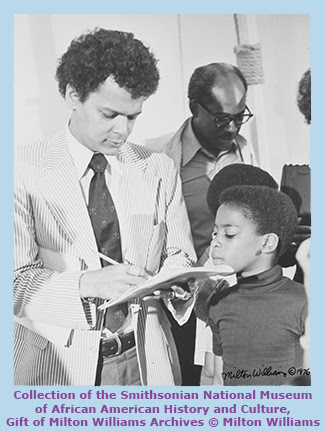
Julian Bond came of age during that critical time in this nation’s history when winning equal rights for all took a great deal: a clear head, a big heart, a razor-sharp intellect, and a way with words. Julian Bond had it all. And he could wrap all of it up to create whatever was needed at the time – either a tool or a weapon, a poem or a sermon. He was driven by a commitment to make America better. While a Morehouse-based member of Student Nonviolent Coordinating Committee (SNCC), helping to organize the Freedom Summer of 1964 and its massive voter registration drive in Mississippi, Julian Bond took to task the American public and President Lyndon B. Johnson. “We have learned through bitter experience in the past three years that the judicial, legislative and executive bodies of Mississippi form a wall of absolute resistance to granting civil rights to Negroes. It is our conviction that only a massive effort by the country backed by the full power of the President can offer some hope for even minimal change in Mississippi.” Those words came from a letter Julian Bond wrote on April 28, 1964 to one of America’s most inspiring writers, James Baldwin. He was writing to encourage Baldwin to join a “jury” to hear “testimony” about Civil Rights violations from African Americans facing discrimination in employment, housing, and voting rights in Mississippi. Under a plan designed by SNCC and other members of the Council of Federated Organizations, the testimony would be presented to the President so he would be moved to create a government-sanctioned way to protect the Freedom Summer workers. “The President must be made to understand that this responsibility rests with him, and him alone, and that neither he nor the American people can afford to jeopardize the lives of the people who will be working in Mississippi this summer by failing to take the necessary precautions before the summer begins.” Bond’s letter to Baldwin has entered the collections of the National Museum of African American History and Culture. It will be used alongside similar documents to show how people like Julian Bond helped design and fuel the Civil Rights Movement. Bond was so committed to helping us tell that story well, that he became a member of the museum’s Civil Rights History Project advisory committee. In that role he helped us land interviews with some of the most important workers in the movement; he also conducted two of the more than 150 interviews for this oral history project. One was with Lawrence Guyot, the director of the 1964 Freedom Summer project in Hattiesburg, Mississippi. Julian Bond wrote his letter to James Baldwin in 1964 at the age of 23. Less than three years later he would be awarded his seat in the Georgia House of Representatives by a unanimous decision of the U.S. Supreme Court. Four years after that, in 1971, he would become the founding president of the Southern Poverty Law Center. Nearly 30 years later, in 1998, he would take the helm of the NAACP serving as its national chairman for an astonishing 12 years. Julian Bond has spent his life as a champion in the campaign for equality. Much of what we as a nation know about compassion and commitment, we have learned from Julian Bond, the people he emulated and the people he inspired. We are sad because he has left us. And we are deeply honored that we had him for as long as we did … to help us help America live up to her promises. We are better people because he walked among us for a while. Thank you, Horace Julian Bond.
|
Tag Archives: United States2008 election
Sarah Breedlove … Millionaire 12/23/1867
This Child of Slaves Grew Up to Become America’s First Female Millionaire
Random Celebrity Article By Paula Wilson on October 20, 2014
America is considered to be the “land of opportunity”. Historically, it’s the country people have run to in order to escape persecution, poor living conditions, or lack of opportunities somewhere else. However, for the large number of African people stolen from their homes, shipped across the Atlantic, and sold into slavery, America was anything but a land of opportunity. So it’s pretty darn incredible that America’s first female self-made millionaire, Madam C.J. Walker, was the child of former slaves. Her story is one of perseverance, ingenuity, and triumph. If her amazing life doesn’t make you want to get off your butt and go make your dreams happen, than nothing will.
Madam C.J. Walker, also known as Sarah Breedlove, was born on December 23, 1867, just outside of Delta, Louisiana. She was born on the cotton plantation where her family had been enslaved. She held the distinction of being the first free-born child in the family. The youngest of five, she was the first person in her family born after the signing of the Emancipation Proclamation. However, by age 7, she was orphan. Both of her parents passed away within a year of each other. Their cause of death was not recorded. She was sent to live with her older sister in Mississippi, where it is believed she worked picking cotton and doing housework. Her life in Mississippi was anything but ideal, and though slavery had technically been abolished, most people in the South had yet to “get the memo”, as it were. She worked the same hours she would have worked as a slave and was paid a pittance. Then, she and her family members had to pay exorbitant fees to live in the very same shack that her sister had lived in while she was a slave. Making matters worse, was that her brother-in-law was physically abusive. Eventually, she couldn’t take it anymore. At 14, she married a man named Moses McWilliams, mostly in an effort to get away from her current living situation.

The pair had a baby in 1885. Two years later, Moses passed away, and Sarah and her daughter A’Lelia moved to St. Louis to be closer to Sarah’s older brothers. Her brothers had found some success working as barbers. In St. Louis, she began working as a washerwoman. Her pay was only $1.50 per day. She used the majority of the money to pay for her daughter’s schooling, and also took whatever classes she could herself. She subsequently met and married Charles J. Walker. Mr. Walker worked in advertising and their relationship would prove to be a fortuitous one.
Due to a severe scalp condition, most likely caused by the lye-based products used to straighten her hair, Sarah Breedlove had begun to lose her hair in bunches. Whenever she had a spare moment in her kitchen, she began making her own hair care products, and experimenting with ways to treat her own scalp. A black woman named Annie Turnbo Malone heard about Sarah. Ms. Malone made and marketed her own line of African-American hair care products. She invited Sarah to come work for her as a commission agent. So Sarah, Charles, and A’Lelia relocated to Denver, Colorado and launched a hair care business under Ms. Malone. At the urging of her husband, Sarah changed her professional name to Madam C.J. Walker, and launched her business in earnest. Between her genuinely effective and well-made products and her husband’s advertising acumen, her business grew by leaps and bounds. The couple spent much of the early 1900s, traveling around selling her products all over the south. By 1908, she was able to go out on her own. She opened a factory and her own beauty school in Pittsburgh.

The company continued to grow, so Sarah, now Madam C.J., moved operations to Indianapolis. She began training a group of employees who were both salespeople and beauticians. Known as “Walker Agents“, these African-American entrepreneurs began selling her products all over the United States. She began sponsoring conventions, sales awards, and community events. She and her husband divorced in 1913, and rather than slowing her down, it seemed to galvanize her. She traveled to the Caribbean and Latin America, adding more and more “Walker Agents” to her roster and increasing her sales base. By this time, her daughter A’Lelia, had begun to take charge of some portions of operations. A’Lelia purchased prime real estate in Harlem and made it the new base of operations for Madam C. J. Walker Manufacturing. As more responsibility was shifted to her daughter, Madam C.J. Walker began focusing on philanthropy and community improvement. She created scholarship funds, sponsored the building and maintenance of multiple homes for the elderly, donated large sums to both the NAACP and the National Conference on Lynching, and, in 1913, donated the largest amount of money by an African-American to the Indianapolis YMCA.

She built a home in Irvington-on-Hudson, New York sometime around 1916 or 1917, and passed away there in 1919, due to hypertension. She was 51 years old. She was the sole owner of Madam C.J. Walker Manufacturing for most of its existence, and the company was worth over $1 million when she died. Additionally, she was worth close to $700,000 herself, separate from the company. That’s the equivalent of $13 million in today’s dollars. It was an astronomical amount in 1919.
At the time of her death in 1919, Madam C.J. Walker was the wealthiest African-American in the United States. She was also generally believed to the country’s first self-made female multi-millionaire. Assuming her net worth was approximately $2 million the year she died, that would be equivalent to $37 million today.


When she died, her will dictated that 2/3 of all future company profits be donated to charity from that point on. One third of her estate went to her daughter. Her home in Irvington-on-Hudson is now a registered landmark, and the arts center named after her in Indianapolis, the Walker Center, has become nationally famous.
Madam C.J. Walker, aka Sarah Breedlove, went from absolutely nothing, to wealthier than just about everyone else around her. Along the way, she made sure to give back to the community that supported her, and trained hundreds of “Walker Agents” about entrepreneurship, civic duty, and pride. She proved to an entire generation of African-Americans, many of whom had grown up enslaved, that success was possible. Historically and socially, the example she set has proven far more valuable than her millions of dollars.

HIPAA Rights … You should know them – a repost

Information is powerful medicine. The Health Insurance Portability and Accountability Act (HIPAA) gives you the right to get your personal health information, make sure it’s correct and know who has seen it. With access to your own medical records, you can make decisions with your health care provider, track your medications and dosages, and much more.
Read More: Information Is Powerful Medicine: Understanding Your HIPAA Rights
On This Day …
Presidential Jackson submits Indian treaty to Congress, 1836
Crime Man chased to his death in Howard Beach hate-crime, 1986
American Revolution Virginia cedes western land to federal government, 1783
Ancient Aliens
Investigate the mysteries.
Ferguson … justice for only some? a repost
Corinne Ball, MoveOn.org Civic Action
Many of us have wrestled with intense emotions—sadness, anger, shock, and more—as we’ve followed the ongoing situation in Ferguson, Missouri.
The police killing of unarmed 18-year-old Michael Brown has ignited weeks of demonstrations. Even though most protesters have been peaceful, police appeared armed with military-grade equipment.1 Reporters have been threatened and arrested by police while trying to report the story.2 The whole country has been watching what’s happening in Ferguson.3
Many of us have asked: What can we do to ensure justice for Michael Brown? What is this awful situation revealing—or reminding us—about racism in America, police militarization, and the way our criminal justice system too often fails communities of color?
Many of us have been moved to take action. Nearly 150,000 MoveOn members joined ColorOfChange.org to call on the Department of Justice to intervene in the investigation into Michael Brown’s death. That petition will be delivered next week in Washington, DC.
Tens of thousands of us added our names to MoveOn member and Missouri State Senator Jamilah Nasheed’s petition calling for an independent prosecutor in the case. And many of us have made phone calls, joined community protests and vigils, and more.
The vigils and national outcry have already had an impact in Ferguson. Attorney General Eric Holder—who came to meet with Ferguson residents in person—is overseeing a Department of Justice investigation.5 The FBI is conducting an investigation into civil rights abuses by the Ferguson police department.6 And a grand jury has been convened to determine if charges will be filed against Officer Darren Wilson.7
We still have much left to do and many complex issues to address before Ferguson—and America—can heal and move forward. There is no quick fix. But there are things we can all do right now to get involved in the push for justice.
One step you can take—if you haven’t already—is to sign Senator Nasheed’s petition calling for a special prosecutor to investigate the shooting death of Michael Brown. Faith leaders and local residents have joined Senator Nasheed in expressing serious doubts about whether the prosecutor in St. Louis County, who previously failed to charge officers for murdering two unarmed black men, will objectively investigate the officer responsible.8
There’s also a huge amount of thoughtful online commentary that’s been sparked by this tragedy. Whatever you’re reading about Ferguson now, consider passing it along to a friend to keep the conversation going. Here’s one option: This piece from MSNBC’s “All In With Chris Hayes” puts the story in a broader perspective in a conversation with Marq Claxton, a retired New York Police Department detective, and Phillip Agnew, founder of the young activist group Dream Defenders:
Together, let’s continue to reflect, to speak out, and to take action.
Thanks for all you do.
–Corinne, Maria, Anna, Mark, and the rest of the team
Sources:
http://www.moveon.org/r/?r=300422&id=100249-17809870-7a_RFkx&t=7
http://www.moveon.org/r/?r=300423&id=100249-17809870-7a_RFkx&t=8
3. “A Movement Grows in Ferguson,” The New Yorker, August 17, 2014
http://www.moveon.org/r/?r=300415&id=100249-17809870-7a_RFkx&t=9 4. “Concerns arise about prosecutor in Michael Brown case,” CNN, August 20, 2014
http://www.moveon.org/r/?r=300425&id=100249-17809870-7a_RFkx&t=10“Missouri Governor Won’t Replace Prosecutor in Michael Brown Probe,” Wall Street Journal, August 21, 2014
http://www.moveon.org/r/?r=300426&id=100249-17809870-7a_RFkx&t=115. “Jay Nixon: Missouri Highway Patrol Will Take Over Supervision Of Security In Ferguson,” Associated Press, August 14, 2014
http://www.moveon.org/r/?r=300416&id=100249-17809870-7a_RFkx&t=126. “FBI Will Investigate Death of Black Teenager in Missouri,” The Washington Post, August 11, 2014
http://www.moveon.org/r/?r=300417&id=100249-17809870-7a_RFkx&t=14
7. “Holder visits Ferguson as grand jury hearings begin,” Los Angeles Times, August 20, 2014
http://www.moveon.org/r/?r=300424&id=100249-17809870-7a_RFkx&t=15
8. “Protesting the Prosecution,” Slate, August 21, 2014
http://www.moveon.org/r/?r=300418&id=100249-17809870-7a_RFkx&t=18
Want to support our work? MoveOn Civic Action is entirely funded by our 8 million members—no corporate contributions, no big checks from CEOs. And our tiny staff ensures that small contributions go a long way. Chip in here.


You must be logged in to post a comment.