Tag Archives: vote

What you can do to fight poverty


CARE -- Help her Live, Learn and Earn -- Donate now

3 ways you can fight poverty -- $3 million can: help save lives -- help educate girls -- help women start their own businesses -- Donate now

Facebook Twitter Tell a Freind

Fatima didn’t have a chance.

Instead of learning how to read and write as a child, she fetched water and herded livestock. At the age of 15, her father forced her to marry. Today, she is the mother of eight children.

Although Fatima and her family struggle to make ends meet, she didn’t see the value of sending her eldest daughter to school. “I told myself that she will get married like me and she does not need education,” Fatima said.

Fatima’s daughter faced the same grim future as herself — forced to live a life that wasn’t on her own terms. When a girl marries young, she usually drops out of school to start a family, but faces a greater chance of dying in childbirth. She’s also less likely to earn enough to support herself and her family and keep them healthy. One generation follows the next, locked in a vicious cycle of poverty.

You can help break this cycle. By making a tax-deductible gift today, you’ll help empower women and girls in the world’s poorest countries to access the education and resources they need to lift themselves and their families out of poverty for good.

Fatima is on her way. She joined a CARE-sponsored women’s group and learned to read and write. A whole new world opened before her eyes, and Fatima realized she had the power to change the course of her daughter’s future. With a basic education, her daughter could chart her own path. Fatima’s daughter is in school today — and she’s learning leadership skills with CARE that will serve her for her entire life.

When you invest in empowering poor women and girls like Fatima and her daughter, they can create a promising future for themselves, their families and their whole communities! Fatima took the first step. Now it’s your turn.

We’ve set an ambitious goal of raising $3 million online between now and December 31, and we invite you to give to CARE today to help us reach it.

Here are examples of how far a gift to CARE can go overseas:

  • $25 can provide a village savings and loan group with start-up materials to help put women and families on the path to financial empowerment
  • $49 can send a girl to school for a year
  • $62 can train a community health worker to provide care and hospital referrals to expectant mothers

As you can see, with the support of people like you, CARE can reach thousands of girls and women. Please give today so that CARE can continue helping women like Fatima who are creating a brighter future for themselves, their families and their communities.

Thank you.

Sincerely,

Helene D. Gayle, MD, MPH
President and CEO, CARE

President Obama Endorses the Rally to Restore Sanity — Watch Now!


The Daily Show
The Daily Show - Mon-Thurs 11pm/10c
Follow Us - Twitter Like Us - Facebook
BBQ & A

President Obama endorsed Jon’s rally to a room full of high schoolers on Wednesday, but will any of them show up? The Daily Show has the story.

Watch Now!

ObamaRally

Get the latest news from @TheDailyShow on Twitter.

Medicaid enrollment spikes to 48M in weak economy…states are now cutting Medicaid to curb costs!


By RICARDO ALONSO-ZALDIVAR, Associated Press Writer Ricardo Alonso-zaldivar, Associated Press Writer 1 hr 49 mins ago

WASHINGTON – A record number of Americans signed up for Medicaid last year, as the recession wiped out jobs and workplace health coverage.

A report released Thursday by the nonprofit Kaiser Family Foundation found that enrollment in the safety-net medical insurance program jumped to more than 48 million — a record 15.7 percent share of the U.S. population. With the economy barely improving, states are forecasting a 6 percent increase in the rolls next year, meaning another strain on their cash-depleted budgets.

The Medicaid numbers are the latest piece to emerge in a grim statistical picture of the recession’s toll. The ranks of the working-age poor climbed to the highest level since the 1960s last year, according to a recent Census report. Nearly 12 million households received food stamps, a record.

Rising Medicaid enrollment also underscores the growing role of the government in health care, a polarizing issue in this year’s midterm congressional elections after President Barack Obama and Democrats pushed through a massive overhaul of the nation’s health care system.

Since the start of the recession in December 2007, nearly 6 million people have signed up for Medicaid, according to Kaiser. That period includes the biggest 12-month increase since the program’s early days: 3.7 million new enrollees from December 2008 to December 2009.

“There seems to be no end in sight to the fiscal pressure on the Medicaid program,” said Vernon Smith, who co-authored the Kaiser report.

Starting in the fall of 2008, the federal government provided more than $100 billion in additional Medicaid funding to help states cover growing numbers of people in need.

The last of that money will run out in June of next year, and states will face a jump of 25 percent or more in their share of costs, although they are still likely to be financially strapped. If Republicans win control of Congress, they may find it difficult to turn down requests for more aid from the states.

With or without Obama’s overhaul, government is becoming the dominant player in health care. Federal, state and local government spending will overtake private sources in 2011, three years before the new law’s major coverage expansion, Medicare economists said in a recent report.

Medicaid is a federal-state partnership created with Medicare in 1965 under President Lyndon Johnson. It covers low-income families and many elderly in nursing homes, with Washington paying about 60 percent of the cost on average. Medicaid has also been assigned a major role under the new health care law, which expands the program to cover an estimated 18 million additional low-income adults starting in 2014.

For now, states are cutting Medicaid to try to curb costs.

Nearly every state — 48 in all — took some action to limit Medicaid spending this year, and most plan more cuts next year. Although they didn’t reduce eligibility, Kaiser found that states took steps to restrict the scope of coverage:

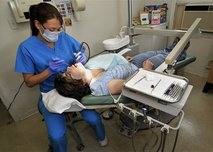
• A record 20 states placed restrictions on benefits, and 14 plan new restrictions next year. Arizona, California, Hawaii and Massachusetts eliminated some or all dental coverage. Other states limited medical imaging, therapies, supplies and personal care.

• Thirty-nine states cut or froze payments to hospitals, doctors and other service providers, and most plan another round next year. Medicaid payment rates are already so low that in many states it’s hard to find doctors who will accept the coverage. Yet 20 states lowered payments to doctors this year, and 12 plan to do so next year.

• Eighteen states placed limits on long-term care services, and 10 plan additional limits next year.

The recession officially ended in mid-2009, but the Kaiser study indicates its ill effects will take a while longer to wear off. Meanwhile, states will have to gear up for the major Medicaid expansion under the health care law.

“We’re on a teeter board,” said Carol Steckel, president of the National Association of Medicaid Directors, and head of Alabama’s program. “Every now and then that teeter board balances. But it’s going to be rare. There’s always something else.”

___

Online:

Kaiser Family Foundation: http://www.kff.org


Breaking News: A Big Step for Paycheck Fairness


Stop Discounting Women

A Big Step for Paycheck Fairness

Take Action

We need the Senate to pass Paycheck Fairness quickly once they return. Tell your Senators: Women Are Not WorthLess!

Take Action

We’ve reached an important moment in the Stop Discounting Women campaign — Senate Majority Leader Harry Reid has filed a cloture petition on the Paycheck Fairness Act — which is Washington-DC-speak for preparing a bill for a vote.

This is a huge opportunity for us. We started the campaign with the rallying cry “Women Are Not WorthLess” to bring attention to the 23% wage gap women face compared to their male counterparts. Our first goal was to help pass the Paycheck Fairness Act. And now, thanks to your support, the bill is not only set up for a vote, but it could be one of the first votes the Senate takes when it returns in November!

We need your help to make sure your Senators know that this bill is ripe for a vote when they come back and we need them to pass Paycheck Fairness quickly upon their return. Take action today by sending a quick e-mail message to your Senators.

In this tough economy, more and more families are counting on women’s earnings. Unfair pay practices make things even harder. The Paycheck Fairness Act would deter wage discrimination by closing loopholes in the Equal Pay Act and barring retaliation against workers who disclose their wages to coworkers.

Tell your Senators loud and clear that Women Are Not WorthLess.

Even if you have taken action before, we need you to do it again and again. November is just around the corner, and we need to keep the pressure on.

Thank you so much for all of your work.

Fatima Goss GravesSincerely,

Fatima Goss Graves
Vice President for Education and Employment
National Women’s Law Center

P.S. Your generous donation allows us to continue to stand up for women and their families. Support our work today.

Not waiting for Superman


The Whole Story:
Invaluable Influence

Watch and share this video about Chicago teacher Juan Romero, an everyday hero.

By now, you’ve probably heard about the documentary “Waiting for ‘Superman’” by filmmaker Davis Guggenheim. It tells the very moving stories of five children and their families as they seek better schools. Their stories demonstrate in a real and emotional way that the opportunity for a great public education should come not by chance or by choice, but by right.

Unfortunately, the movie is not just moving, but very misleading. The central themes of the movie—that all charter schools are good and all other public schools are bad, and that teachers and their unions are to blame for failing schools—are incomplete and inaccurate.

Our kids, parents and communities deserve the whole story. And so do our teachers.

We’re not waiting for Superman and neither should anyone else. Visit the AFT’s Not Waiting for Superman webpage at aft.org/NotWaiting to join the conversation on how we can help all children—not just some—get a great public education.

It’s clear we can’t rely on Hollywood to tell the whole story. Get the facts and help fill in the blanks.

And while you’re at it, remember to tell your friends and family the real story about today’s unions—working people working together for a better future.

Thanks,

AFL-CIO Working Families e-Activist Network