
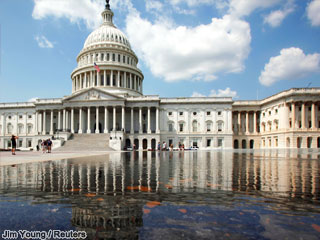
Congress: the Republican led House & -the Senate will both be back on 5/2


The Senate will convene at 2:00 p.mET May 2, 2011. 

Following any leader remarks, the Senate will proceed to a period of morning business for debate only until 4:30 p.m.

Following morning business, the Senate will consider the nominations of Roy Bale Dalton, of Florida, to be U.S. District Judge for the Middle District of Florida; and Kevin Hunter Sharp, of Tennessee, to be U.S. District Judge for the Middle District of Tennessee.

There will be one hour of debate equally divided and controlled between Senators Leahy and Grassley or their designees. Upon the use or yielding back of time, at approximately 5:30 p.m., the Dalton nomination will be confirmed by unanimous consent and the Senate will proceed to a roll call vote on the Sharp nomination.

~~~~~~~~~~~~~~~~~~~~~~~~~~~

The next meeting in the House is scheduled for 9:00 a.m. on April 15, 2011.

CURRENT HOUSE FLOOR PROCEEDINGS

LEGISLATIVE DAY OF APRIL 15, 2011

112TH CONGRESS – FIRST SESSION

3:26 P.M. –

On motion to adjourn Agreed to by voice vote.

The House adjourned pursuant to H. Con. Res. 43. The next meeting is scheduled for 2:00 p.m. on May 2, 2011.

Mr. Runyan moved that the House do now adjourn.

3:25 P.M. –

COMMISSION ON CIVIL RIGHTS – Pursuant to section 2 of the Civel Rights Commission Amendments Act of 1994 (42 U.S.C. 1975 Note), and the order of the House of January 5, 2011, and upon the recommendation of the Minority Leader, the Chair announced the Speaker’s reappointment of the following member on the part of the House to the Commission on Civil Rights for a term expiring December 15, 2016: Mr. Michael Yaki, San Francisoc, CA. The Chair announced that the term of appointment of Mr. Todd Gaziano to the Commission on Civil Rights expires on December 15, 2013.

2:33 P.M. –

SPECIAL ORDER SPEECHES – The House has concluded all anticipated legislative business and has proceeded to Special Order speeches.

2:28 P.M. –

ONE MINUTE SPEECHES – The House proceeded with furher one minute speeches.

UNITED STATES COAST GUARD ACADEMY – Pursuant to 14 U.S.C. 194, and the order of the House of January 5, 2011, the Speaker appointed Mr. Coble of North Carolina and Mr. Courtney of Connecticut to the United States Coast Guard Academy .

CANADA-UNITED STATES INTERPARLIAMENTARY GROUP – Pursuant to 22 U.S.C. 276(d), Clause 10 of Rule 1, and the order of the House of January 5, 2011, the Speaker appointed Mr. Manzullo of Illinois, Chairman, to the Canada-United States Interparliamentary Group .

2:27 P.M. –

UNITED STATES MERCHANT MARINE ACADEMY – Pursuant to 46 U.S.C. 51312(b), and the order of the House of January 5, 2011, the Speaker appointed Mr. King of New York and Mrs. McCarthy of New York to the United States Merchant Marine Academy .

MEXICO-UNITED STATES INTERPARLIAMENTARY GROUP – Pursuant to 22 U.S.C. 276(h), and the order of the House of January 5, 2011, the Speaker appointed Mr. Dreier of California, Chairman, and Mr. McCaul of Texas to the Mexico-United States Interparliamentary Group .

2:26 P.M. –

MIGRATORY BIRD CONSERVATION COMMISSION – Pursuant to section 2 of the Migratory Bird Conservation Act (16 U.S.C. 715a) and the order of the House of January 5, 2011, the Speaker appointed Mr. Wittman of Virgina and Mr. Dingell of Michigan to the Migratory Bird Conservation Commission .

COMMISSION ON CONGRESSIONAL MAILING STANDARDS – Pursuant to 2 U.S.C. 501(b), and the order of the House of January 5, 2011, the Speaker appointed Mr. Schock of Illinois, Chairman, Mr. Price of Georgia, Mr. Latta of Ohio, Mrs. Davis of California, Mr. Sherman of California, and Mr. Richmond of Louisiana to the Commission on Congressional Mailing Standards .

DWIGHT D. EISENHOWER MEMORIAL COMMISSION – Pursuant to 16 U.S.C. 431 Note, and the order of the House of January 5, 2011, the Speaker appointed Mr. Thornberry of Texas, Mr. Simpson of Idaho, and Mr. Boswell of Iowa to the Dwight D. Eisenhower Memorial Commission .

UNITED STATES HOLOCAUST MEMORIAL COUNCIL – Pursuant to 36 U.S.C. 2302, and the order of the House of January 5, 2011, the Speaker appointed Mr. Grimm of New York, Ms. Hayworth of New York, Mr. Meehan of Pennsylvania, Mr. Waxman of California, and Ms. Giffords of Arizona to the United States Holocaust Memorial Council .

2:25 P.M. –

BOARD OF REGENTS OF THE SMITHSONIAN INSTITUTION – Pursuant to sections 5580 and 5581 of the revised statutes (20 U.S.C. 42-43), and the order of the House of January 5, 2011, the Speaker appointed Mr. Becerra of California to the Board of Regents of the Smithsonian Institution .

2:24 P.M. –

Mr. Upton asked unanimous consent that the Committee on Energy and Commerce be permitted to file reports until April 27, 2011, on H.R. 1213, H.R. 1214, H.R. 1215, and H.R. 1216. Agreed to without objection.

2:23 P.M. –

On approving the Journal Agreed to by voice vote.

2:22 P.M. –

UNFINISHED BUSINESS – The Chair announced that the unfinished business was on the question of the Speaker’s approval of the Journal.

H. Con. Res. 34:

establishing the budget for the United States Government for fiscal year 2012 and setting forth appropriate budgetary levels for fiscal years 2013 through 2021

Motion to reconsider laid on the table Agreed to without objection.

On agreeing to the resolution Agreed to by the Yeas and Nays: 235 – 193 (Roll no. 277).

2:02 P.M. –

The previous question was ordered pursuant to the rule.

The House adopted the amendment in the nature of a substitute as agreed to by the Committee of the Whole House on the state of the Union.

2:01 P.M. –

The House rose from the Committee of the Whole House on the state of the Union to report H. Con. Res. 34.

1:12 P.M. –

GENERAL DEBATE – Pursuant to H. Res. 223, the Committee of the Whole proceeded with 20 minutes of general debate on H. Con. Res. 34.

1:11 P.M. –

On agreeing to the Van Hollen amendment Failed by recorded vote: 166 – 259 (Roll no. 276).

12:03 P.M. –

DEBATE – Pursuant to the provisions of H.Res. 223, the Committee of the Whole proceeded with 30 minutes of debate on the Van Hollen substitute amendment no. 5.

12:02 P.M. –

Amendment offered by Mr. Van Hollen.

A substitute amendment numbered 5 printed in Part B of House Report 112-62 to reduce deficits gradually to avoid disrupting the recovery and reaches primary balance by 2018 while protecting guarantees to seniors and investments that are essential for the well-being of our citizens. Would also make strategic investments in education, innovation, and infrastructure, while restraining the growth in overall discretionary spending. Would extend middle-income tax relief and streamlines the tax code to remove special interest tax breaks that distort economic activity.

11:58 A.M. –

On agreeing to the Garrett amendment Failed by recorded vote: 119 – 136, 172 Present (Roll no. 275).

11:35 A.M. –

On agreeing to the Grijalva amendment Failed by recorded vote: 77 – 347 (Roll no. 274).

11:11 A.M. –

UNFINISHED BUSINESS – The Chair announced that the unfinished business was the question on adoption of amendments which had been debated earlier and on which further proceedings had been postponed.

POSTPONED PROCEEDINGS – At the conclusion of debate on the Garrett substitute amendment, the Chair put the question on adoption of the amendment and by voice vote announced that the noes had prevailed. Mr. Garrett demanded a recorded vote and the Chair postponed further proceedings on the question of adoption of the amendment until in the legislative day.

10:31 A.M. –

DEBATE – Pursuant to the provisions of H.Res. 223, the Committee of the Whole proceeded with 30 minutes of debate on the Garrett(NJ) substitute amendment no. 4.

10:30 A.M. –

Amendment in the nature of a substitute offered by Mr. Garrett.

An substitute amendment numbered 4 printed in House Report 112=62 to establish a Fiscal Year 2012 budget and set the appropriate budgetary levels for Fiscal Year 2011 through 2021.

10:29 A.M. –

Subsequently, the Committee resumed it’s sitting.

10:28 A.M. –

The House received a message from the Senate. The Senate passed S. 216, and H.R. 1308. Senate agreed to H.Con. Res. 33 and H. Con. Res. 43.

H. Con. Res. 34:

establishing the budget for the United States Government for fiscal year 2012 and setting forth appropriate budgetary levels for fiscal years 2013 through 2021

The Committee of the Whole rose informally to receive a message from the Senate.

POSTPONED PROCEEDINGS – At the conclusion of debate on the Grijalva substitute amendment, the Chair put the question on adoption of the amendment and by voice vote announced that the noes had prevailed. Mr. Grijalva demanded a recorded vote and the Chair postponed further proceedings on the question of adoption of the amendment until in the legislative day.

10:04 A.M. –

WORDS TAKEN DOWN – During the course of debate, exception was taken to certain words used and a demand was made to have words taken down. Mr. Brooks asked unanimous consent to withdraw the words. Without objection the words were withdrawn. The Committee of the Whole resumed with debate on the Grijalva substitute amendment.

9:45 A.M. –

DEBATE – Pursuant to the provisions of H.Res. 223, the Committee of the Whole proceeded with 30 minutes of debate on the Grijalva substitute amendment no. 3.

9:44 A.M. –

Amendment in the nature of a substitute offered by Mr. Grijalva.

An substitute amendment numbered 3 printed in House Report 112-62 to eliminate the deficit by 2021, while putting America back to work, restoring America’s economic competitiveness, implementing a fair tax system, keeping Americans healthy and bringing our troops back home.

9:41 A.M. –

Subsequently, the Committee resumed its sitting.

9:40 A.M. –

The Committee of the Whole rose informally to receive a message from the Senate.

On agreeing to the Cleaver substitute amendment Failed by recorded vote: 103 – 303 (Roll no. 273).

9:16 A.M. –

The House resolved into Committee of the Whole House on the state of the Union for further consideration.

Considered as unfinished business.

9:02 A.M. –

ONE MINUTE SPEECHES – The House proceeded with one minute speeches which by direction of the Chair, would be limited to 5 per side of the aisle.

PLEDGE OF ALLEGIANCE – The Chair designated Mr. Cicilline to lead the Members in reciting the Pledge of Allegiance to the Flag.

POSTPONED PROCEEDINGS – The Chair announced that he had examined the Journal of the last day’s proceedings and had approved it. Mr. Poe (TX) demanded that the question be put on agreeing to the Speaker’s approval of the Journal and by voice vote, the Chair announced that the ayes had prevailed. Mr. Poe (TX) objected to the voice vote based upon the absence of a quorum and the Chair postponed further proceedings on the question of the Speaker’s approval of the Journal until later in the legislative day.

9:00 A.M. –

Today’s prayer was offered by the House Chaplain, Rev. Daniel Coughlin.

The Speaker designated the Honorable Jack Kingston to act as Speaker pro tempore for today.

The House convened, starting a new legislative day.

House Republicans have warped values


The budget is a blueprint of our nation’s values. Based on their proposal, the House Republicans have warped values.

The Ryan budget sums it up: destroy Medicare and leave seniors and people with disabilities to fend for themselves. They’d give huge tax cuts to billionaires and corporations while slashing the most basic services our fellow Americans rely upon.

President Obama said it exactly right yesterday: The Republican vision is dead wrong, and it’s not going to happen as long as he’s president – and as long as Democrats hold the Senate. Here’s where your help is urgently needed.

The DSCC has an FEC deadline on April 30, and we need to raise $245,000 to ensure we can maintain our majority. If the GOP had just 4 more seats, the Ryan budget would sail through Congress. It’s imperative that we stop them.

Help stop the radical Republicans with an immediate gift of $5 or more to the DSCC. More than 90 percent of our donations come from grassroots supporters. We CAN stop them, but not without your help!

President Obama outlined the stakes. In the past decade, the average income of 90% of working Americans dropped. On average, the top 1% are making an extra quarter million each. Yet Republicans demand tax cuts for them. Republicans would slash education, clean energy investments, and even the health care our parents rely on in order to shift more wealth to the extremely wealthy and corporations.

It’s not hard to see why. The Citizens United decision means that these same corporations can turn around and spend an unlimited amount in support of candidates. You can be sure that Republicans would be handsomely rewarded for the tax cut largesse.

If President Obama’s 2008 campaign taught us anything, however, it’s this: A million small voices aren’t so small when they speak out in unison. When we stand together – and invest in the beliefs we share – we can make a difference. We have, and we will.

Your gift of $5 or more right now will make a difference. Every dollar you give helps stop the radical Republican agenda and protect our Senate majority. We can stop them, but only if we work together.

Democrats have a vision – and it’s a vision entirely different than the bleak future Republicans have put forward. If you believe in our vision, I’m asking you to back it up. Let’s stand together and fight.

Sincerely,

Guy Cecil

Budget:A Better Path To Prosperity


As the nation edges closer to hitting the debt ceiling, President Obama delivered at George Washington University yesterday a new plan to reduce the deficit by $4.4 trillion over the next 12 years — a rebuttal to the GOP’s “Path to Prosperity” plan sponsored by House Budget Committee Chairman Paul Ryan (R-WI). Matching targeted spending cuts with less drastic entitlement reform and a more realistic tax policy, Obama’s plan, as Center for American Progress notes, “puts us on a much more sustainable path, and most importantly, would do so without putting further burdens on seniors and an already-struggling middle class.” While a big step away from his 2012 budget, Obama’s plan stands in stark contrast to Ryan’s “draconian” vision that gouges out the budget at their expense. Trading cuts and reforms that overly burden vulnerable populations for tax cuts for corporations and the wealthy, Ryan’s budget earned rebuke even from conservative economists. Former President Ronald Reagan’s budget director called it “a measure of how far off the deep end Republicans have gone.” Obama did not mince words when drawing the contrast between the GOP vision and his “compassionate” alternative. In response, House Republicans elected to decry what they saw as the president’s political, unfriendly treatment rather than offer the merits of their policy. Hearkening back to the 1995 government shutdown, Republicans are now hinting that Obama’s strong words might be enough to derail budget negotiations — no matter how valid the proposal.

OBAMA’S VISION: Rather than relying exclusively on deep spending cuts, President Obama’s deficit plan offers a framework to more responsibly reduce the deficit over the next 12 years through a multi-pronged approach. To achieve the $4 trillion in deficit reductions, Obama called for $2 trillion in spending cuts while maintaining “investments” in “schools, highways, bridges and research” that help maintain global competitiveness. However, aware of the ballooning defense budget, Obama also called to cut $400 billion from national security over 10 years — a move the GOP has specifically avoided. On entitlement programs, Obama asked both parties to “work together now to strengthen Social Security” and proposed saving $340 billion on Medicare and Medicaid by 2021 through increasing efficiency. “We will reduce wasteful subsidies and erroneous payments” and “cut spending on prescription drugs by using Medicare’s purchasing power to drive greater efficiency,” he said. In stark contrast to Ryan’s Medicare voucher plan, Obama’s Medicare plan builds on the cost containment reforms in the health care reform law by expanding IPAB, a 15-person commission tasked with advising Congress on how to reduce excess growth in Medicare if costs exceed GDP per capita plus one percent but will do so without rationing care or raising premiums or cost sharing. Obama’s clearest policy declaration, however, centered on his rebuke of the Bush-era tax cuts. “We cannot afford one trillion dollars in tax cuts for every millionaire and billionaire in our society. We can’t afford it. And I refuse to renew then again,” he said. Opting to move towards his fiscal commission’s policies, Obama plans to allow those tax cuts to expire at the end of 2012 and would raise an additional $1 trillion by overhauling the tax code to lower rates and eliminate tax breaks. And should all these deficit reduction efforts miss their targets, Obama called for a fail-safe “trigger mechanism ” that would force “across-the-board spending reductions if the ratio of debt-to-GDP is not stabilized by 2014 and projected to decline for the rest of the decade.” While Obama’s plan does propose significant cuts and misses opportunities to add additional revenues and find secure additional savings in the Pentagon budget, it provides a more “balanced” deficit plan than offered by the GOP. In response, U.S. bonds and the dollar rose based on hopes that Obama’s plan would “shore up the United States’ credit-worthiness and the dollar’s reserve status.” Oil recovered by 1.5 percent.

RYAN’S ‘PESSIMISTIC’ PLAN: A driving factor behind Obama’s plan was to provide a “compassionate” alternative to slash-and-burn Republican proposal offered last week. “This debate over budgets and deficits is about more than just numbers on a page,” Obama said. “It’s about the kind of future we want.” Dubbing Ryan’s plan as a “pessimistic” vision that “is less about reducing the deficit than it is about changing the basic social compact in America,” Obama blasted Republicans for implementing cuts that allow our infrastructure to “crumble” and “collapse” and, by slashing billions from Pell Grants, for telling “bright young Americans” that “we can’t afford” to support their education. He then lambasted Ryan’s Medicare voucher program for “end[ing] Medicare as we know it.” “Instead of guaranteed health care, you will get a voucher. And if that voucher isn’t worth enough to buy insurance, tough luck — you’re on your own,” he said. Indeed, according to the non-partisan CBO, seniors will end up paying significantly more for their health benefits if House Republicans have their way. He viewed the GOP’s plan to rob Medicaid of $771 billion over the next decade by turning it into a block grant program as a vision that tells 50 million Americans, including “poor children,” “middle-class families” with disabled children, and low-income seniors “to fend for themselves.” But “worst of all,” he said, was the Republican vision increase the burden on the vulnerable just so a corporate tax rate can be ten points lower and so we can “afford more than $1 trillion in new tax breaks for the wealthy.” Criticizing the tax break he’d receive while asking seniors to pay “$6,400” more in health costs, Obama said “that’s not right, and it’s not going to happen as long as I’m President.”

POLITICS OF WHINING: Invited to the address, House Republicans bristled under Obama’s rebuke and quickly rejected his plan as a “political broadside from the campaigner-in-chief.” Almost completely ignoring his policies, House Republicans took their turn at the podium to lambast the president for engaging in “partisan rhetoric .” House Majority Whip Kevin McCarthy (R-CA) insisted that Obama’s plan was “light on the specifics” but “didn’t lack shameless political attacks and scare tactics.” Ryan claimed Obama’s “demagoguery” was “exploiting people’s emotions of fear, envy, and anxiety.” Indeed, Ryan gave a detailed account of his hurt feelings, tracing them from “excited” to “naively optimistic” to “disappointed” then to “sad,” and hinted that Obama’s rebuke “sure doesn’t help” Republicans forge a budget consensus. Now “sincerely disappointed” at Obama’s “partisan broadsides against us,” Ryan is also suggesting that his hurt feelings will make it “that much harder for the two parties to come together with mutual respect of one another to get things done.” House Majority Leader Eric Cantor (R-VA), however, did offer House Republicans’ sole policy response: “We, as a conference, won’t raise taxes” on the wealthy.

The view from outside Washington


The President’s speech today began a new conversation in Washington about how to reduce the deficit while protecting crucial investments in our country’s future.

But as we seek to build an organization based outside of Washington, President Obama’s speech also provides an unusually stark contrast — one all of us can use to start conversations with our friends and neighbors about what’s at stake in this election.

He spoke about things you don’t generally hear in Washington conversations too often dominated by special interests: He’ll cut waste and excess at the Pentagon — particularly spending that is requested not by our military, but by politicians and corporate interests.

He’ll eliminate tax cuts for Americans in the highest tax brackets who don’t need them, including himself — and he will reform the individual tax code so that it’s fair and simple and so that the amount of taxes you pay isn’t determined by what kind of accountant you can afford.

Some cuts he proposed are tough. But they’re also smart and surgical — helping us balance our books while still doing the right things to win the future. President Obama’s plan would protect the middle class, invest in our kids’ education, and make sure we don’t protect the wealthiest Americans from the costs of reform at the expense of the most vulnerable.

The other side has presented a very clear alternative: End Medicare as we know it, privatizing the program that millions of seniors rely on for health care. Make deep cuts to education. Slash investments in clean energy and infrastructure. All to pay for tax cuts for people making over $250,000 a year, and all while actually raising our national debt.

In short, their plan will please a special interest donor base and those who put ideology before results rather than reduce deficits over the long term. And let’s be clear: They think they can get away with it because, fundamentally, they don’t think you’ll do anything about it.

That’s where I know we can prove them wrong. Because we can respond right now by building an organization that will stop them — not just in this deficit battle, but in the next election so they never have the chance to enact these proposals.

Here’s the first step. Join our fight for a deficit reduction plan that will actually reduce the deficit — with a goal of shared prosperity through shared responsibility. Add your name to support President Obama’s plan — and then help bring more people into the conversation:

www.barackobama.com