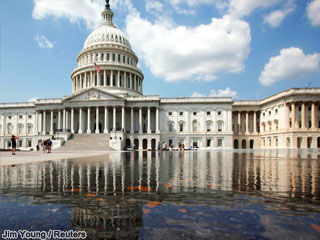
new polling … Jason Rosenbaum, DSCC Director of Online Communications


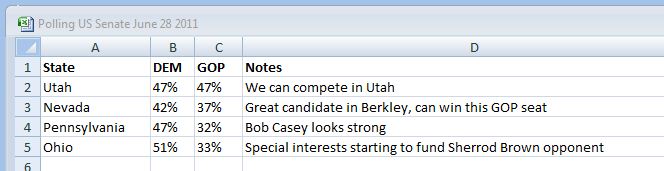
Hey, we’ve got some new polling that I wanted to show you:
Democrats are already competitive in two GOP-held seats, in UT and NV.
Democratic incumbents in OH and PA (Sherrod Brown and Bob Casey) look strong

GOP efforts to sabotage the economy for political gain are not paying off – yet. But Republicans are reading the same polls and writing big checks. Karl Rove’s group just made a $20 million ad buy in crucial swing states (including Nevada). We have no margin for error in 2012. If they flip just 4 Democratic seats, we lose the Senate.

Our FEC deadline 48 hours from now will help determine which states we can compete in, and which we must let go. We want to compete everywhere we’ve got a shot at victory. Your gift now can help make that happen. If we fall short, we’ll leave states on the table.

If everyone kicks in $5 we’ll have the $201,000 we need in the bank before midnight Thursday.

Thanks,

Jason Rosenbaum
DSCC Director of Online Communications

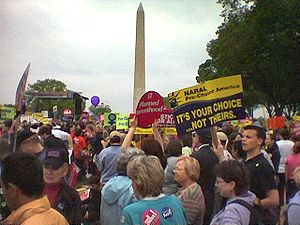
Tell President Obama: Stand Up for Women & Families in Budget Negotiatio​ns


Budget negotiations in Washington are at a critical point.

Republicans who want to slash programs for low-income people while rejecting any revenue increases are threatening to refuse to raise the debt ceiling — which must happen to avoid a fiscal crisis — unless they get their way.

President Obama needs to hear that women and families are counting on him to protect programs for low-income people.

You can help! Call 1-888-245-0215 to be connected to the White House comment line. In your message:State your name, where you’re from, and if you’re affiliated with a service provider or work with low-income people (though that is not necessary to call).
Then say: “Please tell the President and the Vice President to hold firm and insist that any deficit-reduction plan must protect programs for low-income people and not increase poverty. Women and their families shouldn’t bear the brunt of deficit reduction through cuts to critical programs like Medicaid, food stamps, child care and Head Start, and Pell grants. Increased revenues from those with the greatest ability to pay must be a major part of any deficit-reduction plan.”
Unless programs for low-income people are protected in the budget negotiations, women and their families will bear the brunt of deficit reduction. Women are more likely than men to be poor at all stages of their lives and their families disproportionately rely on programs designed to help low-income people. Maintaining and strengthening programs like Medicaid, food stamps, child care assistance, Head Start, and Pell grants protects vulnerable women and families today — and expands their opportunities for a better life.

Please ask President Obama and Vice President Biden to demand fair change in the budget negotiations. Dial 1-888-245-0215 today!

Sincerely,

Joan Entmacher
Vice President, Family Economic Security
National Women’s Law Center

Judy Waxman
Vice President for Health and Reproductive Rights
National Women’s Law Center

P.S. Please spread the word by forwarding this message to friends, family and colleagues.

Examining the impact of clean energy innovation …Official Google blog


Posted: 28 Jun 2011 04:00 AM PDT

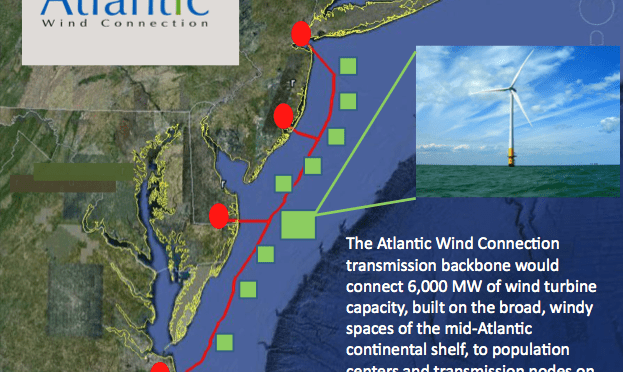
At Google, we’re committed to using technology to solve one of the greatest challenges we face as a country: building a clean energy future. That’s why we’ve worked hard to be carbon neutral as a company, launched our renewable energy cheaper than coal initiative and have invested in several clean energy companies and projects around the world.

But what if we knew the value of innovation in clean energy technologies? How much could new technologies contribute to our economic growth, enhance our energy security or reduce greenhouse gas (GHG) emissions? Robust data can help us understand these important questions, and the role innovation in clean energy could play in addressing our future economic, security and climate challenges.

Through Google.org, our energy team set out to answer some of these questions. Using McKinsey’s Low Carbon Economics Tool (LCET), we assessed the long-term economic impacts for the U.S. assuming breakthroughs were made in several different clean energy technologies, like wind, geothermal and electric vehicles. McKinsey’s LCET is a neutral, analytic set of interlinked models that estimates the potential economic and technology implications of various policy and technology assumptions.

The analysis is based on a model and includes assumptions and conclusions that Google.org developed, so it isn’t a prediction of the future. We’ve decided to make the analysis and associated data available everywhere because we believe it could provide a new perspective on the economic value of public and private investment in energy innovation. Here are just some of the most compelling findings:
Energy innovation pays off big: We compared “business as usual” (BAU) to scenarios with breakthroughs in clean energy technologies. On top of those, we layered a series of possible clean energy policies (more details in the report). We found that by 2030, when compared to BAU,  breakthroughs could help the U.S.:
Grow GDP by over $155 billion/year ($244 billion in our Clean Policy scenario)
Create over 1.1 million new full-time jobs/year (1.9 million with Clean Policy)
Reduce household energy costs by over $942/year ($995 with Clean Policy)
Reduce U.S. oil consumption by over 1.1 billion barrels/year
Reduce U.S. total carbon emissions by 13% in 2030 (21% with Clean Policy)
Speed matters and delay is costly: Our model found a mere five year delay (2010-2015) in accelerating technology innovation led to $2.3-3.2 trillion in unrealized GDP, an aggregate 1.2-1.4 million net unrealized jobs and 8-28 more gigatons of potential GHG emissions by 2050.
Policy and innovation can enhance each other: Combining clean energy policies with technological breakthroughs increased the economic, security and pollution benefits for either innovation or policy alone. Take GHG emissions: the model showed that combining policy and innovation led to 59% GHG reductions by 2050 (vs. 2005 levels), while maintaining economic growth.
This analysis assumed that breakthroughs in clean energy happened and that policies were put in place, and then tried to understand the impact. The data here allows us to imagine a world in which the U.S. captures the potential benefits of some clean energy technologies: economic growth, job generation and a reduction in harmful emissions. We haven’t developed the roadmap, and getting there will take the right mix of policies, sustained investment in technological innovation by public and private institutions and mobilization of the private sector’s entrepreneurial energies. We hope this analysis encourages further discussion and debate on these important issues.

Posted by Bill Weihl, Green Energy Czar, and Charles Baron, Google.org, Clean Energy Team

what’s going on in Congress -the Republican led House -the Senate


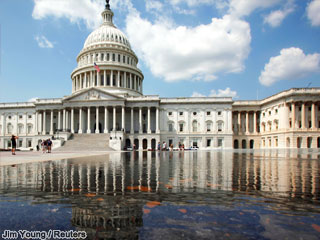
The Senate Convenes at 10amET June 28, 2011

  • Following any Leader remarks, the Senate will proceed to Executive Session
    to consider the following nominations, en bloc:

  • There will be 2 hours for concurrent debate on the nominations equally
    divided in the usual form. Upon the use or yielding back of time (at
    approximately 12:00pm), the Senate will proceed to up to 3 roll call votes on
    the nominations in the order listed.  Senators should be aware a roll call vote
    is expected on confirmation of the Cole nomination.  While roll call votes are
    possible on confirmation of the Monaco and Seitz nominations, we are hopeful the
    nominations can be confirmed by voice vote.
  • Following disposition of the Cole, Monaco, and Seitz nominations, the Senate
    will recess until 2:15pm for the weekly caucus meetings.
  • At 2:15pm, the Senate will resume consideration of S.679, the Presidential
    Appointment Efficiency and Streamlining Act.  We are working on an agreement to
    complete action on S.679.  Additional roll call votes are expected during
    Tuesday’s session of the Senate.
  • At approximately 12:10pm today, the Senate will conduct up to 3 roll call
    votes on confirmation of the following nominations:
  • Senators should be aware a roll call vote is expected on confirmation of the
    Cole nomination.  While roll call votes are possible on confirmation of the
    Monaco and Seitz nominations, we are hopeful the nominations can be confirmed by
    voice vote.
  •  The Senate confirmed the following nominations by voice vote on Tuesday, June
    28, 2011:

    • Calendar #145 Lisa O. Monaco, of the District of Columbia, to be an
      Assistant Attorney General
    • Calendar #110 Virginia A. Seitz, of the District of Columbia, to be an
      Assistant Attorney General
    • At  12:07pm The Senate began a roll call vote on confirmation of Executive Calendar
      #62 James Michael Cole, of the District of Columbia, to be Deputy Attorney
      General; Confirmed: 55-42  
    • At  6:04pm The Senate began a roll call vote on the Reid motion to instruct the
      Sergeant at Arms to request the presence of absent Senators.     
      • The Senate has reached the following agreement with respect to S.679, the
        Presidential Appointment Efficiency and Streamlining Act.  As a result of this
        agreement, Senators should expect a series of up to 5 roll call votes (but more
        likely 3 roll call votes)  beginning at approximately 11am on Wednesday, June
        29, 2011.
      • The following pending amendments will be agreed to by unanimous consent:
        • Akaka #512, as modified with the changes that are at the desk (Commissioner
          of the Administration for Native Americans);
        • Carper #517 (GAO report); and
        • Paul #503 (Director of the Mint)
        • Managers’ amendment, which is at the desk
      • At 11am on Wednesday, June 29th, the Senate will proceed to vote in relation
        to the remaining amendments to S.679 in the following order:

        • DeMint #501 (IMF bailouts)(60-vote threshold);
        • Portman-Udall(NM)-Cornyn #509, as modified with the changes that are at the
          desk (Comptrollers of Navy, Army, Air Force; Controller of OMB and department
          CFOs)(expected voice vote);
        • DeMint #511 (legislative & public affairs);
        • Toomey #514(strikes the provision relating to the Governors and alternate
          governors of the IMF and the International Bank for Reconstruction and
          Development)(expected voice vote);
      • Further, that the Cornyn amendment #504, McCain #493 and the Paul amendment
        #502 will be withdrawn; no amendments will be in order to any of the amendments
        prior to the votes.  Upon disposition of the amendments, the bill will be read a
        third time and the Senate proceed to a roll call vote on passage of the bill, as
        amended (60-vote threshold). There will be no motions or points of order in
        order to the bill or any of the amendments other than budget points of order and
        the applicable motions to waive.
      • Following disposition of S.679, the Senate will proceed to the consideration
        of S.Res.116, under the previous order.
      •  Discharged Foreign Relations and Adopted S.Res.185, a resolution reaffirming the
        commitment of the United States to a negotiated settlement of the
        Israeli-Palestinian conflict through direct Israeli-Palestinian negotiations.

~~~~~~~~~~~~~~~~~~~~~~~~~~~~~~~~~~~~~~~~~~~~~~~~~~

The next meeting is scheduled for 10:00 a.m. on June 28, 2011.

CURRENT HOUSE FLOOR PROCEEDINGS
LEGISLATIVE
DAY OF JUNE 28, 2011
112TH CONGRESS – FIRST SESSION

10:09 A.M. – The Speaker announced that the House do now adjourn. The next meeting is
scheduled for 10:00 a.m. on July 1, 2011.The House received a message from the Senate. The Senate passed H.R.
2279
and agreed to S. Con. Res. 15.

PLEDGE OF ALLEGIANCE – The Chair lead the members in reciting the Pledge of
Allegiance to the Flag.

The Speaker announced approval of the Journal. Pursuant to clause 1, rule I,
the Journal stands approved.

10:07 A.M. – Today’s prayer was offered by the House Chaplain, Rev. Patrick J. Conroy.The Speaker designated the Honorable Andy Harris to act as Speaker pro
tempore for today.

10:00 A.M. – The House convened, starting a new legislative day