
Daily Archives: 02/21/2013

PHOTO OF THE MONTH : National Geographic

by Diane Cook and Len Jenshel, from the March 2013 feature story “Night Gardens”
|
Witness the magic of nocturnal gardens, designed to flourish when the sun sets. In Japan the nighttime viewing of cherry blossoms in spring, like these at Kyoto’s Hirano Shrine, is a special event. |
Share this:

Laila Sapphira Williams, Greenpeace
 |
||
| Cameroon Indonesia Herakles Farm and Bruce Wrobel | ||
www.greenpeace.org
Industrial scale palm oil production is coming to Africa and it’s bad news for the rainforest of Cameroon. |
||


Share this:

Jobs V Loopholes
7 Tax Loopholes the GOP Loves to Love
In less than two weeks the very damaging across the board “sequester” cuts will kick in unless Republicans agree to a replacement that is a balanced compromise including both new revenues from closing tax loopholes and smarter, more targeted spending cuts.
When it was convenient for them to do so, Republicans including Speaker Boehner and Mitt Romney argued vociferously for closing loopholes and ending wasteful giveaways in the tax code. But now that push is coming to shove, these Republicans are refusing to help protect the economy and jobs by replacing the sequester cuts with new revenues from closing loopholes.
This intransigence has real consequences. As the president laid out yesterday, these cuts will cause pain:
So these cuts are not smart. They are not fair. They will hurt our economy. They will add hundreds of thousands of Americans to the unemployment rolls. This is not an abstraction — people will lose their jobs. The unemployment rate might tick up again.
Here’s a look at the top seven loopholes and giveaways that Republicans think are more important than protecting our economy, jobs, the middle class, and the most vulnerable among us:
- Extra tax breaks enjoyed by the wealthiest Americans — $520 BILLION
- Tax break for companies that ship jobs overseas — $168 BILLION
- Special tax breaks for the largest oil companies — $25 BILLION
- The loophole that allow people like Mitt Romney to pay a lower tax rate than middle-class workers — $21 BILLION
- Tax deductions for vacation homes and yachts — $10 BILLION
- The corporate jet loophole — $3 BILLION
- Special write-offs for horse breeders (aka the Bluegrass Boondoggle) — $126 MILLION
BOTTOM LINE: The Republicans are choosing to protect millionaires and special interests like Big Oil and Wall Street instead of funding our military and programs vital for the middle class and the health of our economy.
Evening Brief: Important Stories That You Might’ve Missed
Annals right-wing media failure: how a joke became an attack against Chuck Hagel.
Florida’s GOP governor will expand Medicaid under Obamacare.
Marco Rubio is no savior for women.
800.000 defense workers to be furloughed because of the sequester.
Fox News: Al Jazeera America is a plot to activate Muslim sleeper cells in Detroit.
Supporters of the Keystone XL tar sands pipeline outspend opponents 35 to 1.
The latest sneak attack on unions.
The science of addictive junk food.
How the sequester cuts hurt the long-term unemployed.
Share this:

An update on our war against account hijackers

Posted: 19 Feb 2013 09:00 AM PST
Have you ever gotten a plea to wire money to a friend stranded at an international airport? An oddly written message from someone you haven’t heard from in ages? Compared to five years ago, more scams, illegal, fraudulent or spammy messages today come from someone you know. Although spam filters have become very powerful—in Gmail, less than 1 percent of spam emails make it into an inbox—these unwanted messages are much more likely to make it through if they come from someone you’ve been in contact with before. As a result, in 2010 spammers started changing their tactics—and we saw a large increase in fraudulent mail sent from Google Accounts. In turn, our security team has developed new ways to keep you safe, and dramatically reduced the amount of these messages.
Spammers’ new trick—hijacking accounts To improve their chances of beating a spam filter by sending you spam from your contact’s account, the spammer first has to break into that account. This means many spammers are turning into account thieves. Every day, cyber criminals break into websites to steal databases of usernames and passwords—the online “keys” to accounts. They put the databases up for sale on the black market, or use them for their own nefarious purposes. Because many people re-use the same password across different accounts, stolen passwords from one site are often valid on others.
With stolen passwords in hand, attackers attempt to break into accounts across the web and across many different services. We’ve seen a single attacker using stolen passwords to attempt to break into a million different Google accounts every single day, for weeks at a time. A different gang attempted sign-ins at a rate of more than 100 accounts per second. Other services are often more vulnerable to this type of attack, but when someone tries to log into your Google Account, our security system does more than just check that a password is correct.

Legitimate accounts blocked for sending spam: Our security systems have dramatically reduced the number of Google Accounts used to send spam over the past few years
How Google Security helps protects your account Every time you sign in to Google, whether via your web browser once a month or an email program that checks for new mail every five minutes, our system performs a complex risk analysis to determine how likely it is that the sign-in really comes from you. In fact, there are more than 120 variables that can factor into how a decision is made.
If a sign-in is deemed suspicious or risky for some reason—maybe it’s coming from a country oceans away from your last sign-in—we ask some simple questions about your account. For example, we may ask for the phone number associated with your account, or for the answer to your security question. These questions are normally hard for a hijacker to solve, but are easy for the real owner. Using security measures like these, we’ve dramatically reduced the number of compromised accounts by 99.7 percent since the peak of these hijacking attempts in 2011.
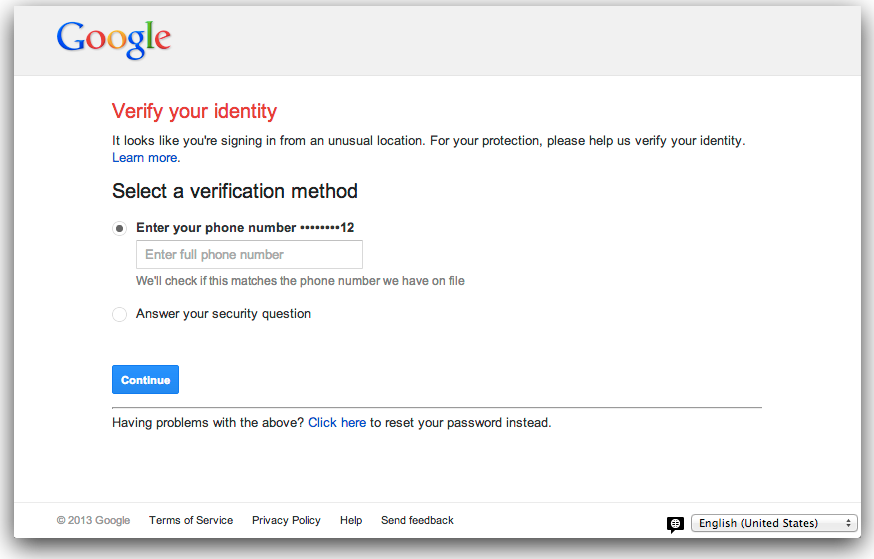
Help protect your account While we do our best to keep spammers at bay, you can help protect your account by making sure you’re using a strong, unique password for your Google Account, upgrading your account to use 2-step verification, and updating the recovery options on your account such as your secondary email address and your phone number. Following these three steps can help prevent your account from being hijacked—this means less spam for your friends and contacts, and improved security and privacy for you.
Posted by Mike Hearn, Google Security Engineer


 Be a Seed for Change
You must be logged in to post a comment.