
image: internet

The Twenty-Seventh Amendment has one of the most unusual histories of any amendment ever made to the U.S. Constitution. Congress passed the Twenty-Seventh Amendment by a two-thirds vote of both Houses, in 1789, along with eleven other proposed constitutional amendments (the last ten of which were ratified by the states in 1791, becoming the Bill of Rights). The Amendment provides that: “No law, varying the compensation for the services of the Senators and Representatives, shall take effect, until an election of representatives shall have intervened.”
During the Philadelphia Constitutional Convention, congressional pay was a central topic, one that took up several days of discussion. Benjamin Franklin’s initial speech to the Convention was on the topic of public salaries: he was against them. Public servants should not get paid at all, Franklin argued, or we would get representatives with “bold and the violent” personalities, engaged in “selfish pursuits.” Franklin’s extreme argument did not prevail because the Framers wisely did not want only the wealthy to be able to afford to hold federal offices. This is a very good thing.
For more constitutioncenter.org

posted by M. Swift
May 17, 1881: Frederick Douglass Becomes Recorder of Deeds for Washington D.C. 1. On this day in Black history, orator and abolitionist, Frederick Douglass became the first recorder of deeds for Washington D.C. In the years prior to taking the position, Douglass was very active with his speeches and writing.
for the complete article … blackthen.com
blackthen.com/may-17-1881-frederick-douglass-becomes-recorder-deeds-washington
The first Senate vote in the impeachment of President Andrew Johnson was taken on May 16, 1868. Article XI was called the “omnibus article” because it combined all of the charges against the President. As a result of 19 voting “Not Guilty” and 35 voting “Guilty,” the Senate fell 1 vote short of the two-thirds majority required for removal. After a 10-day recess, the Senate reconvened and voted on Articles II and III. In each case, the result was identical: Johnson was not guilty by a single vote. The Senate then voted to end the trial.
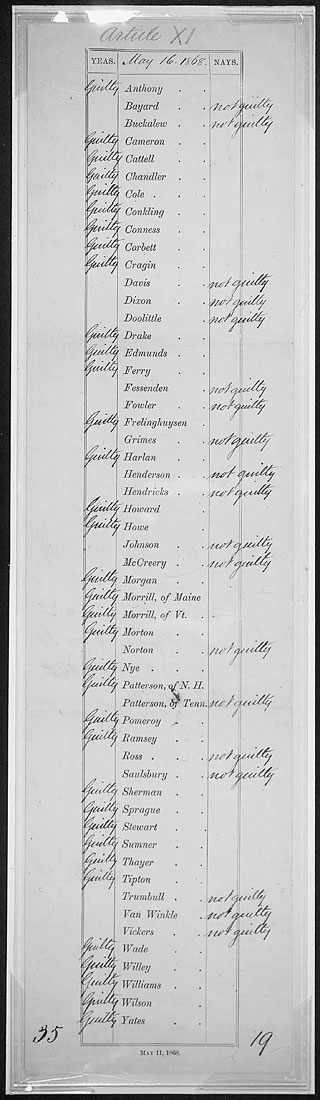
In the 1868 Johnson impeachment trial, the embattled president was just one vote away from being removed from office on each of the three charges put to a vote. There were 11 total articles of impeachment, but the Senate voted to adjourn the trial when it was clear that the voting would be the same for each remaining charge.


You must be logged in to post a comment.