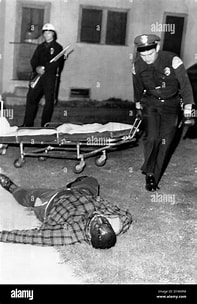
New Riot in Watts Kills 2, Injures 25; 200 Police Quiet Negro Teen-Agers; 2 Are Killed and 25 Injured as Negro Teen-Agers Riot in Watts District. 200 POLICE QUIET LOS ANGELES AREA But Officer Warns It Could ‘Flare Up in a Second’ Guard on Standby Alert
LOS ANGELES, March 15 Hundreds of Negro teen-agers rioted this afternoon in Watts, the same poor section of the city that was torn by racial disorders last summer. Two men were killed and at least 25 were injured. VIEW FULL ARTICLE IN TIME MACHINE
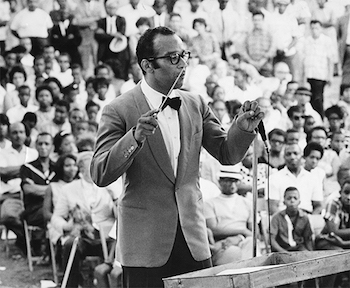
In 1968, 36-year-old Henry Lewis makes history when he is chosen, over more than 150 other candidates, as the first Black conductor of a major U.S. orchestra: the New Jersey Symphony. It marks just one highlight in a barrier-breaking career that prompted The New York Times to liken him to Jackie Robinson of classical music.
Under Lewis’ musical direction, the Newark, N.J.-based NJSO transformed from a regional ensemble that gave around two dozen performances annually into a large-scale, nationally recognized orchestra that performed 100 concerts a year. It went from playing in the shadow of New York City to performing at some of the nation’s most prestigious concert halls, including the Kennedy Center and Carnegie Hall.
With the symphony based in Newark, a city that had been wracked by racial unrest and rioting the year before he arrived, Lewis dedicated himself to making the orchestra—and classical music—accessible to underserved audiences. Concert tickets sold for as little as $1. And under his direction, the NJSO brought performances out of the concert hall and into local schools and community centers. Lewis continued his position as the musical director and conductor until 1976.
The Source and complete article can be found: history.com
James Mercer Langston Hughes was born February 1, 1902, in Joplin, Missouri. His parents divorced when he was a young child, and his father moved to Mexico. He was raised by his grandmother until he was thirteen, when he moved to Lincoln, Illinois, to live with his mother and her husband, before the family eventually settled in Cleveland, Ohio. It was in Lincoln that Hughes began writing poetry. After graduating from high school, he spent a year in Mexico followed by a year at Columbia University in New York City. During this time, he held odd jobs such as assistant cook, launderer, and busboy. He also travelled to Africa and Europe working as a seaman. In November 1924, he moved to Washington, D. C. Hughes’s first book of poetry, The Weary Blues, (Knopf, 1926) was published by Alfred A. Knopf in 1926. He finished his college education at Lincoln University in Pennsylvania three years later. In 1930 his first novel, Not Without Laughter, (Knopf, 1930) won the Harmon gold medal for literature.
Hughes, who claimed Paul Lawrence Dunbar, Carl Sandburg, and Walt Whitman as his primary influences, is particularly known for his insightful, colorful portrayals of black life in America from the twenties through the sixties. He wrote novels, short stories and plays, as well as poetry, and is also known for his engagement with the world of jazz and the influence it had on his writing, as in his book-length poem Montage of a Dream Deferred (Holt, 1951). His life and work were enormously important in shaping the artistic contributions of the Harlem Renaissance of the 1920s. Unlike other notable black poets of the period—Claude McKay, Jean Toomer, and Countee Cullen—Hughes refused to differentiate between his personal experience and the common experience of black America. He wanted to tell the stories of his people in ways that reflected their actual culture, including both their suffering and their love of music, laughter, and language itself.
The critic Donald B. Gibson noted in the introduction to Modern Black Poets: A Collection of Critical Essays (Prentice Hall, 1973) that Hughes “differed from most of his predecessors among black poets . . . in that he addressed his poetry to the people, specifically to black people. During the twenties when most American poets were turning inward, writing obscure and esoteric poetry to an ever decreasing audience of readers, Hughes was turning outward, using language and themes, attitudes and ideas familiar to anyone who had the ability simply to read . . . Until the time of his death, he spread his message humorously—though always seriously—to audiences throughout the country, having read his poetry to more people (possibly) than any other American poet.”
Langston Hughes died of complications from prostate cancer in May 22, 1967, in New York City. In his memory, his residence at 20 East 127th Street in Harlem has been given landmark status by the New York City Preservation Commission, and East 127th Street has been renamed “Langston Hughes Place.”
In addition to leaving us a large body of poetic work, Hughes wrote eleven plays and countless works of prose, including the well-known “Simple” books: Simple Speaks His Mind, (Simon & Schuster, 1950); Simple Stakes a Claim, (Rinehart, 1957); Simple Takes a Wife, (Simon & Schuster, 1953); and Simple’s Uncle Sam (Hill and Wang, 1965). He edited the anthologies The Poetry of the Negro and The Book of Negro Folklore, wrote an acclaimed autobiography, The Big Sea (Knopf, 1940), and cowrote the play Mule Bone (HarperCollins, 1991) with Zora Neale Hurston.
Selected Bibliography
Poetry
Collected Poems of Langston Hughes (Knopf, 1994) The Panther and the Lash: Poems of Our Times (Knopf, 1967) Ask Your Mama: 12 Moods for Jazz (Knopf, 1961) Montage of a Dream Deferred (Holt, 1951) One-Way Ticket (Knopf, 1949) Fields of Wonder (Knopf, 1947) Freedom’s Plow (Musette Publishers, 1943) Shakespeare in Harlem (Knopf, 1942) The Dream Keeper and Other Poems (Knopf, 1932) Scottsboro Limited (The Golden Stair Press, 1932) Dear Lovely Death (Troutbeck Press, 1931) Fine Clothes to the Jew (Knopf, 1927) The Weary Blues (Knopf, 1926)
Prose
Remember Me to Harlem: The Letters of Langston Hughes and Carl Van Vechten, 1925-1964 (Knopf, 2001) The Arna Bontemps-Langston Hughes Letters (Dodd, Mead, 1980) Good Morning, Revolution: Uncollected Social Protest Writings by Langston Hughes (Hill, 1973) Simple’s Uncle Sam (Hill and Wang, 1965) Something in Common and Other Stories (Hill and Wang, 1963) Tambourines to Glory (John Day, 1958) Simple Stakes a Claim (Rinehart, 1957) I Wonder as I Wander (Rinehart, 1956) Laughing to Keep From Crying (Holt, 1952) Simple Takes a Wife (Simon & Schuster, 1953) Simple Speaks His Mind (Simon & Schuster, 1950) The Ways of White Folks (Knopf, 1934) Not Without Laughter (Knopf, 1930)
Drama
Collected Works of Langston Hughes, vol. 5: The Plays to 1942: Mulatto to The Sun Do Move (University of Missouri Press, 2000) The Political Plays of Langston Hughes (Southern Illinois University Press, 2000) Mule Bone (HarperCollins, 1991) Five Plays by Langston Hughes (Indiana University Press, 1963)
Poetry in Translation
Cuba Libre (Anderson & Ritchie, 1948) Selected Poems of Gabriela Mistral (Indiana University Press, 1957)
Four men dressed as police officers enter gangster Bugs Moran’s headquarters on North Clark Street in Chicago, line seven of Moran’s henchmen against a wall, and shoot them to death. The St. Valentine’s Day Massacre, as it is now called, was the culmination of a gang war between …read more
There’s great news today in the case of Kelley Williams-Bolar, the Ohio mother who was convicted of a felony after allegedly misleading authorities and sending her children to a school outside her district. We just learned that Ohio GovernorJohn Kasich granted Williams-Bolar executive clemency, reducing her convictions from felonies to misdemeanors. Gov. Kasich took this action despite the fact that Friday, the Ohio parole board made a unanimous recommendation against any form of clemency.
This is a huge victory, and it wouldn’t have happened without the activism of ColorOfChange members, and our friends at Change.org and MomsRising.org:
When we first learned of the case in February, more than 67,000 ColorOfChange members called on Gov. Kasich to take a public stand and commit to pardoning Williams-Bolar.
We delivered your signatures to Gov. Kasich’s office, along with thousands more from Change.org and MomsRising.org — more than 165,000 signatures in all. The next day, Gov. Kasich responded to the public pressure by asking the state’s parole board to review Williams-Bolar’s case.
On Friday, Ohio’s parole board finally came back with a recommendation for the Governor — to deny Williams-Bolar a pardon.
In response to the parole board’s recommendation, many of you swung into action this week, calling Gov. Kasich’s office and urging him to issue Williams-Bolar a pardon anyway. Today, Gov. Kasich announced that he would reduce Williams-Bolars felony convictions to first-degree misdemeanors.
Williams-Bolar will still be on probation and will need to complete 80 hours of community service; but she won’t have a felony conviction following her for the rest of her life, limiting her opportunities. Thanks for getting involved — without your voice, things could have turned out much differently for Kelley Williams-Bolar. You should be proud.
At ColorOfChange, we’ll continue to fight to end inequality in education and the criminal justice system, we hope you’ll continue to be there with us. Remember, our work is powered by you, our members. If you can support our work financially, in any amount, please click the link below.
— Rashad, James, Gabriel, William, Dani, Matt, Natasha and the rest of the ColorOfChange.org team
September 7th, 2011
Help support our work. ColorOfChange.org is powered by YOU—your energy and dollars. We take no money from lobbyists or large corporations that don’t share our values, and our tiny staff ensures your contributions go a long way. You can contribute here:







 Be a Seed for Change
You must be logged in to post a comment.