
On May 12, 1972, Mexican-American labor organizer and civil rights activist Cesar Chavez begins a hunger strike. The strike, which he undertook in opposition to an Arizona law severely restricting farm workers’ ability to organize, lasted 24 days and drew national attention to the …read more
Monthly Archives: May 2026

history… may 12

1588 – King Henry III fled Paris after Henry of Guise triumphantly entered the city.
1780 – Charleston, South Carolina fell to British forces.
1847 – William Clayton invented the odometer.
1870 – Manitoba entered the Confederation as a Canadian province.
1881 – Tunisia, in North Africa became a French protectorate.
1885 – In the Battle of Batoche, French Canadians rebelled against the Canadian government.
1888 – Charles Sherrill of the Yale track team became the first runner to use the crouching start for a fast break in a foot race.
1926 – The airship Norge became the first vessel to fly over the North Pole.
1926 – In Britain, a general strike by trade unions ended. The strike began on May 3, 1926.
1937 – Britain’s King George VI was crowned at Westminster Abbey.
1940 – The Nazi conquest of France began with the German army crossing Muese River.
1942 – The Soviet Army launched its first major offensive of World War II and took Kharkov in the eastern Ukraine from the German army.
1943 – The Axis forces in North Africa surrendered during World War II.
1949 – The Soviet Union announced an end to the Berlin Blockade.
1950 – The American Bowling Congress abolished its white males-only membership restriction after 34 years.
1957 – A.J. Foyt won his first auto racing victory in Kansas City, MO.
1965 – West Germany and Israel exchanged letters establishing diplomatic relations.
1970 – Ernie Banks, of the Chicago Cubs, hit his 500th home run.
1975 – U.S. merchant ship Mayaguez was seized by Cambodian forces in international waters.
1978 – The National Oceanic and Atmospheric Administration announced that they would no longer exclusively name hurricanes after women.
1982 – South Africa unveiled a plan that would give voting rights to citizens of Asian and mixed-race descent, but not to blacks.
1984 – South African prisoner Nelson Mandela saw his wife for the first time in 22 years.
1999 – Russian President Boris Yeltsin dismissed Prime Minister Yevgeny Primakov and named Interior Minister Sergei Stepashin as his successor.
2002 – Former U.S. President Carter arrived in Cuba for a visit with Fidel Castro. It was the first time a U.S. head of state, in or out of office, had gone to the island since Castro’s 1959 revolution.
2003 – In Texas, fifty-nine Democratic lawmakers went into hiding over a dispute with Republican’s over a congressional redistricting plan.
2008 – In the U.S., the price for a one-ounce First-Class stamp increased from 41 to 42 cents.
2015 – It was announced that Verizon would be acquiring AOL.
Source: on-this-day.com
Share this:

1994 – Nelson Mandela was chosen to be South Africa’s first black president.

1994 – Nelson Mandela, South Africa’s first Black president, is inaugurated
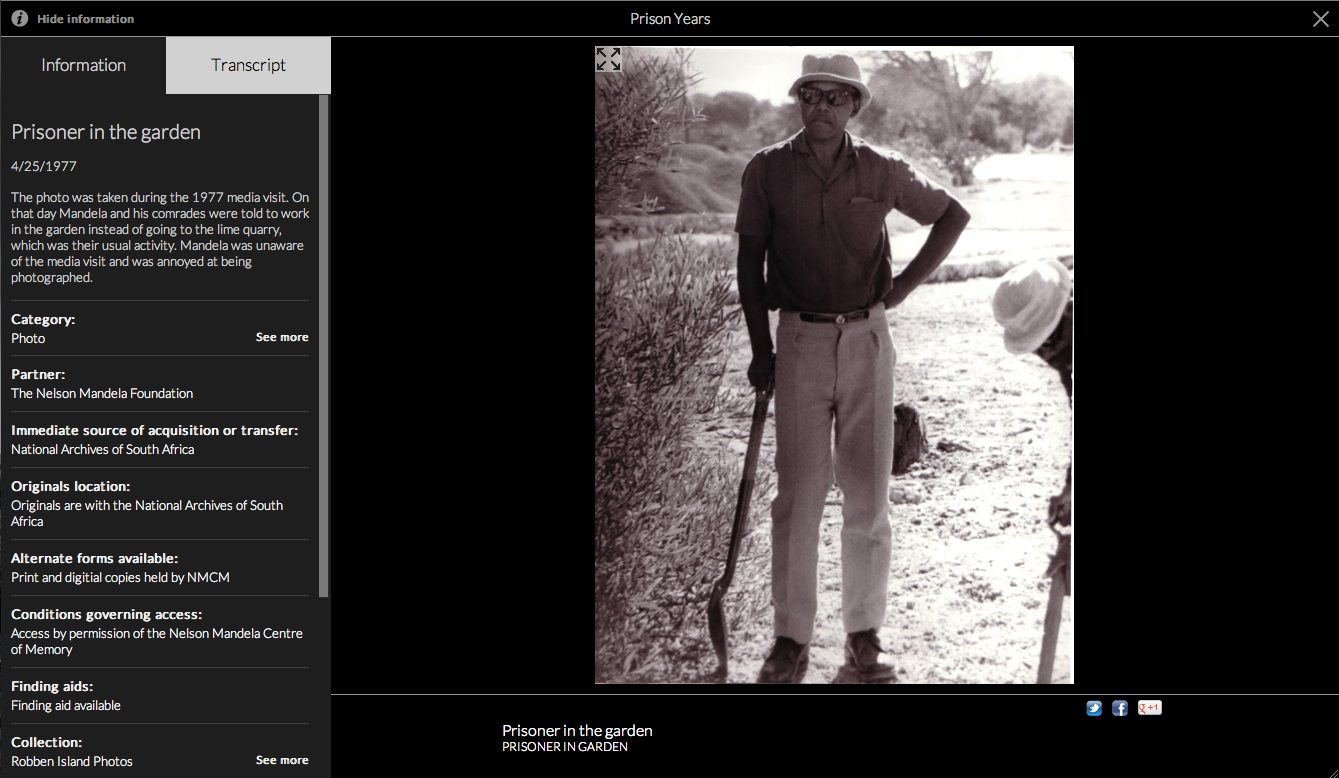
In South Africa, Nelson Rolihlahla Mandela is sworn in as the first Black president of South Africa. In his inaugural address, Mandela, who spent 27 years of his life as a political prisoner of the South African government, declared that “the time for the healing of the wounds …read more
Share this:

on this day 5/10

1503 – Christopher Columbus discovered the Cayman Islands.
1676 – Bacon’s Rebellion, which pits frontiersmen against the government, began.
1768 – The imprisonment of the journalist John Wilkes as an outlaw provoked violence in London. Wilkes was returned to parliament as a member for Middlesex.
1773 – The English Parliament passed the Tea Act, which taxed all tea in the U.S. colonies.
1774 – Louis XVI ascended the throne of France.
1775 – Ethan Allen and Colonel Benedict Arnold led an attack on the British Fort Ticonderoga and captured it from the British.
1796 – Napoleon Bonaparte won a brilliant victory against the Austrians at Lodi bridge in Italy.
1840 – Mormon leader Joseph Smith moved his band of followers to Illinois to escape the hostilities they had experienced in Missouri.
1857 – The Seepoys of India revolted against the British Army.
1865 – Confederate President Jefferson Davis was captured by Union troops near Irvinville, GA.
1869 – Central Pacific and Union Pacific Rail Roads meet in Promontory, UT. A golden spike was driven in at the celebration of the first transcontinental railroad in the U.S.
1872 – Victoria Woodhull became the first woman nominated for the U.S. presidency.
1876 – Richard Wagner’s “Centennial Inaugural March” was heard for the first time at the Centennial Exposition in Philadelphia, PA.
1898 – A vending machine law was enacted in Omaha, NE. It cost $5,000 for a permit.
1908 – The first Mother’s Day observance took place during a church service in Grafton, West Virginia.
1924 – J. Edgar Hoover was appointed head of the Federal Bureau of Investigation.
1927 – The Hotel Statler in Boston, MA. became the first hotel to install radio headsets in each of its 1,300 rooms.
1928 – WGY-TV in Schenectady, NY, began regular television programming.
1930 – The Adler Planetarium opened to the public in Chicago, IL.
1933 – The Nazis staged massive public book burnings in Germany.
1940 – Germany invaded Belgium, France, the Netherlands, and Luxembourg.
1941 – England’s House of Commons was destroyed by a German air raid.
1941 – Rudolf Hess, Adolf Hitler’s deputy, parachuted into Scotland on what he claimed was a peace mission.
1942 – U.S. forces in the Philippines began to surrender to the Japanese.
1943 – U.S. troops invaded Attu in the Aleutian Islands to expel the Japanese.
1960 – The U.S.S. Triton completed the first circumnavigation of the globe under water. The trip started on February 16.
1962 – Marvel Comics published the first issue of “The Incredible Hulk.”
1968 – Preliminary Vietnam peace talks began in Paris.
1969 – The National and American Football Leagues announced their plans to merge for the 1970-71 season.
1978 – Britain’s Princess Margaret and the Earl of Snowdon announced they were divorcing after 18 years of marriage.
1982 – Elliott Gould made his dramatic television debut after 30 movies in 17 years. He starred in “The Rules of Marriage” on CBS-TV.
1986 – Navy Lt. Commander Donnie Cochran became the first black pilot to fly with the Blue Angels team.
1994 – Nelson Mandela was sworn in as South Africa’s first black president.
1997 – An earthquake in northeastern Iran killed at least 2,400 people.
1999 – China broke off talks on human rights with the U.S. in response to NATO’s accidental bombing of the Chinese Embassy in Yugoslavia.
1999 – The Cezanne painting “Still Life With Curtain, Pitcher and Bowl of Fruit” sold for 60.5 million.
2000 – 11,000 residents were evacuated in Los Alamos, NM, due to a fire that was blown into a canyon. The fire had been deliberately set to clear brush.
2001 – Boeing Co. announced that it would be moving its headquarters to Chicago, IL.
2001 – In Ghana, 121 people were killed in a stampede at a soccer game.
2002 – Robert Hanssen was sentenced to life in prison with no chance for parole. Hanssen, an FBI agent, had sold U.S. secrets to Moscow for $1.4 million in cash and diamonds.
2002 – Taiwan test fired a locally made Sky Bow II surface-to-air missile for the first time. They also fired three U.S.-made Hawk missiles.
2002 – Dr. Pepper announced that it would be introducing a new flavor, Red Fusion, for the first time in 117 years.
2011 – It was announced that Microsoft had closed a deal to purchase the internet phone service Skype for $8.5 billion.
2013 – In New York, NY, crane operators hoisted the final pieces of the spire atop One World Trade Center (formerly called the Freedom Tower).


You must be logged in to post a comment.