Tag Archives: United State

NMAAHC Brings “Treasures​” to Houston on October 29 …National Museum of African American History and Culture


National Museum of African American History and Culture

National Museum of
African American History and Culture
Brings “Treasures” to Houston October 29
The Smithsonian’s National Museum of African American History and Culture and the Houston Public Library will co-host a program to help Houston-area residents identify and preserve items of historical and cultural significance tucked away in the attics, closets and basements of their homes. The freeevent will feature presentations, hands-on activities and preservation tips.The program will take place Saturday, Oct. 29, from 10 a.m. to 4 p.m., at the Houston Public Library Central Library, 500 McKinney Street, Houston. Free and open to the public, the event is the 11th in a series from the museum’s signature program “Save Our African American Treasures: A National Collections Initiative of Discovery and Preservation.” All are welcome.

Save Our African American Treasures in Indianola, MS
National Museum of African American History and Culture’s
“Save Our African American Treasures” program in
Indianola, MS in September 2011.
Photo Credit: Michael Barnes, Smithsonian Institution.

Participants may bring up to three personal items for a 20-minute, one-on-one professional consultation with experts on how to care for them. The specialists will serve as reviewers, not appraisers, and will not determine an item’s monetary value. Objects such as books, paper and textiles that are no larger than a shopping bag can be reviewed. No furniture, carpets, firearms or paintings are allowed. Additional information is available at nmaahc.si.edu, by emailing treasures@si.edu or by calling (877) 733-9599.

The “Treasures” program also includes the following activities throughout the day:

  • The Gregory School: The African American Library at the Gregory School is the newest special collections unit operated by the Houston Public Library. Learn how it developed and about the unique collections and services it provides.
  • Preservation Presentations: Informal basic preservation sessions will take place during the day. The sessions will provide information on preserving clothing and textiles, family photographs and papers, digital memories and explain the process to establish an object’s provenance. Participants will have the opportunity to ask questions.
  • Hands-on Preservation: In this hands-on activity, participants are invited to learn how to store letters properly, pack garments and prepare photographs for preservation storage and presentation.

As a companion to the series, the museum has produced African American Treasures: A Preservation Guide, a 30-page guidebook that is distributed free to attendees to highlight the importance of proper preservation techniques. The guidebook is part of the “Treasures” kit. Also distributed will be white cotton gloves, archival tissue papers and archival documents sleeves to help people keep their personal treasures safe.

Save Our African American Treasures in Dalllas, TX
National Museum of African American History and Culture’s
“Save Our African American Treasures” program in
Dallas, TX in June 2011.
Photo Credit: Michael Barnes, Smithsonian Institution.

“Save our African American Treasures” is made possible with support from the Bank of America Charitable Foundation and the W.K. Kellogg Foundation. The grants also support the pre-design and construction of the museum on the National Mall in Washington, D.C., scheduled to open in 2015.

For more information about The National Museum of African American History and Culture, visit nmaahc.si.edu or call Smithsonian information at (202) 633-1000, (202) 633-5285 (TTY).

For further information about the Houston Public Library please visit www.houstonlibrary.org or call 832-393-1313.

Quote of the Day …


“The people of Texas are informed that in accordance with a Proclamation from the Executive of the United States, all slaves are free. This involves an absolute equality of rights and rights of property between former masters and slaves, and the connection heretofore existing between them became that between employer and free laborer.”

Audubon day … April 26


Birds of America
April 26 is
Audubon daymockingbird

by Slayer

John James Audubon (1785-1851) was America’s foremost ornithological illustrator. After studying drawing in Paris under the French painter Jacques Louis David, Audubon struggled for many years to make a living from his art, shuttling back and forth between Europe and the United States and supplementing his income by giving drawing lessons, turning out portraits, playing the flute or violin at local dances, and at one time running a general store.

In 1820 he began a flatboat excursion down the Mississippi River to seek out new varieties of birds to paint. Eventually he had enough bird portraits to publish in book form. Birds of America, produced with the help of engraver Robert Havell, Jr., contains 435 hand-colored plates and was published in “elephant folio” format to accommodate the life-sized portrayals of birds on which Audubon insisted.

After his death in 1851, Audubon’s wife Lucy returned to teaching to support herself. One of her students, George Bird Grinnell, became the editor of Forest and Stream magazine and in 1886 organized the Audubon Society for the study and protection of birds. Today there are many branches of this organization, known as the National Audubon Society, and it remains dedicated to the conservation of wildlife and natural resources. Its members honor Audubon on his birthday, April 26. In some states, Audubon Day and Arbor Day are celebrated together by planting trees in bird sanctuaries.

Read more: http://www.answers.com/topic/audubon-day#ixzz1t9SHCcAV

On this day: March 31, 1889


ParisOriginally intended as a temporary installation, the Eiffel Tower has become one of the most enduring symbols of France and the industrial age.

On March 31, 1889, the Eiffel Tower is dedicated in Paris in a ceremony presided over by Gustave Eiffel, the tower’s designer, and attended by French Prime Minister Pierre Tirard, a handful of other dignitaries, and 200 construction workers.

In 1889, to honor of the centenary of the French Revolution, the French government planned an international exposition and announced a design competition for a monument to be built on the Champ-de-Mars in central Paris. Out of more than 100 designs submitted, the Centennial Committee chose Eiffel’s plan of an open-lattice wrought-iron tower that would reach almost 1,000 feet above Paris and be the world’s tallest man-made structure. Eiffel, a noted bridge builder, was a master of metal construction and designed the framework of the Statue of Liberty that had recently been erected in New York Harbor.

Eiffel’s tower was greeted with skepticism from critics who argued that it would be structurally unsound, and indignation from others who thought it would be an eyesore in the heart of Paris. Unperturbed, Eiffel completed his great tower under budget in just two years. Only one worker lost his life during construction, which at the time was a remarkably low casualty number for a project of that magnitude. The light, airy structure was by all accounts a technological wonder and within a few decades came to be regarded as an architectural masterpiece.

The Eiffel Tower is 984 feet tall and consists of an iron framework supported on four masonry piers, from which rise four columns that unite to form a single vertical tower. Platforms, each with an observation deck, are at three levels. Elevators ascend the piers on a curve, and Eiffel contracted the Otis Elevator Company of the United States to design the tower’s famous glass-cage elevators.

The elevators were not completed by March 31, 1889, however, so Gustave Eiffel ascended the tower’s stairs with a few hardy companions and raised an enormous French tricolor on the structure’s flagpole. Fireworks were then set off from the second platform. Eiffel and his party descended, and the architect addressed the guests and about 200 workers. In early May, the Paris International Exposition opened, and the tower served as the entrance gateway to the giant fair.

The Eiffel Tower remained the world’s tallest man-made structure until the completion of the Chrysler Building in New York in 1930. Incredibly, the Eiffel Tower was almost demolished when the International Exposition’s 20-year lease on the land expired in 1909, but its value as an antenna for radio transmission saved it. It remains largely unchanged today and is one of the world’s premier tourist attractions.

http://www.history.com

Social Security …


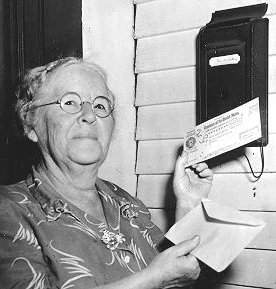
Ida May Fuller (b. September 6, 1874 – d. January 31, 1975) was the first American to receive a monthly benefit Social Security check. She received the check, amounting to $22.54, on January 31, 1940.

America is a community. We look out for each other as a nation. We build schools for our children, fund police for our safety and provide a secure retirement for our grandparents.  We don’t toss aside our seniors when they need our help the most. Instead, each generation of American workers invests in the Social Security Trust Fund under the guarantee that someday when they retire or get too sick to work, the Trust Fund will be there for them.

Source: unknown,