|
www.crf-usa.org
Following the Civil War, Radical Republicans in Congress introduced a series of laws and constitutional amendments to try to secure civil and political rights for black people. This wing of the Republican Party was called “radical” because of its strong stance on these and other issues. The right that provoked the greatest controversy, especially in the North, concerned black male suffrage: the right of the black man to vote.
In 1867, Congress passed a law requiring the former Confederate states to include black male suffrage in their new state constitutions. Ironically, even though African American men began voting in the South after 1867, the majority of Northern states continued to deny them this basic right.
In the North, the Republican’s once-huge voter majority over the Democratic Party was declining. Radical Republican leaders feared that they might lose control of Congress to the Democrats.
One solution to this problem called for including the black man’s vote in all Northern states. Republicans assumed the new black voters would vote Republican just as their brothers were doing in the South. By increasing its voters in the North and South, the Republican Party could then maintain its stronghold in Congress.
The Republicans, however, faced an incredible dilemma. The idea of blacks voting was not popular in the North. In fact, several Northern states had recently voted against black male suffrage.
In May 1868, the Republicans held their presidential nominating convention in Chicago and chose Ulysses S. Grant as their candidate. The Republicans agreed that African-American male suffrage continued to be a requirement for the Southern states, but decided that the Northern states should settle this issue for themselves.
Grant was victorious in the election of 1868, but this popular general won by a surprisingly slim margin. It was clear to Republican leaders that if they were to remain in power, their party needed the votes of black men in the North.
The 15th Amendment
When the new year began in 1869, the Republicans were ready to introduce a constitutional amendment guaranteeing the black man’s right to vote. For two months, Congress considered the proposed amendment. Several versions of the amendment were submitted, debated, rejected and then reconsidered in both the House and Senate.
Finally, at the end of February 1869, Congress approved a compromise amendment that did not even specifically mention the black man:
Section 1: The right of citizens of the United States vote shall not be denied or abridged by the United States or by any State on account of race, color, or previous condition of servitude.
Section 2: The Congress shall have the power to enforce this article by appropriate legislation.
Once approved by the required two-thirds majorities in the House and Senate, the 15th Amendment had to be ratified by 28, or three-fourths, of the states. Due to the reconstruction laws, black male suffrage already existed in 11 Southern states. Since almost all of these states were controlled by Republican reconstruction governments, they could be counted on to ratify the 15th Amendment. Supporters of the 15th Amendment needed only 17 of the remaining 26 Northern and Western states in order to succeed. At this time, just nine of these states allowed the black man to vote. The struggle for and against ratification hung on what blacks and other political interests would do.
The Blacks
Only days after General Lee surrendered at Appomattox in April, 1865, black abolitionist Frederick Douglass spoke before the Massachusetts Anti-Slavery Society. In his speech, Douglass explained why the black man wanted the right to vote “in every state of the Union”:
It is said that we are ignorant; admit it. But if we know enough to be hung, we know enough to vote. If the Negro knows enough to pay taxes to support government, he knows enough to vote; taxation and representation should go together. If he knows enough to shoulder a musket and fight for the flag for the government, he knows enough to vote ….What I ask for the Negro is not benevolence, not pity, not sympathy, but simply justice.
While Congress debated the 15th Amendment early in 1869, 150 black men from 17 states assembled for a convention in Washington, D.C. This was the first national meeting of black Americans in the history of the United States. Frederick Douglass was elected president of the convention.
The delegates praised the Republicans in Congress for passing the reconstruction laws and congratulated General Grant on his election to the White House. They also pledged their continued support of the Republican Party.
Those attending the convention also spent time meeting with members of Congress, encouraging them to pass a strong amendment guaranteeing black male suffrage nationwide. When the meeting adjourned, the delegates were confident that a new era of democracy for the black man was about to begin.
 |
| A poster celebrates the passage of the 15th Amendment. (Wikimedia Commons) |
The Democrats
The Democrats realized they were fighting for political survival. They feared ratification of the 15th Amendment would automatically create some 170,000 loyal black Republican voters in the North and West.
In debates over the amendment, Democrats argued against the ratification by claiming that the 15th Amendment restricted the states’ rights to run their own elections. The Democrats also charged the Republicans with breaking their promise of allowing the states, outside the South, to decide for themselves whether to grant black male suffrage. Democrat leaders cited the low level of literacy in the black population and they predicted black voters would be easily swayed by false promises and outright bribery.
Victory, Then Tragedy
Despite Democratic opposition, the Republicans steadily won ratification victories throughout 1869. Ironically, it was a Southern state, Georgia that clinched the ratification of the 15th Amendment on February 2, 1870.
On March 30, President Grant officially proclaimed the 15th Amendment as part of the Constitution. Washington and many other American cities celebrated. More than 10,000 blacks paraded through Baltimore. In a speech on May 5, 1870, Frederick Douglass rejoiced. “What a country — fortunate in its institutions, in its 15th Amendment, in its future.”
The jubilation over victory did not last long. While Republicans acquired loyal black voters in the North, the South was an entirely different matter. The Ku Klux Klan and other violent racist groups intimidated black men who tried to vote, or who had voted, by burning their homes, churches and schools, even by resorting to murder.
When the election for president in 1876 ended with a dispute over electoral votes, the Republicans made a deal with the Southern Democrats. First, the Southerners agreed to support Republican candidate Rutherford B. Hayes for president. In turn, the Republicans promised to withdraw troops from the South and abandon federal enforcement of black’s rights, including the right to vote.
Within a few years, the Southern state governments required blacks to pay voting taxes, pass literacy tests and endure many other unfair restrictions on their right to vote. In Mississippi, 67 percent of the black adult men were registered to vote in 1867; by 1892 only 4 percent were registered. The political deal to secure Hayes as president rendered the 15th Amendment meaningless. Another 75 years passed before black voting rights were again enforced in the South.
For Discussion and Writing
- What was the “Republican dilemma” in 1868?
- During the ratification of the 15th Amendment, women’s suffrage leaders were told that it was “the Negro’s hour.” What did this mean? How did Elizabeth Stanton and Susan Anthony respond to this argument? Do you think they did the right thing? Why or why not?
For Further Reading
Douglass, Frederick. Frederick Douglass; selections from his writings, edited, with an introduction, by Philip S. Foner. New York International Press, 1964.
Gillette, William. The Right to Vote: Politics and Passage of the Fifteenth Amendment. Baltimore: The John Hopkins Press, 1965.
A C T I V I T Y
Voting Rights Convention
In this activity, you will have a chance to re create history by going back to the year 1868 to participate in a voting rights convention. You will be assigned to a group that had a particular viewpoint on voting rights in 1868. Your group and four others at the convention will write a voting rights amendment to recommend to Congress. In this way, your class will have the opportunity to improve upon the original 15th Amendment that was passed by Congress early in 1869. For the purposes of this activity, it does not matter what your own sex or race is when you are assigned to one of the convention groups listed below.
Voting Rights Convention Groups: Republicans, Blacks, Abolitionists, Woman Suffragists, Democrats
- At random, assign each student to one of the five groups listed above.
- You should first re read the section of the article relating to your group (For example, Republicans should read “The Republican Dilemma.”)
- Next, discuss with your group what you think your purpose should be at this voting rights convention. For example, is your group in favor of a voting rights amendment? If so, what should it include? Write your purpose on a sheet of paper and have your teacher check it.
- Now re read the section titled, “The 15th Amendment.” If you are a member of the “Blacks” or “Abolitionists” also re-read the last section, “Victory, Then Tragedy.”
- With the other members of your group, write your own voting rights amendment. Remember to pay attention to the views and purpose of your group at this convention. You can use the wording of the actual 15th Amendment as a guide, but try to change or improve it from your group’s point of view.
- All the amendments written at the convention should now be put on the board. Each group with a proposed amendment should explain it to the entire convention. Members of other groups may ask questions or argue against it at this time.
- Finally, the convention members should vote on which voting rights amendment to recommend to Congress. However, the rules of the convention require that in order for an amendment to be recommended, two thirds of the convention members must approve it. If none of the proposed amendments receives at least two thirds of the convention votes, the group members should try to negotiate a compromise amendment that will attract the support of the other groups.
- After completing this activity, contrast your convention’s amendment with the original 15th Amendment. How are they different? Is the convention amendment better? Why? If the convention amendment had been ratified in 1870, would it have made any difference to black voters, women or other groups in American society?
Return to Black History Month Home Page |




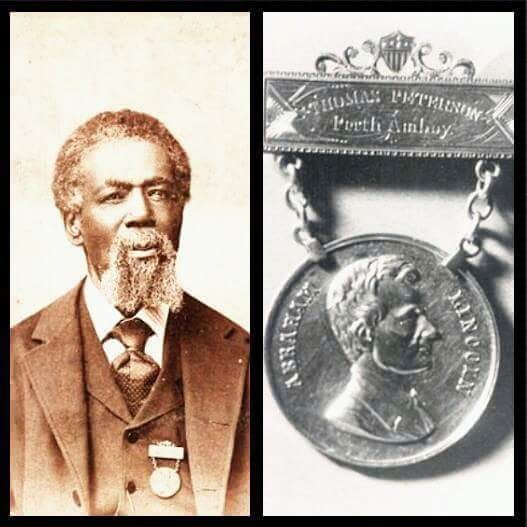 Thomas Peterson-Mundy of Perth Amboy, New Jersey, became the 1st African American to vote. His vote was under the authority of the 15th Amendment, a day after it was adopted.


You must be logged in to post a comment.