Category Archives: ~ Culture & History

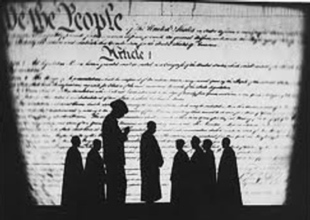
U.S. Constitution – Amendment 14


Amendment 14 – Citizenship Rights

|

1. All persons born or naturalized in the United States, and subject to the jurisdiction thereof, are citizens of the United States and of the State wherein they reside. No State shall make or enforce any law which shall abridge the privileges or immunities of citizens of the United States; nor shall any State deprive any person of life, liberty, or property, without due process of law; nor deny to any person within its jurisdiction the equal protection of the laws.

2. Representatives shall be apportioned among the several States according to their respective numbers, counting the whole number of persons in each State, excluding Indians not taxed. But when the right to vote at any election for the choice of electors for President and Vice-President of the United States, Representatives in Congress, the Executive and Judicial officers of a State, or the members of the Legislature thereof, is denied to any of the male inhabitants of such State, being twenty-one years of age, and citizens of the United States, or in any way abridged, except for participation in rebellion, or other crime, the basis of representation therein shall be reduced in the proportion which the number of such male citizens shall bear to the whole number of male citizens twenty-one years of age in such State.

3. No person shall be a Senator or Representative in Congress, or elector of President and Vice-President, or hold any office, civil or military, under the United States, or under any State, who, having previously taken an oath, as a member of Congress, or as an officer of the United States, or as a member of any State legislature, or as an executive or judicial officer of any State, to support the Constitution of the United States, shall have engaged in insurrection or rebellion against the same, or given aid or comfort to the enemies thereof. But Congress may by a vote of two-thirds of each House, remove such disability.

4. The validity of the public debt of the United States, authorized by law, including debts incurred for payment of pensions and bounties for services in suppressing insurrection or rebellion, shall not be questioned. But neither the United States nor any State shall assume or pay any debt or obligation incurred in aid of insurrection or rebellion against the United States, or any claim for the loss or emancipation of any slave; but all such debts, obligations and claims shall be held illegal and void.

5. The Congress shall have power to enforce, by appropriate legislation, the provisions of this article.

Confession​s of an ex-politic​al candidate …for a seat on the Mashantucket Pequot Tribal Council


Confessions of an ex-political candidate

by Lori Ann Potter

In 2003 I ran for political office.  I was a candidate vying for a seat on the Mashantucket Pequot Tribal Council, and  I learned s ome stuff about tribal politics that I’d like to share.  So without further adieu, I hereby dedicate this week’s post to tribal communities everywhere and their political candidate hopefuls.  Here is my top ten lessons-learned during the 2003 campaign season:

  1. “Big families” mean “more votes”.  The largest families typically hold the lion’s-share of strategic political power on our reservation.   This being the case, it didn’t take “rocket science” for me to realize the odds were considerably stacked against me.  With only seven direct relatives at proper voting age (at least 18 years old), I hail from the second smallest family line at Mashantucket. You can easily fit all of us into one mini-van.
  2. I did alright.  When everything was tallied I received 45 votes, landing somewhere in the middle of all the candidate vote totals.  It was not enough to win, but with approximately 20% of the overall vote, I have to admit it wasn’t bad for a first-time campaign.  And I can now cross “run for office” off my bucket list.
  3. 45 Votes may as well be 4 votes because they still won’t win an election.  From what I’ve observed, it takes between 80-120 votes to win a tribal council seat – depending on how many candidates are running, how many seats are vacant, and how many voters show up that first Sunday in November before polls close at noon.
  4. Every year, there are “secret deals”.  Alliances are commonly forged privately between one or more mid-sized family candidates and larger-family representatives.  Basically what happens is this: candidate “A” seeks support from council members representing the largest family line, offering his or her unequivocal political allegiance in exchange for whatever number of votes is needed to win.
  5. Secret deals” aggravate me.  I just can’t bring myself to align politically with people in “power”.   A former chairman once confronted me about it privately when he was still in office. “We don’t support placing you in a leadership position because we don’t know where you stand politically,” he declared, matter-of-factly.  I quipped right back: “If you or anyone else wants to know ‘where I stand’ on any political matter, all you need to do is ask me and I will tell you.”  He wasn’t fond of my abrupt honesty.  I simply doubt that it’s in my tribe’s best interest for any candidate to promise their unwavering support to a dictatorship without regard to the potential outcome such support may b ring.  I believe doing so lowers one’s standard of ethics considerably, focusing instead on power brokering, scoring titles or raking in a much higher paycheck.  When such “deals” are done, their outcome always points to a manipulative, fear-based style of leadership. Frankly, I’d rather sleep at night.
  6. People who feel threatened by you will do really stupid things.  I paid way too much for ten double-sided campaign signs, only to discover that all but one were completely destroyed by the vandalism of strategic knife-slashes, burn marks, tire treads, and the sharpie-inflicted “enhancements” of mustaches, F-bombs and smatterings of other colorful expletives.  Mind you, that’s in addition to all the wildly half-baked gossip that kept bumbling its way back to me.  It’s amazing how inventive lies can become.
  7. Campaigning can be hazardous to your health.  Yes, the rumors are true.  Some candidates have indeed received “threats”.  A few have even dodged potentially harmful or even fatal “accidents”.  For instance, in 2003 one candidate shared with me a threatening hand-written note she received.  It was tied to a rock that shattered her living room window, warning her to drop out of the race …or else.  Another candidate walked out to his vehicle one night after a long meeting and discovered his severed brake-line with the fluid trickling down to the moonlit pavement below.  I know because I was there.
  8. Half of the people who promise to vote for you actually will.  If you are a hopeful candidate this season, please heed these words of advice.   When people shower you with smiles, compliments, shoulder-pats and hugs, promises to “have your back” in the voting booth and other random “feel-good” fluffy stuff… For the love of all common-sense and decency don’t fall for that crap!   And to all of the folks out there who get their kicks from pumping candidates’ heads full of sanctimonious euphoric nonsense – stop it!  Have enough courage to represent the real you.  If you cannot commit, then do not promise that you will.
  9. Losing an election can be the best thing that ever happened to you.   In my situation, I went right back to school and finished two degrees that I might never have achieved had I won that election.  And with the added perspective gained from several years working with my tribe’s constitution review team, I can see that the root of our political problems is directly linked to the governing foundation spelled out in my tribe’s constitution.  At Mashantucket, all powers of government are centralized into one branch – a tribal council of seven people.  Because they hold this magnitude of power, the tribal council can do whatever they want with whatever funds or resources they choose whenever they feel like it.   So just imagine for a moment what would happen if a tribe had no checks and balances on its government power, while hundreds of millions of dollars filter down from their casino through one group of seven leaders every year for 20 straight years.  Would those seven leaders have the strength to uphold integrity rather than yield to fear and temptation?
  10. You don’t need a leadership position in order to make a difference.  Some of the most powerful leaders in world history have been those who were not holding leadership positions when they wielded the most influence, overcame unbelievable odds, and radically disrupted the status quo of dictatorships.  Moses contended with Pharaoh and won freedom for Israel.  Martin Luther challenged Catholicism and the Protestant church was born.  Rosa Parks rebelled against racist laws by not moving to the back of a bus. Helen Keller was so influential with advocating women’s rights that she was placed on the FBI’s “watch list” despite being blind, deaf and mute.  And a boy named David once hurled a small stone at a giant warrior, killing him instantly in front of  his own army cowering in fear, decades before he was crowned King.   All of them “underdogs”.  All of them championed their values no matter what the cost.  And all of them were history makers.

Stop anti-immig​rant laws from coming to Washington …Marissa Graciosa, Reform Immigration FOR America


Stand up for Alabama families under attack

Schoolchildren in Alabama are hiding. Immigrant families are fleeing the state. Alabama passed an anti-immigrant law so extreme that it is scaring students from attending school, and would allow indefinite detention for those stopped by the police to ask for immigration status without proper paperwork. And a federal judge just approved it.

This is an all-out assault on immigrant families, and it’s not isolated to Alabama. Congress’ inaction on federal immigration reform has left the door wide open for this racist and inhumane legislation, in Arizona, Georgia, Indiana and now Alabama. These states aren’t waiting for Washington to do something. They’re writing their own policy, with anti-immigrant leaders holding the pen.

Alabama launched an assault on its immigrant communities — and we must not let these disgraceful actions stand. Take the pledge now to stand with Alabama families against these unjust practices.

A massive outcry of individuals supporting Alabama communities now will send a wake-up call to Washington: we need comprehensive immigration reform now, before other states follow this devastating example. We need your voice to deliver our message to families in the state that the entire country is watching.

 Click here to learn more http://act.reformimmigrationforamerica.org/go/1271?akid=758.164689.TCzbeK&t=4  and to pledge your solidarity with Alabama families against the state’s injustice and demand Congressional action on immigration reform.

Thanks for all that you do,

Marissa Graciosa
Reform Immigration FOR America

the state of relations between African Americans and Cherokee Indians …voting for a new Cherokee Principal Chief — a process that began September 24 and will collect votes through October 8.


MacArthur ‘Genius’ Dr. Tiya Miles Talks Cherokee-African American relations

Cherokee Indians disowning black tribe members forces look at slavery

Last week, University of Michigan history professor Dr. Tiya Miles was surprised when she got the call from the MacArthur Foundation that she would be a 2011 recipient of their highly coveted “genius” fellowship grants — a $500,000 no-strings-attached sum that is dispersed to fellows and stretched out over five years. The professor had been excavating many long-buried stories about the relationships between Cherokee Indians, enslaved African-Americans and free blacks over the the past few centuries in America. She is the author of several books, chapters and articles on the subject, including her first book “Ties That Bind: The Story of an Afro-Cherokee Family in Slavery and Freedom,” which tells the story of a young African-American woman who was married into a Cherokee tribe, and also about how Cherokee women fought for her and her black children to have rights among the Cherokees. Miles plans to use the grant to further her studies, but delving into new subjects considering northern slave-holding states such as Michigan.

The award also came at an apt time given the citizenship status of black “freedmen” — the descendants of enslaved Afro-Cherokees — has been in question and was only just recently settled. Their citizenship will impact voting for a new Cherokee Principal Chief — a process that began September 24 and will collect votes through October 8.

The Loop 21 had the privilege of speaking with Dr. Miles, about the state of relations between African Americans and Cherokee Indians, the history behind it, and what the future brings.

Loop 21: The expulsion of the freedmen in 2007 — would it be accurate to describe that in terms of pure racism towards the descendants of slaves, or is it more complex than that?

Dr. Tiya Miles: I think that one aspect of this is a latent anti-black prejudice. And I have to say, Cherokees aren’t alone in this. What group in this country has not been affected by the anti-black prejudice that proliferates within our culture and has for our whole history? I think everyone is affected by this. And native people have really been targeted to be drawn into a heightened awareness of racial hierarchy and where they sit in that hierarchy. That’s an aspect people might not want to address directly. I think another issue is also a fear of depleted resources. This is a moment when everyone is concerned about economics and thinking about whether or not we’re going to see a double-dip recession, and how long the downturn will last. In this kind of environment I think people want to tighten their fist. And they want to think about how they can better their own small group. Perhaps to the detriment of minorities in that group — I think that’s going here too. And also the Cherokee Nation has legitimate reason to feel resentful — not to the descendants of freed people; I think they ought to be grateful to them since their ancestors helped build that nation — but resentful to the United States government. I think that the Cherokee’s feelings of resentment is legitimate when it’s directed toward the federal government, and I think it’s illegitimate when turned toward the descendants of slaves who helped the Cherokee nation to survive, who helped them to move across the Trail of Tears, who did the labor to make their journey that was awful, to make their journey less horrific, and who really built their wealth in Indian territory.

Loop 21: What are the moral problems with the Dawes laws that started this separation between Cherokee and black freedmen?

Miles: I think that most people who have looked at the Dawes laws and thought about them would acknowledge that these are really flawed lists of not only the Cherokee nation but also all Native nations. They are flawed in more ways than we can even talk about right now. First of all, Native people, for the most part, didn’t even want to be involved in the process. Of course that was a process started by the United States federal government to divide up tribal lands and individuals. This was a policy on the part of the government to break up native peoplehood, and to get them to feel like private property was all important to them, as opposed to communal property, or betterment of the entire group. From the very beginning this was something that native people protested and didn’t want. So it’s saddening that — and ironic — that right now in 2011 these lists that Native people didn’t even want to be involved in are now being used to legitimize things like taking away citizenship status from descendants of slaves — that’s only one part of the problem.

Loop 21: What other problems are there?

These rolls have no way of making a notation of the deep cultural relations between the freed people and Cherokees. These were black people who connected deeply with their Native American context. They thought of themselves as Cherokee men and women as opposed to thinking of themselves as American blacks. They even referred to black people who were moving in from the Southern states moving into Indian territory as “state Negroes.” They used this term as a way to distinguish between their own cultural context, which was the Native American one, and the cultural context of the Exodusters, people who were coming West, which was really an African-American one, one that connected them to a larger American context, not a Native American one. So these rolls have so many holes in them that it’s really a shame that we rely on them today to decide who should or should not be included in these nations.

Loop 21: Has there ever been a point in your research where you became so discouraged that you wanted to leave the subject altogether?
Miles: Yes, I’ve been discouraged. One time during a graduate seminar on Native American history, a colonial historian named James Merrell came to talk about his book about the Catawba Indians of South Carolina. I asked him about his research about blacks and Catawbas and he told us that he had been asked by the members of Catawba Tribal Council not to publish materials that gave evidence of black-Catawba intermarriage. I have to say, that to me was very disheartening to think that members of Native American nation would ever want to disavow that they had ever allied with or been intimate with African Americans when this was an important part of that history.  To me it was a signal that native people just like all people in this country have been caught up in the racial hierarchy. It was very disheartening, but it was also discouraging because it made me want to keep digging and keep finding the information and perhaps start to rebuild those bridges. But my mother in that moment helped me straighten my back and get back to work, by telling me that that maybe I didn’t choose this topic, maybe it chose me. And I do feel like all of these people who are doing scholarship or creative work and remembering the experiences of our ancestors are helping us to respect them  and bring back for them in their memory the regard that they should have had in their lifetimes but didn’t have in this country.

Loop 21: The U.S. Housing and Urban Development froze $33 million from the Cherokee nation. Did that move undermine Cherokee sovereignty?

Miles: I am no legal scholar, but my own personal opinion about this is that I would have been very disturbed if the U.S. Supreme Court came out and told the Cherokee Nation that you must do x, y and z. Because I think that would have definitely undercut Cherokee sovereignty. That’s not what happened, though. What happened was the U.S. government told the Cherokee government that they might be withholding funds. And that sounded to me like a nation-to-nation discussion, and that’s what sovereign nations do. So if China told the United States they were going to withhold funds from us would we say they are undercutting our sovereignty? Probably not. We’d be very upset, but we would say they have a right as a nation to do that. So while I think even though this whole situation and the way it was played out was ugly, and you have to admit that it was, it could have been much worse, if the United States government did in some direct way said you Cherokee nation must do x, y or z, but that didn’t happen. The Cherokee nation made a decision.

Loop 21: Was winning the MacArthur ever a dream or goal of yours when you were younger?

Miles: When I was much younger — and I have to say that I grew up in an amazing family that was really all about education — but even so I didn’t know that being a professor was a job that somebody could do! I didn’t know that until I went to college and one of my roommates was a child of professors. Let me tell you, I felt pretty intimidated then because I thought this was a whole world that I never knew about or had access to growing up. So even just to have this job being able to read, write and teach, think to me is a great privilege that I am very grateful for. In terms of the MacArthur Fellowship, of course, I knew that the people who had won it in the past, I was aware of it, but frankly I never thought I would be someone who would be considered for this. I was completely shocked when I got the phone call. I am so honored, I feel like the foundation and the anonymous nominators were just so generous to consider me for this.

Your vision propels us forward! a message from NMAAMC


It is a tremendous and rewarding challenge to build something the size and scope of the Smithsonian’s National Museum of African American History and Culture.

Your willingness to get involved in this historic project during these early stages is inspiring. It underscores your vision; your ability to see the entire scope of the plan, and the promise of things to come!

Equally important is the work your support makes possible. Just look for a moment at the Museum’s image above. You can see that you are helping to create a truly spectacular museum on the National Mall.

What will be featured inside will be equally exciting. A collection of exhibitions and treasures that will tell the entire, rich story of the African American experience and its role in our history. Simply put, the African American story is America’s story.

You can tell I am proud and excited about this Museum. I believe you share that pride and anticipation.

That is why I am asking for your financial support today. We cannot build this museum without your help.      http://go.si.edu/site/R?i=mhj_5OJO7nPU690Zcjf6EA..

The entire project will cost $500 million, with Congress providing half of that amount. The remaining $250 million must be raised via private resources and, most importantly, from individual contributions from men and women who, like you, share the greater vision of what this Museum will be when we open our doors in 2015.

There are many good reasons to support the Museum: the powerful history and culture that will be presented in exhibitions and public programs; the opportunity to be part of something that will inspire and educate future generations; and the telling of this important story in the grand tradition of a Smithsonian museum.

Whatever your reasons, we are honored by your commitment to the Museum. Our campaign to build the Museum continues to gain momentum. With the help of supporters like you we remain on schedule to break ground in 2012.

However, the bottom line is that we need your steadfast support now and are very grateful to receive it.   http://go.si.edu/site/R?i=mhj_5OJO7nPU690Zcjf6EA..

So, please, take a moment right now to make a contribution to the National Museum of African American History and Culture.

Again, thank you very much.

All the best,

Lonnie Bunch
Director


P.S. I just want to remind you of the great tax benefit your contribution to the Museum represents. Whatever amount you are able to generously contribute today is tax-deductible to the full extent allowed by the law. $250 million is a tremendous goal. We truly need and are grateful for your support.