Category Archives: ~ Culture & History

NMAAHC Brings “Treasures​” to Dallas for Juneteenth


National Museum of
African American History and Culture
Brings “Treasures” to Dallas for Juneteenth

 The Smithsonian’s National Museum of African American History and Culture celebrates Juneteenth with a two-day program to help Dallas/Ft. Worth-area residents identify and preserve items of historical and cultural significance tucked away in the attics, closets and basements of their homes. Presented in collaboration with the Dallas Public Library, the event will feature presentations, hands-on activities and preservation tips.

The program will take place Saturday, June 18, from 10 a.m. to 4 p.m., and Sunday, June 19, from 1 p.m. to 4 p.m. at the J. Erik Jonsson Central Library, 1515 Young Street in Dallas. It will feature welcoming remarks by Lonnie Bunch, founding director of the museum, and Dallas Public Library interim director Corinne Hill. Free and open to the public, the event is the ninth in a series from the museum’s signature program “Save Our African American Treasures: A National Collections Initiative of Discovery and Preservation.” All are welcome.

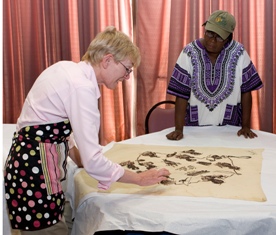
Mary Ballard, senior textile conservator at the
Smithsonian’s Museum Conservation Institute,
inspects an artifact during a “Treasures” event.

 
Participants can reserve in advance to bring up to three personal items for a 20-minute, one-on-one professional consultation with experts on how to care for them. The specialists will serve as reviewers, not appraisers, and will not determine items’ monetary values. Objects such as books, paper and textiles no larger than a shopping bag (furniture, carpets, firearms and paintings are excluded) can be reviewed. Those wishing to have items reviewed must make reservations by emailing treasures@si.edu or by calling toll free (877) 733-9599. Reservations are only required for those wishing a one-on-one consultation. Additional information is available at nmaahc.si.edu.

“We are extremely proud to bring ‘Save our African American Treasures’ to Dallas during Juneteenth weekend,” said Bunch. “We encourage people to become aware of what they have, to protect it and to preserve it so the story of African Americans in this country can be told. Nineteenth and 20th-century objects — family photographs, military uniforms, farm tools and wedding dresses — can help tell this story for future generations; if we do not act now to preserve these items, the tangible evidence of a critical component of American history will be lost.”

 
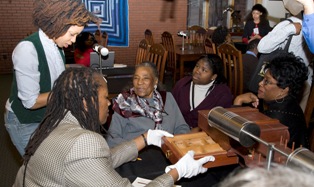
A participant from “Treasures” Atlanta meets with
senior objects conservator, Carol Grissom of the
Smithsonian’s Museum Conservation Institute.
“We are so honored that the Smithsonian’s National Museum of African American History and Culture is bringing this outstanding program to the Dallas Public Library,” said Hill.

The “Treasures” program also includes the following activities throughout the day:

 
Marion Butts: A Lens on Dallas:  Carol Roark, the Dallas Public Library’s manager of special collections, discusses its collection of photographs taken by one of the most important and prolific documentarians of African American life in the city.
Preservation Presentations:  Informal basic preservation sessions will take place during the day. The sessions will provide information on preserving clothing and textiles, family photographs and papers, and digital memories.  Participants will have the opportunity to ask questions.
Hands-on Preservation:  In this hands-on activity, participants are invited to learn how to properly store letters, pack garments and prepare photographs for preservation storage and presentation.

On Saturday, from 2 to 4 p.m., participants can meet 94.5 KSoul’s Kelli Simms.

Elaine Nichols, supervisory curator of culture at the
Smithsonian’s National Museum of African American
History and Culture, meets with 99 year old
Amelia Boynton Robinson during “Treasures” Atlanta.

 
“Save our African American Treasures” is made possible with support from the Bank of America Charitable Foundation and the W.K. Kellogg Foundation. The grants also support the pre-design and construction of the museum on the National Mall in Washington, D.C., scheduled to open in 2015.

As a companion to the series, the museum has produced African American Treasures: A Preservation Guide, a 30-page guidebook that is distributed free to attendees to highlight the importance of proper preservation techniques. The guidebook is part of the “Treasures” kit. Also distributed will be white cotton gloves, archival tissue papers and archival documents sleeves to help people keep their personal treasures safe.

The National Museum of African American History and Culture was established in 2003 by an Act of Congress, making it the 19th Smithsonian Institution museum. Scheduled for completion in 2015, it will be built on the National Mall in Washington, D.C., on a five-acre tract adjacent to the Washington Monument. Currently, during the pre-building phase, the museum is producing publications, hosting public programs and assembling collections. It is presenting exhibitions at other museums across the country and at its own gallery at the National Museum of American History. For more information about the museum, visit nmaahc.si.edu or call Smithsonian information at (202) 633-1000, (202) 633-5285 (TTY).

For information on the many free programs and services available at the Dallas Public Library, visit www.dallaslibrary.org. The Dallas Public Library operates the J. Erik Jonsson Central Library, 26 branch locations, Bookmarks in NorthPark Center and two bookmobiles. A library card is free for any Dallas resident.

National Museum of African American History and Culture


For All The World To See:
Visual Culture and the Struggle for Civil Rights

~~~~~~~~~~~~~~~~~

Sanitation workers assembled before Clayborn Temple
Ernest C. Withers, Sanitation Workers assemble in front of Clayborn
Temple for a solidarity march.
Memphis, TN, March 28, 1968.
Ernest C. Withers, Sanitation Workers assemble in front of Clayborn

Civil rights leaders and activists were often exceptionally skillful image-makers, adept at capitalizing on the authority of pictures to edify, educate, and persuade. They also understood, and took advantage of, new visual technologies as well as society’s insatiable hunger for pictures. Through compelling photographs, television and film clips, and other historic artifacts, For All the World to See explores the role of visual culture — from the late 1940s to the mid-1970s — in shaping and transforming the struggle for racial equality and justice.

Curated by Maurice Berger, Ph.D. For All The World To See was organized by the Center for Art, Design and Visual Culture, University of Maryland, Baltimore County, in partnership with the Smithsonian National Museum of African American History and Culture.

The exhibition opens June 10 and runs through November 24, 2011 in NMAAHC‘s gallery on level two at the Smithsonian National Museum of American History. For information about this exhibition please click here.

Equality hangs in the balance. Will you tip the scales? … from HRC


I just got off the phone with HRC Board Member Bruce Bastian. He’s challenged HRC supporters to raise $100,000 – and he’ll match every dollar with one of his own.

He’s doing it because big things are happening here at HRC and all across the country – thanks to you. You’ve helped run ads and mobilize thousands of volunteers in an all-out blitz to win marriage equality in New York. You helped bring 250 pro-equality clergy members to Capitol Hill this week. And together we’ve sparked a new, national conversation about homophobia in sports.

But make no mistake. We could win in New York – or right-wing hatred could prevail. More sports stars could support equality – or more slurs could air on national TV. Speaker Boehner could stop spending tax dollars to defend discrimination in the DOMA case – or we could see a resurgence of discriminatory efforts in Congress.

It all depends on how quickly we can react to a crisis, on how skillfully we can fight when it counts – and on you.

www.hrc.org

Don’t miss this chance to double your impact – all gifts will be matched up to $100,000.

Look around. From TV sitcoms to professional sports, to new polls showing unprecedented support for equality – we’ve reached a tipping point in our culture.

After years of discrimination, when a single victory for LGBT equality was cause for hope, we are now in a place where it’s hate that’s out of place. And you’ve been at the center of that change. In just the past few months, look what you’ve accomplished:

•After an outcry from HRC supporters, a major law firm dropped its defense of the discriminatory Defense of Marriage Act (DOMA).

•After HRC’s rapid-response campaign in major media outlets and on Twitter, all-star Kobe Bryant personally called me to apologize for calling a referee a “f***ing f***ot” in front of millions of young viewers – and the commissioner of the NBA fined him an unprecedented $100,000.

•Star athletes such as the NBA’s Steve Nash and the NHL’s Sean Avery have joined our “New Yorkers for Marriage Equality” campaign – the videos are everywhere from cable TV to New York City cabs right now – and when Avery was attacked for his brave stand, thousands of you spoke out in his defense.

•Mayors, governors, actors, past presidents and even George W. Bush’s daughter Barbara have all joined HRC’s campaign for marriage equality in New York.

And, for the first time ever, polls show a majority of Americans support marriage equality – not just civil unions.

These aren’t unconnected events. But this moment is only what we make of it. People like you generously funded ads, fueled outreach to prominent figures, and gave us the strength to respond to attacks without delay – and to seize this opportunity, we’ll need you again.

www.hrc.org

Don’t miss out: have your gift MATCHED in the next seven days.

We can create a sea change in our society – but we may still slip backward. I know that HRC supporters like you will be the deciding factor, and that we can count on you to fight.

Let’s tip the scales,

Joe Solmonese

President

Culture:The Political Meaning Behind Summer Blockbusters


This summer’s blockbuster movies may be escapism, but they’re powerful expressions of major trends in American politics. Movies as diverse as Sam Raimi’s foreclosure horror flick DragMetoHell and Adam McKay’s financial melt down cop comedy The Other Guys have explored the rage and helplessness of an economy that may be altered forever. James Cameron’s science-fiction epic Avatar sparked as many, if not more, environmental debates than Al Gore‘s An Inconvenient Truth. And, Hollywood director Michael Bay sought out the Defense Department’s cooperation when he started making his Transformers movies, the third of which arrives in theaters on June 29, and switches American troops from fighting Afghans and Iraqis to fighting giant robots, symbolically referencing the human cost of our ongoing wars. Rather than trying to escape politics in our entertainment, it’s time to embrace them. In the next few months, a trio of superhero movies is poised to exploit post-bin Laden American triumphalism. In the midst of our sluggish economic recovery, a new crop of comedies are poised to help audiences adjust their economic expectations. And the most controversial education reform movie since Waiting for Superman stars Cameron Diaz. We may think we’re seeking mindless entertainment when we buy tickets to an action movie or a romantic comedy, but those films are both the product of our politics and an expression of them. Welcome to The Progress Report’s progressive guide to summer movie season.

OLD ENEMIES AND NEW ONES: In future summers, we’ll see an explosion of action movies based on Osama bin Laden‘s death. Kathryn Bigelow, director of the Oscar-winning movie The Hurt Locker, was already working on a movie about an attempt on Bin Laden’s life when President Obama announced that the terrorist had been killed. Universal green litan adaptation of Marcus Luttrell’s memoir about his service as a Navy SEAL in Afghanistan. And Disney’s moved to trade mark the term “Seal Team 6,” locking up the name of the squad that got Bin Laden, now a valuable bit of intellectual property. But this year, superhero movies are turning back to old enemies, and to conflicts where the exercise of American power was decidedly less complicated than it is now. Captain America: The First Avenger, due out on July 22, is an origin story, but it’s also very much a period piece, a high-gloss flashback to World War II. Captain America will fight terrorists in that movie, but terrorists who are acting as agents of the Nazistate under the command of the Red Skull, a super villain who, according to some origin stories, was recruited by Hitler himself. Unlike Tony Stark, who has to destroy a terrorist cell who kidnapped him while avoiding civilian casualties so he can keep the allegiance of Afghan citizens, Captain America won’t be required to show much restraint. Similarly, X-Men: FirstClass goes back to the ’60s to bring its titular mutant heroes together for the first time. The X-Men aren’t agents of the government — in fact, they’re precisely the opposite, a group of people whose extraordinary abilities make them despised rather than prized, and whose struggle to figure out if they should assimilate into society or withdraw in it is a major metaphor for gay rights. But in this origin story, the characters have a chance to earn their spurs as heroes and a place in mainstream America by acting as a fail-safe for President Kennedy when his brinksmanship on the Cuban Missile Crisis goes awry. By contrast, Michael Bay’s Transformer: Dark of the Moon, is dipping into more contemporary politics. The movie is relying on American distaste for Julian Assange and Wikileaks — as well on the rather contradictory pleasure of watching our major cities get destroyed on-screen — to power a script in which giant robots try to bring down the United States government by revealing state secrets.

ON ECONOMY, LAUGH OR CRY: While our foreign policy plays out on a super heroic scale this summer, a new spate of comedies suggests that we’d better buck up about the economy, because we’re stuck with its hardships. The people who get hit by hard times in these movies range up and down the economic spectrum. In a subplot of the ensemble wedding comedy Jumping the Broom, economic issues create strain for a couple rushing to the altar. In Bridesmaids, comedian Kristin Wiig’s Annie is a failed entrepreneur, working in a jewelry store after her bakery became a victim of the downturn, taking with it her boyfriend and business partner. And at the lower end of the scale, Tom Hanks is a big-box store veteran who loses not just his chance for a promotion but his job because he doesn’t have a college degree in LarryCrowne, which opens on July 1. All of these movies mine the indignities of economic disasters for laughs, sometimes uncomfortable ones. The pretensions of the wealthy family in Jumping the Broom often make them look ridiculous. Losing her life savings propels Annie into sharing a house with two deeply strange roommates and into a job at a jewelry store where she subtly undermines her love bird customers. And the pursuit of his degree places Larry in a community college that makes Community’sGreendale look almost legitimate by comparison. That humor aims to make the recession bearable. But these movies also take a hopeful tack, recasting hardship as an opportunity to revitalize your soured relationship with your husband, win back your shattered personal and professional confidence, or build the life you always wanted on a foundation of a used motorbike, clothes out of the back of a truck, and a romance with a burned-out speech professor. It’s the comedy of resignation, using humor to acclimate us to changes in our economic expectations that on some days seem worrisomely permanent. The exception is Seth Gordon’s Horrible Bosses, due out on July 8, which suggests that if you’re stuck in a job where your employer forces you to drink so he can cast you as an alcoholic, makes you discriminate against your coworkers, or you’re being sexually harassed by Jennifer Aniston, offing your supervisor may be your only option, but though the solution’s less uplifting, the desperation is the same. Desperate times call for desperate measures.

THE BIG ISSUES: And while studios normally save their big, pointed issue movies for the winter Oscar-bait season, sometimes a few sneak into the summer lineup — however unintentionally. Bad Teacher, in theaters on June 24, may be the first dark sex comedy built around standardized testing. Cameron Diaz, a burned-out teacher, seizes on the idea that breast implants are her ticket to marriage to Justin Timberlake, a wealthy man who has chosen to teach rather than go into his family’s business. Her plan to get the money? Winning a bonus awarded to the teacher whose students do best on a state achievement test. Whether Bad Teacher ends up being ammunition against testing, an argument against merit pay, or just another step forward for the burgeoning women’s raunch-comedy movement remains an open question. And coming out on the same day, and in loose sync with President Obama’s renewed call for immigration reform, is Chris Weitz‘s ABetterLife, which follows a man trying to build a landscaping business in Los Angeles while avoiding the constant risk of deportation. Weitz’s last project was vampire phenomenon Twilight: New Moon, and he’s never been involved in an explicitly political project before. But his grandmother is a Mexican immigrant, and if Weitz can sell an immigration reform drama to the Twilight fan base, it could be the summer’s best piece of pop activism.

DOMA:The Sinking Ship


From: The Progress Report  …

Lesbian, gay, bisexual, and transgender activists have resigned themselves to not seeing any substantial legislative progress toward equality while Republicans control the House of Representatives. Nevertheless, it has never been more apparent how the times have changed in the two decades since laws like the Defense of Marriage Act (DOMA) and Don’t Ask, Don’t Tell (DADT) passed, both of which were actually seen as progress at the time. DOMA, some argued, at least allowed for individual states to legalize marriage for same-sex couples (as some since have), and DADT at least allowed gays, lesbians, and bisexuals to serve in the military, just so long as nobody knew who they were. It’s now been 15 years since the DOMA boat set sail, but its titanic barriers to equality are slowly sinking. In the meantime, same-sex couples are still struggling to make due without the federal protections marriage provides, while conservatives try every trick they know to keep inequality on the books.

LOST AT SEA: Though DOMA blocks 1,138 federal marriage benefits from same-sex couples, there is one in particular that’s particularly hard on some couples: not having the right to sponsor a foreign-born partner for residency. Immigration Equality estimates there are 36,000 same-sex binational couples living in the U.S., 45 percent of whom are raising children. Because of DOMA, any couple not protected by employment sponsorship is at risk of being separated by deportation. The Gay & Lesbian Advocates & Defenders (GLAD) legal group actually warns these couples not to get married (PDF) as doing so may expose the foreign-born partner’s status and lead to deportation. In the wake of the President’s decision that DOMA is unconstitutional and should not be defended, the Department of Justice has twice suggested it might halt deportations, only to then reassert that deportations will continue. The first occasion was in March, when Citizenship and Immigration Services announced they would suspend the cases of married gay couples, but announced the following day that nothing had changed. Then, last week, Attorny General Eric Holder vacated a case, asking the Board of Immigration Appeals to reconsider it outside the context of DOMA. Again, hopes were raised, and a judge in Newark, New Jersey actually adjourned in a different case on Friday to give that couple an extra six months. On Saturday, however, the DOJ reaffirmed that deportations are still underway. Two proposed bills, the Uniting American Families Act (UAFA) and Reuniting Families Act (RFA), would protect same-sex couples from deportation, but the demise of DOMA would likely eliminate the disparities entirely.

PLUGGING THE LEAKS: As the DOJ chips away at DOMA and the military works toward certification of repeal of DADT, conservatives at both the state and federal levels are trying to halt the flow of equality in any way they can (in addition to the House’s radically expensive plan to defend DOMA). This week, Rep. Todd Akin (R-MO) will introduce an amendment to the Defense Authorization Act to prevent Navy bases from performing marriages for same-sex couples after DADT is lifted, even in states where those marriages are legal. He claims that “federal property and federal employees, like Navy chaplains, should not be used to perform marriages that are not recognized by federal law.” Rep. Duncan Hunter (R-CA) is going a step further, introducing the second of many expected bills and amendments intended to derail the DADT repeal process. General George Casey opposed a similar move by Hunter in January. Meanwhile, Republican-controlled states like Pennsylvania and Minnesota are following Indiana’s lead by considering constitutional amendments banning same-sex marriage even though both states already prohibit same-sex marriage by law. In fact, the religious right is ramping up an extensive new multi-million dollar campaign called “Ignite An Enduring Cultural Transformation” that will push for anti-LGBT measures in states up through the 2012 election. But times have changed even since 2004, and it’s unlikely conservatives will have the same success using same-sex marriage as a wedge issue as they did then.

THE RISING TIDE: For the first time ever, opposing LGBT equality is the unpopular position in American politics. Polls have been consistently showing majority support for marriage equality, just as they showed overwhelming support for repealing DADT last fall. Target and Chik-Fil-A have gotten incredible pressure from LGBT activists for their support of anti-gay candidates and groups. Law firm King & Spalding backed out of their defense of DOMA after clients and employees voiced their dissent. Olympic gold medalist Peter Vidmar had to step down from his appointment as chef de mission for the 2012 U.S. Olympic team because of his support for Proposition 8, California’s rollback of marriage equality. Graduates of the University of Michigan Law School walked out of their own commencement ceremony this weekend to protest the anti-gay voting record of the guest speaker, Sen. Rob Portman (R-OH). Despite the clear growing unpopularity of anti-gay positions, almost every GOP presidential candidate has towed the party line in maintaining them. Romney, Bachmann, Gingrich, Santorum, Pawlenty, Trump, Paul and others have all defended DOMA and come out against LGBT equality in other ways. The only exception is Fred Karger, who is actually making history as the first-ever openly gay presidential candidate, though the national stage has not given him much attention. Hopefully the history books look upon Karger kindly as the first Republican candidate to step out of the shadow of the religious right and join the Zeitgeist in embracing LGBT equality