Category Archives: ~ Culture & History

the state of relations between African Americans and Cherokee Indians …voting for a new Cherokee Principal Chief — a process that began September 24 and will collect votes through October 8.


MacArthur ‘Genius’ Dr. Tiya Miles Talks Cherokee-African American relations

Cherokee Indians disowning black tribe members forces look at slavery

Last week, University of Michigan history professor Dr. Tiya Miles was surprised when she got the call from the MacArthur Foundation that she would be a 2011 recipient of their highly coveted “genius” fellowship grants — a $500,000 no-strings-attached sum that is dispersed to fellows and stretched out over five years. The professor had been excavating many long-buried stories about the relationships between Cherokee Indians, enslaved African-Americans and free blacks over the the past few centuries in America. She is the author of several books, chapters and articles on the subject, including her first book “Ties That Bind: The Story of an Afro-Cherokee Family in Slavery and Freedom,” which tells the story of a young African-American woman who was married into a Cherokee tribe, and also about how Cherokee women fought for her and her black children to have rights among the Cherokees. Miles plans to use the grant to further her studies, but delving into new subjects considering northern slave-holding states such as Michigan.

The award also came at an apt time given the citizenship status of black “freedmen” — the descendants of enslaved Afro-Cherokees — has been in question and was only just recently settled. Their citizenship will impact voting for a new Cherokee Principal Chief — a process that began September 24 and will collect votes through October 8.

The Loop 21 had the privilege of speaking with Dr. Miles, about the state of relations between African Americans and Cherokee Indians, the history behind it, and what the future brings.

Loop 21: The expulsion of the freedmen in 2007 — would it be accurate to describe that in terms of pure racism towards the descendants of slaves, or is it more complex than that?

Dr. Tiya Miles: I think that one aspect of this is a latent anti-black prejudice. And I have to say, Cherokees aren’t alone in this. What group in this country has not been affected by the anti-black prejudice that proliferates within our culture and has for our whole history? I think everyone is affected by this. And native people have really been targeted to be drawn into a heightened awareness of racial hierarchy and where they sit in that hierarchy. That’s an aspect people might not want to address directly. I think another issue is also a fear of depleted resources. This is a moment when everyone is concerned about economics and thinking about whether or not we’re going to see a double-dip recession, and how long the downturn will last. In this kind of environment I think people want to tighten their fist. And they want to think about how they can better their own small group. Perhaps to the detriment of minorities in that group — I think that’s going here too. And also the Cherokee Nation has legitimate reason to feel resentful — not to the descendants of freed people; I think they ought to be grateful to them since their ancestors helped build that nation — but resentful to the United States government. I think that the Cherokee’s feelings of resentment is legitimate when it’s directed toward the federal government, and I think it’s illegitimate when turned toward the descendants of slaves who helped the Cherokee nation to survive, who helped them to move across the Trail of Tears, who did the labor to make their journey that was awful, to make their journey less horrific, and who really built their wealth in Indian territory.

Loop 21: What are the moral problems with the Dawes laws that started this separation between Cherokee and black freedmen?

Miles: I think that most people who have looked at the Dawes laws and thought about them would acknowledge that these are really flawed lists of not only the Cherokee nation but also all Native nations. They are flawed in more ways than we can even talk about right now. First of all, Native people, for the most part, didn’t even want to be involved in the process. Of course that was a process started by the United States federal government to divide up tribal lands and individuals. This was a policy on the part of the government to break up native peoplehood, and to get them to feel like private property was all important to them, as opposed to communal property, or betterment of the entire group. From the very beginning this was something that native people protested and didn’t want. So it’s saddening that — and ironic — that right now in 2011 these lists that Native people didn’t even want to be involved in are now being used to legitimize things like taking away citizenship status from descendants of slaves — that’s only one part of the problem.

Loop 21: What other problems are there?

These rolls have no way of making a notation of the deep cultural relations between the freed people and Cherokees. These were black people who connected deeply with their Native American context. They thought of themselves as Cherokee men and women as opposed to thinking of themselves as American blacks. They even referred to black people who were moving in from the Southern states moving into Indian territory as “state Negroes.” They used this term as a way to distinguish between their own cultural context, which was the Native American one, and the cultural context of the Exodusters, people who were coming West, which was really an African-American one, one that connected them to a larger American context, not a Native American one. So these rolls have so many holes in them that it’s really a shame that we rely on them today to decide who should or should not be included in these nations.

Loop 21: Has there ever been a point in your research where you became so discouraged that you wanted to leave the subject altogether?
Miles: Yes, I’ve been discouraged. One time during a graduate seminar on Native American history, a colonial historian named James Merrell came to talk about his book about the Catawba Indians of South Carolina. I asked him about his research about blacks and Catawbas and he told us that he had been asked by the members of Catawba Tribal Council not to publish materials that gave evidence of black-Catawba intermarriage. I have to say, that to me was very disheartening to think that members of Native American nation would ever want to disavow that they had ever allied with or been intimate with African Americans when this was an important part of that history.  To me it was a signal that native people just like all people in this country have been caught up in the racial hierarchy. It was very disheartening, but it was also discouraging because it made me want to keep digging and keep finding the information and perhaps start to rebuild those bridges. But my mother in that moment helped me straighten my back and get back to work, by telling me that that maybe I didn’t choose this topic, maybe it chose me. And I do feel like all of these people who are doing scholarship or creative work and remembering the experiences of our ancestors are helping us to respect them  and bring back for them in their memory the regard that they should have had in their lifetimes but didn’t have in this country.

Loop 21: The U.S. Housing and Urban Development froze $33 million from the Cherokee nation. Did that move undermine Cherokee sovereignty?

Miles: I am no legal scholar, but my own personal opinion about this is that I would have been very disturbed if the U.S. Supreme Court came out and told the Cherokee Nation that you must do x, y and z. Because I think that would have definitely undercut Cherokee sovereignty. That’s not what happened, though. What happened was the U.S. government told the Cherokee government that they might be withholding funds. And that sounded to me like a nation-to-nation discussion, and that’s what sovereign nations do. So if China told the United States they were going to withhold funds from us would we say they are undercutting our sovereignty? Probably not. We’d be very upset, but we would say they have a right as a nation to do that. So while I think even though this whole situation and the way it was played out was ugly, and you have to admit that it was, it could have been much worse, if the United States government did in some direct way said you Cherokee nation must do x, y or z, but that didn’t happen. The Cherokee nation made a decision.

Loop 21: Was winning the MacArthur ever a dream or goal of yours when you were younger?

Miles: When I was much younger — and I have to say that I grew up in an amazing family that was really all about education — but even so I didn’t know that being a professor was a job that somebody could do! I didn’t know that until I went to college and one of my roommates was a child of professors. Let me tell you, I felt pretty intimidated then because I thought this was a whole world that I never knew about or had access to growing up. So even just to have this job being able to read, write and teach, think to me is a great privilege that I am very grateful for. In terms of the MacArthur Fellowship, of course, I knew that the people who had won it in the past, I was aware of it, but frankly I never thought I would be someone who would be considered for this. I was completely shocked when I got the phone call. I am so honored, I feel like the foundation and the anonymous nominators were just so generous to consider me for this.

Your vision propels us forward! a message from NMAAMC


It is a tremendous and rewarding challenge to build something the size and scope of the Smithsonian’s National Museum of African American History and Culture.

Your willingness to get involved in this historic project during these early stages is inspiring. It underscores your vision; your ability to see the entire scope of the plan, and the promise of things to come!

Equally important is the work your support makes possible. Just look for a moment at the Museum’s image above. You can see that you are helping to create a truly spectacular museum on the National Mall.

What will be featured inside will be equally exciting. A collection of exhibitions and treasures that will tell the entire, rich story of the African American experience and its role in our history. Simply put, the African American story is America’s story.

You can tell I am proud and excited about this Museum. I believe you share that pride and anticipation.

That is why I am asking for your financial support today. We cannot build this museum without your help.      http://go.si.edu/site/R?i=mhj_5OJO7nPU690Zcjf6EA..

The entire project will cost $500 million, with Congress providing half of that amount. The remaining $250 million must be raised via private resources and, most importantly, from individual contributions from men and women who, like you, share the greater vision of what this Museum will be when we open our doors in 2015.

There are many good reasons to support the Museum: the powerful history and culture that will be presented in exhibitions and public programs; the opportunity to be part of something that will inspire and educate future generations; and the telling of this important story in the grand tradition of a Smithsonian museum.

Whatever your reasons, we are honored by your commitment to the Museum. Our campaign to build the Museum continues to gain momentum. With the help of supporters like you we remain on schedule to break ground in 2012.

However, the bottom line is that we need your steadfast support now and are very grateful to receive it.   http://go.si.edu/site/R?i=mhj_5OJO7nPU690Zcjf6EA..

So, please, take a moment right now to make a contribution to the National Museum of African American History and Culture.

Again, thank you very much.

All the best,

Lonnie Bunch
Director


P.S. I just want to remind you of the great tax benefit your contribution to the Museum represents. Whatever amount you are able to generously contribute today is tax-deductible to the full extent allowed by the law. $250 million is a tremendous goal. We truly need and are grateful for your support.

NMAAHC Brings “Treasures​” to Dallas for Juneteenth


National Museum of
African American History and Culture
Brings “Treasures” to Dallas for Juneteenth

 The Smithsonian’s National Museum of African American History and Culture celebrates Juneteenth with a two-day program to help Dallas/Ft. Worth-area residents identify and preserve items of historical and cultural significance tucked away in the attics, closets and basements of their homes. Presented in collaboration with the Dallas Public Library, the event will feature presentations, hands-on activities and preservation tips.

The program will take place Saturday, June 18, from 10 a.m. to 4 p.m., and Sunday, June 19, from 1 p.m. to 4 p.m. at the J. Erik Jonsson Central Library, 1515 Young Street in Dallas. It will feature welcoming remarks by Lonnie Bunch, founding director of the museum, and Dallas Public Library interim director Corinne Hill. Free and open to the public, the event is the ninth in a series from the museum’s signature program “Save Our African American Treasures: A National Collections Initiative of Discovery and Preservation.” All are welcome.

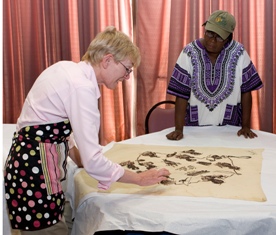
Mary Ballard, senior textile conservator at the
Smithsonian’s Museum Conservation Institute,
inspects an artifact during a “Treasures” event.

 
Participants can reserve in advance to bring up to three personal items for a 20-minute, one-on-one professional consultation with experts on how to care for them. The specialists will serve as reviewers, not appraisers, and will not determine items’ monetary values. Objects such as books, paper and textiles no larger than a shopping bag (furniture, carpets, firearms and paintings are excluded) can be reviewed. Those wishing to have items reviewed must make reservations by emailing treasures@si.edu or by calling toll free (877) 733-9599. Reservations are only required for those wishing a one-on-one consultation. Additional information is available at nmaahc.si.edu.

“We are extremely proud to bring ‘Save our African American Treasures’ to Dallas during Juneteenth weekend,” said Bunch. “We encourage people to become aware of what they have, to protect it and to preserve it so the story of African Americans in this country can be told. Nineteenth and 20th-century objects — family photographs, military uniforms, farm tools and wedding dresses — can help tell this story for future generations; if we do not act now to preserve these items, the tangible evidence of a critical component of American history will be lost.”

 
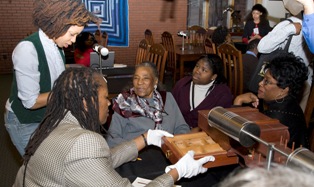
A participant from “Treasures” Atlanta meets with
senior objects conservator, Carol Grissom of the
Smithsonian’s Museum Conservation Institute.
“We are so honored that the Smithsonian’s National Museum of African American History and Culture is bringing this outstanding program to the Dallas Public Library,” said Hill.

The “Treasures” program also includes the following activities throughout the day:

 
Marion Butts: A Lens on Dallas:  Carol Roark, the Dallas Public Library’s manager of special collections, discusses its collection of photographs taken by one of the most important and prolific documentarians of African American life in the city.
Preservation Presentations:  Informal basic preservation sessions will take place during the day. The sessions will provide information on preserving clothing and textiles, family photographs and papers, and digital memories.  Participants will have the opportunity to ask questions.
Hands-on Preservation:  In this hands-on activity, participants are invited to learn how to properly store letters, pack garments and prepare photographs for preservation storage and presentation.

On Saturday, from 2 to 4 p.m., participants can meet 94.5 KSoul’s Kelli Simms.

Elaine Nichols, supervisory curator of culture at the
Smithsonian’s National Museum of African American
History and Culture, meets with 99 year old
Amelia Boynton Robinson during “Treasures” Atlanta.

 
“Save our African American Treasures” is made possible with support from the Bank of America Charitable Foundation and the W.K. Kellogg Foundation. The grants also support the pre-design and construction of the museum on the National Mall in Washington, D.C., scheduled to open in 2015.

As a companion to the series, the museum has produced African American Treasures: A Preservation Guide, a 30-page guidebook that is distributed free to attendees to highlight the importance of proper preservation techniques. The guidebook is part of the “Treasures” kit. Also distributed will be white cotton gloves, archival tissue papers and archival documents sleeves to help people keep their personal treasures safe.

The National Museum of African American History and Culture was established in 2003 by an Act of Congress, making it the 19th Smithsonian Institution museum. Scheduled for completion in 2015, it will be built on the National Mall in Washington, D.C., on a five-acre tract adjacent to the Washington Monument. Currently, during the pre-building phase, the museum is producing publications, hosting public programs and assembling collections. It is presenting exhibitions at other museums across the country and at its own gallery at the National Museum of American History. For more information about the museum, visit nmaahc.si.edu or call Smithsonian information at (202) 633-1000, (202) 633-5285 (TTY).

For information on the many free programs and services available at the Dallas Public Library, visit www.dallaslibrary.org. The Dallas Public Library operates the J. Erik Jonsson Central Library, 26 branch locations, Bookmarks in NorthPark Center and two bookmobiles. A library card is free for any Dallas resident.

National Museum of African American History and Culture


For All The World To See:
Visual Culture and the Struggle for Civil Rights

~~~~~~~~~~~~~~~~~

Sanitation workers assembled before Clayborn Temple
Ernest C. Withers, Sanitation Workers assemble in front of Clayborn
Temple for a solidarity march.
Memphis, TN, March 28, 1968.
Ernest C. Withers, Sanitation Workers assemble in front of Clayborn

Civil rights leaders and activists were often exceptionally skillful image-makers, adept at capitalizing on the authority of pictures to edify, educate, and persuade. They also understood, and took advantage of, new visual technologies as well as society’s insatiable hunger for pictures. Through compelling photographs, television and film clips, and other historic artifacts, For All the World to See explores the role of visual culture — from the late 1940s to the mid-1970s — in shaping and transforming the struggle for racial equality and justice.

Curated by Maurice Berger, Ph.D. For All The World To See was organized by the Center for Art, Design and Visual Culture, University of Maryland, Baltimore County, in partnership with the Smithsonian National Museum of African American History and Culture.

The exhibition opens June 10 and runs through November 24, 2011 in NMAAHC‘s gallery on level two at the Smithsonian National Museum of American History. For information about this exhibition please click here.

Equality hangs in the balance. Will you tip the scales? … from HRC


I just got off the phone with HRC Board Member Bruce Bastian. He’s challenged HRC supporters to raise $100,000 – and he’ll match every dollar with one of his own.

He’s doing it because big things are happening here at HRC and all across the country – thanks to you. You’ve helped run ads and mobilize thousands of volunteers in an all-out blitz to win marriage equality in New York. You helped bring 250 pro-equality clergy members to Capitol Hill this week. And together we’ve sparked a new, national conversation about homophobia in sports.

But make no mistake. We could win in New York – or right-wing hatred could prevail. More sports stars could support equality – or more slurs could air on national TV. Speaker Boehner could stop spending tax dollars to defend discrimination in the DOMA case – or we could see a resurgence of discriminatory efforts in Congress.

It all depends on how quickly we can react to a crisis, on how skillfully we can fight when it counts – and on you.

www.hrc.org

Don’t miss this chance to double your impact – all gifts will be matched up to $100,000.

Look around. From TV sitcoms to professional sports, to new polls showing unprecedented support for equality – we’ve reached a tipping point in our culture.

After years of discrimination, when a single victory for LGBT equality was cause for hope, we are now in a place where it’s hate that’s out of place. And you’ve been at the center of that change. In just the past few months, look what you’ve accomplished:

•After an outcry from HRC supporters, a major law firm dropped its defense of the discriminatory Defense of Marriage Act (DOMA).

•After HRC’s rapid-response campaign in major media outlets and on Twitter, all-star Kobe Bryant personally called me to apologize for calling a referee a “f***ing f***ot” in front of millions of young viewers – and the commissioner of the NBA fined him an unprecedented $100,000.

•Star athletes such as the NBA’s Steve Nash and the NHL’s Sean Avery have joined our “New Yorkers for Marriage Equality” campaign – the videos are everywhere from cable TV to New York City cabs right now – and when Avery was attacked for his brave stand, thousands of you spoke out in his defense.

•Mayors, governors, actors, past presidents and even George W. Bush’s daughter Barbara have all joined HRC’s campaign for marriage equality in New York.

And, for the first time ever, polls show a majority of Americans support marriage equality – not just civil unions.

These aren’t unconnected events. But this moment is only what we make of it. People like you generously funded ads, fueled outreach to prominent figures, and gave us the strength to respond to attacks without delay – and to seize this opportunity, we’ll need you again.

www.hrc.org

Don’t miss out: have your gift MATCHED in the next seven days.

We can create a sea change in our society – but we may still slip backward. I know that HRC supporters like you will be the deciding factor, and that we can count on you to fight.

Let’s tip the scales,

Joe Solmonese

President