Category Archives: ~ politics petitions pollution and pop culture

1765 – STAMP ACT CONGRESS – Oct 7th – 25th – Nov. 1, 1765 goes into effect


The Stamp Act Congress, which met in New York City from October 7 to 25, 1765, was the first gathering of representatives from several American colonies to devise a unified protest against British taxation. The congress adopted petitions to the British government spelling out the colonial grievances that would eventually lead to the Revolution while simultaneously laying the groundwork for future cooperation between the colonies. It was the forerunner of the Continental Congresses that would meet nearly a decade later to coordinate resistance to British polices.

The costs of fighting the French and Indian War (1754–1763) had left Great Britain burdened with an immense debt. British officials believed that the American colonists, who had benefited from the war by the expulsion of the French from Canada, and who were being protected from their Native American neighbors by British troops, should pay part of the expenses.

The first measure designed to increase revenues from the colonies, the Sugar Act of 1764, imposed import duties on foreign molasses while tightening enforcement of customs laws to reduce smuggling. Although many Americans disliked the Sugar Act, opposition was limited because the colonists accepted the British government’s right to impose trade duties. But the next colonial revenue law, the Stamp Act, provoked fierce opposition

For the complete article, encylopedia.com

on this day 11/1


1512 – Michelangelo’s paintings on the ceiling of the Sistine Chapel were first exhibited to the public.

1604 – “Othello,” the tragedy by William Shakespeare, was first presented at Whitehall Palace in London. 

1611 – “The Tempest,” Shakespeare’s romantic comedy, was first presented at Whitehall Palace in London. 

1755 – At least 60,000 people were killed in Lisbon, Portugal by an earthquake, its aftershocks and the ensuing tsunami.

1765 – The British Parliament enacted The Stamp Act in the American colonies. The act was repealed in March of 1766 on the same day that the Parliament passed the Declaratory Acts which asserted that the British government had free and total legislative power of the colonies.

1800 – U.S. President John Adams became the first president to live in the White House when he moved in.

1848 – The first medical school for women, founded by Samuel Gregory, opened in Boston, MA. The Boston Female Medical School later merged with Boston University School of Medicine.

1856 – The first photography magazine, Daguerreian Journal, was published in New York City, NY.

1861 – Gen. George B. McClellan was made the general-in-chief of the American Union armies.

1864 – The U.S. Post Office started selling money orders. The money orders provided a safe way to payments by mail.

1870 – The U.S. Weather Bureau made its first meteorological observations using 24 locations that provided reports via telegraph. 

1879 – Thomas Edison executed his first patent application for a high-resistance carbon filament (U.S. Pat. 223,898).

1890 – African-Americans are disenfranchised. The Mississippi Plan, approved on November 1, used literacy and “understanding” tests to disenfranchise black American citizens. Similar statutes were adopted by South Carolina (1895), Louisiana (1898), North Carolina (1900), Alabama (1901), Virginia (1901), Georgia (1908), and Oklahoma (1910). blackfacts.com

1894 – “Billboard Advertising” was published for the first time. It later became known as “Billboard.”

1894 – Russian Emperor Alexander III died.

1898 – Allen, C. W. Self_leveling table Nov. 1, 1898 Patent No.613,436 blackfacts.com

1904 – The Army War College in Washington, DC, enrolled the first class.

1911 – Italy used planes to drop bombs on the Tanguira oasis in Libya. It was the first aerial bombing.

1936 – Benito Mussolini made a speech in Milan, Italy, in which he described the alliance between Italy and Nazi Germany as an “axis” running between Berlin and Rome.

1937 – “Hilltop House” was aired for the first time on CBS Radio.

1937 – “Terry and the Pirates” debuted on NBC Radio.

1940 – “A Night in the Tropics” was released. It was the first movie for Abbott and Costello.

1944 – “Harvey,” by Mary Chase, opened on Broadway.

1947 – The famous racehorse Man o’ War died.

1949 – In Washington, 55 people were killed when a fighter plane hit an airliner.

1950 – Two Puerto Rican nationalists tried to assassinate U.S. President Harry Truman. One of the men was killed when they tried to force their way into Blair House in Washington, DC.

1952 – The United States exploded the first hydrogen bomb on Eniwetok Atoll in the Marshall Islands.

1954 – Algeria began to rebel against French rule.

1959 – Jacques Plante, of the Montreal Canadiens, became the first goalie in the NHL to wear a mask.

1963 – The USSR launched Polyot I. It was the first satellite capable of maneuvering in all directions and able to change its orbit.

1968 – The movie rating system of G, M, R, X, followed by PG-13 and NC-17 went into effect.

1973 – Leon Jaworski was appointed the new Watergate special prosecutor in the Watergate case.

1979 – Ayatollah Ruhollah Khomeini urged all Iranians to demonstrate on November 4 and to expand their attacks against the U.S. and Israel. On November 4, Iranian militants seized the U.S. embassy in Tehran and took 63 Americans hostage.

1981 – The U.S. Postal Service raised the first-class letter rate to 20 cents.

1985 – In the village of Ignacio Aldama, 22 members of a Mexican anti-narcotics squad were killed by alleged drug traffickers.

1987 – Deng Xiaoping retired from China’s Communist Party’s Central Committee.

1989 – Tens of thousands of refugees to fled to the West when East Germany reopened its border with Czechoslovakia.

1989 – Nicaraguan President Daniel Ortega announced the end of a cease-fire with the Contra rebels.

1993 – The European Community’s treaty on European unity took effect.

1994 – The Amazon.com domain name was registered.

1995 – In Dayton, OH, the Bosnian peace talks opened with the leaders of Bosnia, Serbia and Croatia present.

1998 – Nicaraguan Vice President Enrique Bolanos announced that between 1,000 and 1,500 people were buried in a 32-square mile area below the slopes of the Casita volcano in northern Nicaragua by a mudslide caused by Hurricane Mitch.

1998 – Iridium inaugurated the first handheld, global satellite phone and paging system.

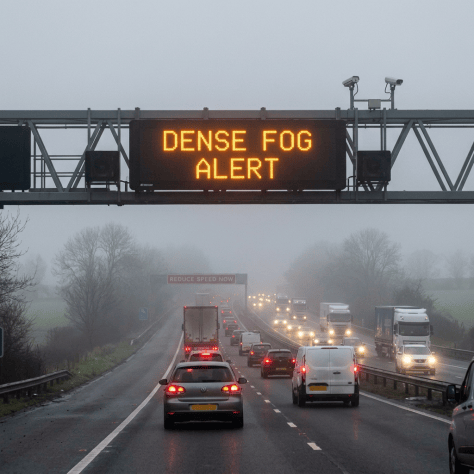
WA ~ Dense Fog ~ Advisory


Electronic motorway sign reading “DENSE FOG ALERT” above traffic in heavy fog
A motorway message board warns drivers of dense fog as traffic moves cautiously through low visibility.

Official update

What: Visibility one-quarter mile or less in dense fog.

Where: Eastern Kitsap County, City of Seattle, Downtown Everett / Marysville Area, Eastside, Lowlands of Lewis and Southern Thurston Counties, Lowlands of Pierce and Southern King Counties, Olympia and Southern Puget Sound, and Shoreline / Lynnwood / South Everett Area.

When: Until 11 AM PST in some areas this morning.

Impacts: Low visibility could make driving conditions hazardous.

Additional Details: Localized freezing fog may also occur as temperatures fall into the 30s for many locations.

Summary: If driving, slow down, use your headlights, and leave plenty of distance ahead of you.

Issued By: NWS Seattle WA

Safety tips

Driving in Fog:

Slow down and allow extra time.

Use low-beam headlights and fog lights if available.

Avoid high-beam lights to prevent glare.

Maintain a safe distance from other vehicles.

Follow road lines to stay in your lane.

In extremely dense fog, turn on hazard lights and pull into a safe location. If not possible, pull off the road, turn off all lights except hazard lights, set the emergency brake, and take your foot off the brake pedal.

Marine Navigation in Fog:

Fog is dense if visibility is less than 1 mile (1.6 kilometers).

Visibility categories

Very Poor: Less than 0.5 nautical miles (0.93 kilometers)

Poor: 0.5 to less than 2 nautical miles (0.93 to 3.7 kilometers)

Moderate: 2 to 5 nautical miles (3.7 to 9.3 kilometers)

Good: Greater than 5 nautical miles (9.3 kilometers)

Slow down to avoid collisions.

Turn on all running lights, even during the day.

Listen for sounds of other boats, fog horns, and bells from buoys.

Use radar and GPS or navigation charts to locate your position.

If disoriented, stay put until the fog lifts, ensuring you are in a safe location.

Know the horn and bell sounds to warn others in dense fog.

Have a compass to determine your direction.

Stay out of shipping lanes as large ships cannot see you.

Hazard information

Fog, particularly when dense, can be hazardous to drivers, mariners and aviators. Fog contributes to numerous travel accidents every year. Restrictions in visibility resulting from fog can also impact takeoff and landing procedures and requirements for pilots, and can be the cause of weather-related aviation delays.

Radiation Fog
Forms at night when the ground cools rapidly, causing the air above it to cool and reach its dew point. This type of fog is common in valleys and low-lying areas.

Advection Fog
Occurs when warm, moist air moves over a cooler surface, causing the air to cool to its dew point. This type of fog is often seen along coastlines.

Valley Fog
Forms in valleys, typically during the winter, when cold air settles in the valley and cools the air to its dew point.

Upslope Fog
Develops when moist air is forced to ascend a slope, cooling as it rises and forming fog.

Freezing Fog
Occurs when the temperature is below freezing, and the fog droplets freeze upon contact with surfaces, creating a layer of ice.

Ice Fog
Found in polar and Arctic regions, this fog consists of tiny ice crystals rather than water droplets.

Steam Fog
Forms when cold air moves over warmer water, causing the water to evaporate and then condense into fog as it mixes with the cold air.

1765 – Nine American colonies sent a total of 28 delegates to New York City for the Stamp Act Congress. The delegates adopted the “Declaration of Rights and Grievances.”


Federal Hall in New York City where the Stamp Act Congress took place. The Stamp Act Congress met in the Federal Hall building in New York City between October 7 and 25, 1765. It was the first colonial action against a British measure and was formed to protest the Stamp Act issued by British Parliament on March 1765. The Stamp Act Congress was attended by 27 representatives of nine of the thirteen colonies. Virginia, North Carolina and Georgia were prevented from attending because their loyal governors refused to convene the assemblies to elect delegates. New Hampshire did not attend but approved the resolutions once Congress was over.

Congress approved thirteen resolutions in the Declaration of Rights and Grievances. It is important to note that colonists, at that point in time, were not intending on separation from the crown. In the first resolution, they stated their allegiance to the king and its Parliament. They declared and affirmed that they were entitled to the rights and liberties of all British subjects. Most importantly they asserted their right to “No taxation without representation” and that because of their circumstances, America was three thousand miles away, they could not be represented in the House of Commons in Britain. The only bodies legally able to impose an internal tax were their respective legislatures whose members were elected by the public.

The Stamp Act Congress declared the Stamp Act duties as extremely bothersome as the scarcity of specie made its payment impractical. Local profits would suffer from the payment of the duty ultimately affecting transatlantic trade. Congress also supported the boycott of British goods.

The colonists also wanted to reassert their right to trial by jury as an inherent right to all British subjects in the colonies and limit the jurisdiction of Admiralty Courts. These courts could try a case anywhere within the British Empire; cases were decided by judges instead than by juries. In addition, judges and naval officers were paid based on the fines they levied leading to abuses.

The colonial petition was rejected on the basis of having been submitted by an unconstitutional assembly. The Stamp Act was eventually repealed primarily based on economic concerns expressed by British merchants.

However, parliament in order to reassert its power and constitutional issues over its right to tax its colonies passed the Declaratory Act.

Colonies sent the following delegates to the Stamp Act Congress:

From Massachusetts: James Otis, Samuel Adams, Oliver Partridge and Timothy Ruggles.
From Rhode Island: Henry Ward and Metcalf Bowler
From Connecticut: William Johnson, Eliphalet Dyer and David Rowland.
From New York: Phillip Livingston, William Bayard, John Cruger, Robert Livingston and Leonard Lispinard.
From Pennsylvania: John Morton, George Bryan and John Dickinson.
From New Jersey: Hendrick Fisher, Robert Ogden and Joseph Gordon.
From Delaware: Caesar Rodney and Thomas McKean.
From Maryland: Edward Tilghman, Thomas Ringgold and William Murdock.
From South Carolina: John Rutledge, Thomas Lynch and Christopher Gadsden.
Secretary: John Cotton
President: Timothy Ruggles from Massachusetts

Resource: stamp-act-history.com

image from wiki

11 Pillars of Fascism


one angle …

In this post, I’ll walk through the 11 pillars of fascism — as defined by historians and political theorists — and provide concrete proof points that show how each one is manifesting under the Trump administration.

These are not hypotheticals. These are happening now.

Let’s get into it.

1. Authoritarianism: Centralized Power and Suppression of Dissent

Fascist Pattern: Consolidation of power by a single leader or ruling party, often accompanied by the suppression of opposition and the erosion of checks and balances.

Proof Points:

  • Retaliation Against Legal Professionals: The Trump administration has targeted law firms representing political opponents, revoking security clearances and initiating investigations, thereby undermining the independence of the legal system.1
  • Utilization of the Alien Enemies Act: The administration invoked this rarely used act to deport individuals without due process, exemplifying authoritarian overreach.2
  • Project 2025: A comprehensive plan by The Heritage Foundation aiming to consolidate executive power and replace civil servants with loyalists, effectively dismantling the administrative state.3

2. Ultra-nationalism: Elevating the Nation Above All

Fascist Pattern: Promoting a sense of national superiority, often at the expense of marginalized groups and international cooperation.

Proof Points:

  • “America First” Policies: The administration’s rhetoric and policies prioritize national interests, leading to strained international relations and the alienation of allies.
  • Immigration Crackdowns: Aggressive deportation strategies, including the deportation of individuals to countries where they face persecution, reflect a disregard for international human rights norms.

3. Militarism and Violence: Glorification of Strength and Force

Fascist Pattern: Emphasizing military power and the use of violence to achieve political ends.

Proof Points:

  • Deployment of Federal Forces Against Protesters: The use of federal agencies to suppress domestic protests demonstrates a militaristic approach to civil dissent.
  • Advocacy for Harsh Law Enforcement Measures: Endorsements of aggressive policing tactics and the pardoning of officials convicted of violent actions signal an acceptance of violence within governance.

4. Scapegoating and Propaganda: Blaming ‘The Other’

Fascist Pattern: Attributing national problems to specific groups, often minorities, to divert attention from governmental shortcomings.

Proof Points:

  • Targeting of Immigrants: Labeling migrants as criminals or terrorists without substantial evidence, leading to policies like mass deportations to dangerous environments.4
  • Discrediting of Media Outlets: Frequent accusations of “fake news” aimed at undermining the credibility of independent journalism.

5. Anti-democracy and Anti-liberalism: Undermining Democratic Institutions

Fascist Pattern: Erosion of democratic norms and institutions, often through the delegitimization of electoral processes and the judiciary.

Proof Points:

  • Challenging Election Legitimacy: Persistent claims of electoral fraud without evidence, aiming to erode public trust in democratic processes.
  • Defiance of Court Orders: Ignoring or circumventing judicial rulings, such as the refusal to comply with orders to return wrongfully deported individuals.5

6. Cult of Personality: Elevating the Leader

Fascist Pattern: Creating an idealized and heroic image of the leader, often demanding unwavering loyalty.

Proof Points:

  • Personalization of Political Power: The leader’s name and image are prominently used in political campaigns and government communications, emphasizing personal loyalty over institutional allegiance.
  • Attacks on Critics: Public denunciations and threats against political opponents, former allies, and dissenting voices within the administration.6

7. Control of Information: Censorship and Manipulation

Fascist Pattern: Manipulating or controlling media and information to suppress dissent and promote the regime’s narrative.

Proof Points:

  • Defunding Independent Media: Cutting funds to organizations like Radio Free Asia and Voice of America, jeopardizing journalistic independence.7
  • Surveillance of Journalists: Implementing measures that intimidate and suppress investigative journalism.

8. Suppression of Unions and Dissent: Silencing Opposition

Fascist Pattern: Cracking down on labor movements and any form of organized opposition.

Proof Points:

  • Targeting Academic Institutions: Freezing federal funds to universities like Cornell and Northwestern under the guise of addressing campus protests, thereby stifling academic freedom.8
  • Executive Orders Against Law Firms: Issuing directives that penalize law firms perceived as oppositional, undermining the right to legal representation.9

9. Corporatism / Crony Capitalism: Favoring Loyal Businesses

Fascist Pattern: Economic power is consolidated among favored corporations that align with the state, undermining fair competition.

Proof Points:

  • Preferential Treatment for Allies: The administration has implemented policies that benefit certain businesses, often those with political connections, while sidelining competitors.
  • Tariff Policies Impacting Small Businesses: The imposition of tariffs under the guise of national security has disproportionately affected small businesses, while larger corporations with government ties have navigated these challenges more effectively.10

10. Sexism and Gender Control: Enforcing Traditional Roles

Fascist Pattern: Traditional gender roles are aggressively enforced, with policies that marginalize women and LGBTQ+ individuals.

Proof Points:

  • Executive Orders Limiting Gender Recognition: The administration has issued orders defining sex strictly as male or female based on biological characteristics, effectively erasing recognition of transgender and non-binary identities.11
  • Restrictions on Gender-Affirming Care: Policies have been enacted to limit or prohibit gender-affirming care, particularly for minors, framing such care as harmful despite medical consensus on its benefits.12

11. Fear as a Tool: Maintaining Control Through Anxiety

Fascist Pattern: A constant state of crisis is maintained to justify authoritarian measures and suppress dissent.

Proof Points:

  • Use of Emergency Powers for Trade Policies: The administration has invoked emergency powers to implement trade policies, such as tariffs, under the pretext of national security threats, fostering a climate of fear and uncertainty.13
  • Rhetoric Targeting Marginalized Groups: Public statements and policies have often portrayed immigrants and LGBTQ+ individuals as threats to societal values, fueling fear and justifying restrictive measures.14

These examples, which don’t include any presidential actions, illustrate a troubling alignment with the core aspects of fascism.

It’s imperative to remain vigilant and advocate for democratic principles and human rights.

Source: pathfinderchronicles.com