Category Archives: ~ politics petitions pollution and pop culture

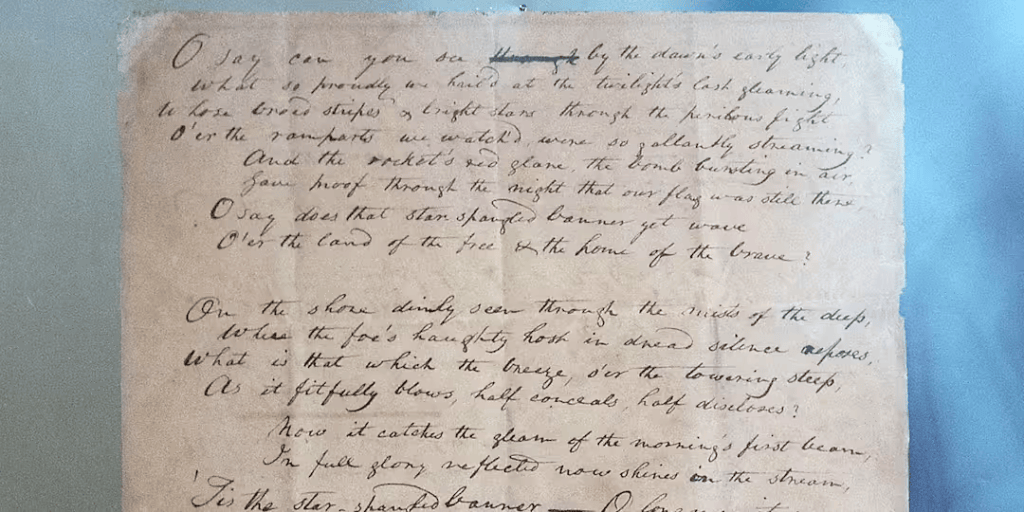
1814 ~ Francis Scott Key pens “The Star-Spangled Banner”


Published: November 24, 2009

On September 14, 1814, Francis Scott Key pens a poem which is later set to music and in 1931 becomes America’s national anthem, “The Star-Spangled Banner.” The poem, originally titled “The Defence of Fort M’Henry,” was written after Key witnessed the Maryland fort being bombarded by the British during the War of 1812. Key was inspired by the sight of a lone U.S. flag still flying over Fort McHenry at daybreak, as reflected in the now-famous words of the “Star-Spangled Banner”: “And the rocket’s red glare, the bombs bursting in air, Gave proof through the night that our flag was still there.”

Francis Scott Key was born on August 1, 1779, at Terra Rubra, his family’s estate in Frederick County (now Carroll County), Maryland. He became a successful lawyer in Maryland and Washington, D.C., and was later appointed U.S. attorney for the District of Columbia.

Source: history.com for the complete article

on this day 9/14


1807 – Former U.S. Vice President Aaron Burr was acquitted of a misdemeanor charge. Two weeks earlier Burr had been found innocent of treason.

1812 – Moscow was set on fire by Russians after Napoleon Bonaparte’s troops invaded.

1814 – Francis Scott Key wrote the “Star-Spangled Banner,” a poem originally known as “Defense of Fort McHenry,” after witnessing the British bombardment of Fort McHenry, MD, during the War of 1812. The song became the official U.S. national anthem on March 3, 1931. 

1847 – U.S. forces took control of Mexico City under the leadership of General Winfield Scott.

1866 – George K. Anderson patented the typewriter ribbon.

1899 – In New York City, Henry Bliss became the first automobile fatality.

1901 – U.S. President William McKinley died of gunshot wounds inflicted by an assassin. Vice President Theodore Roosevelt, at age 42, succeeded him.

1915 – Carl G. Muench received a patent for Insulit, the first sound-absorbing material to be used in buildings.

1938 – The VS-300 made its first flight. The craft was based on the helicopter technology patented by Igor Sikorsky.

1940 – The Selective Service Act was passed by the U.S. Congress providing the first peacetime draft in the United States.

1948 – In New York, a groundbreaking ceremony took place at the site of the United Nations’ world headquarters.

1959 – Luna II, a Soviet space probe, became the first man-made object on the moon when it crashed on the surface.

1960 – The Organization of the Petroleum Exporting Countries (OPEC) was founded. The core members were Iran, Iraq, Kuwait, Saudi Arabia, and Venezuela.

1963 – Mary Ann Fischer gave birth to America’s first surviving quintuplets.

1965 – “My Mother The Car” premiered on NBC TV. The series was canceled after only a few weeks after the debut.

1972 – “The Waltons” premiered on CBS-TV.

1975 – Pope Paul VI declared Mother Elizabeth Ann Bayley Seton the first U.S.-born saint.

1978 – “Mork & Mindy” premiered on ABC-TV.

1983 – The U.S. House of Representatives voted 416-0 in a resolution condemning the Soviet Union for the shooting down of a Korean jet on September 1. 

1984 – Joe Kittinger became the first person to fly a balloon solo across the Atlantic Ocean.

1987 – Tony Magnuson cleared 9.5 feet above the top of the U-ramp and set a new skateboard high jump record.

1989 – Joseph T. Wesbecker shot and killed eight people and wounded twelve others at a printing plant in Louisville, KY. Wesbecker, 47 years old, was on disability for mental illness. He took his own life after the incident.

1994 – It was announced that the season was over for the National Baseball League on the 34th day of the players strike. The final days of the regular season were canceled.

1998 – Jaime Jarrin received a star on the Hollywood Walk of Fame.

1998 – Israel announced that they had successfully tested its Arrow-2 missile defense system. The system successfully destroyed a simulated target.

1999 – Disney World closed down for the first time in its 28-year history. The closure was due to Hurricane Floyd heading for Florida
Disney movies, music and books 

2001 – Nintendo released the GameCube home video game console in Japan.

2001 – The FBI released the names of the 19 suspected hijackers that had taken part in the September 11 terror attacks on the U.S.

2009 – Greyhound UK began operations as an hourly service between London and Portsmouth or Southampton.

2015 – In Livingston, LA, and Hanford, WA, the Laser Interferometer Gravitational-wave Observatory (LIGO) detectors detected gravitational waves for the first time. The news was reported on February 11, 2016.

1957 Central High School integrated – September 4 ~25,1957


Called, The Little Rock Nine

Under escort from the U.S. Army’s 101st Airborne Division, nine black students enter all-white Central High School in Little Rock, Arkansas. Three weeks earlier, Arkansas Governor Orval Faubus had surrounded the school with National Guard troops to prevent its federal court-ordered racial integration. After a tense standoff, President Dwight D. Eisenhower federalized the Arkansas National Guard and sent 1,000 army paratroopers to Little Rock to enforce the court order.

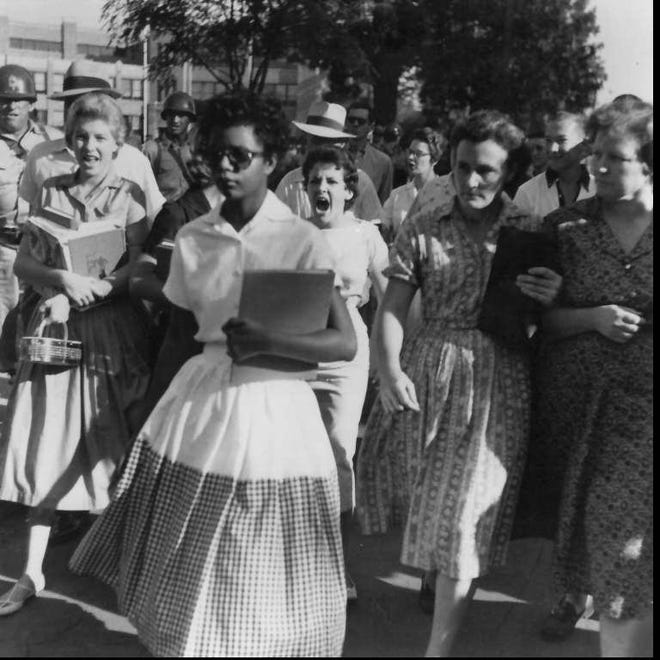
On May 17, 1954, the U.S. Supreme Court ruled unanimously in Brown v. Board of Education of Topeka that racial segregation in educational facilities was unconstitutional. Five days later, the Little Rock School Board issued a statement saying it would comply with the decision when the Supreme Court outlined the method and time frame in which desegregation should be implemented.Whites harass Elizabeth Eckford, one of nine African-American students attempting to attend Central High School in Little Rock, Ark., on Sept. 4, 1957. The governor sent National Guard troops in to keep the nine out.
Arkansas was at the time among the more progressive Southern states in regard to racial issues. The University of Arkansas School of Law was integrated in 1949, and the Little Rock Public Library in 1951. Even before the Supreme Court ordered integration to proceed “with all deliberate speed,” the Little Rock School Board in 1955 unanimously adopted a plan of integration to begin in 1957 at the high school level. The National Association for the Advancement of Colored People (NAACP) filed suit, arguing the plan was too gradual, but a federal judge dismissed the suit, saying that the school board was acting in “utmost good faith.” Meanwhile, Little Rock’s public buses were desegregated. By 1957, seven out of Arkansas’ eight state universities were integrated.

In the spring of 1957, there were 517 black students who lived in the Central High School district. Eighty expressed an interest in attending Central in the fall, and they were interviewed by the Little Rock School Board, which narrowed down the number of candidates to 17. Eight of those students later decided to remain at all-black Horace Mann High School, leaving the “Little Rock Nine” to forge their way into Little Rock’s premier high school.

In August 1957, the newly formed Mother’s League of Central High School won a temporary injunction from the county chancellor to block integration of the school, charging that it “could lead to violence.” Federal District Judge Ronald Davies nullified the injunction on August 30. On September 2, Governor Orval Faubus—a staunch segregationist—called out the Arkansas National Guard to surround Central High School and prevent integration, ostensibly to prevent the bloodshed he claimed desegregation would cause. The next day, Judge Davies ordered integrated classes to begin on September 4. 

September 4, 1957: Arkansas troops block “Little Rock Nine” from segregated high school

That morning, 100 armed National Guard troops encircled Central High School. A mob of 400 white civilians gathered and turned ugly when the black students began to arrive, shouting racial epithets and threatening the teenagers with violence. The National Guard troops refused to let the black students pass and used their clubs to control the crowd. One of the nine, 15-year-old Elizabeth Eckford, was surrounded by the mob, which threatened to lynch her. She was finally led to safety by a sympathetic white woman.

Little Rock Mayor Woodrow Mann condemned Faubus’ decision to call out the National Guard, but the governor defended his action, reiterating that he did so to prevent violence. The governor also stated that integration would occur in Little Rock when and if a majority of people chose to support it. Faubus’ defiance of Judge Davies’ court order was the first major test of Brown v. Board of Educationand the biggest challenge of the federal government’s authority over the states since the Reconstruction Era.

The standoff continued, and on September 20 Judge Davies ruled that Faubus had used the troops to prevent integration, not to preserve law and order as he claimed. Faubus had no choice but to withdraw the National Guard troops. Authority over the explosive situation was put in the hands of the Little Rock Police Department.

On September 23, as a mob of 1,000 whites milled around outside Central High School, the nine black students managed to gain access to a side door.

However, the mob became unruly when it learned the black students were inside, and the police evacuated them out of fear for their safety. That evening, President Eisenhower issued a special proclamation calling for opponents of the federal court order to “cease and desist.” On September 24, Little Rock’s mayor sent a telegram to the president asking him to send troops to maintain order and complete the integration process. Eisenhower immediately federalized the Arkansas National Guard and approved the deployment of U.S. troops to Little Rock. That evening, from the White House, the president delivered a nationally televised address in which he explained that he had taken the action to defend the rule of law and prevent “mob rule” and “anarchy.”

On September 25, the Little Rock Nine entered the school under heavily armed guard.

Troops remained at Central High School throughout the school year, but still the black students were subjected to verbal and physical assaults from a faction of white students. Melba Patillo, one of the nine, had acid thrown in her eyes, and Elizabeth Eckford was pushed down a flight of stairs. The three male students in the group were subjected to more conventional beatings. Minnijean Brown was suspended after dumping a bowl of chili over the head of a taunting white student. She was later suspended for the rest of the year after continuing to fight back. The other eight students consistently turned the other cheek. On May 27, 1958, Ernest Green, the only senior in the group, became the first black to graduate from Central High School.

Governor Faubus continued to fight the school board’s integration plan, and in September 1958 he ordered Little Rock’s three high schools closed rather than permit integration. Many Little Rock students lost a year of education as the legal fight over desegregation continued. In 1959, a federal court struck down Faubus’ school-closing law, and in August 1959 Little Rock’s white high schools opened a month early with black students in attendance.

All grades in Little Rock public schools were finally integrated in 1972

9/13 1787-1788 – The Constitutional Convention decided that the first federal election was to be held on Wednesday the following February. On that day George Washington was elected as the first president of the United States.


The Constitutional Convention decided that the first federal election was to be held on Wednesday the following February.

On that day George Washington was elected as the first president of the United States.

In addition, New York City was named the temporary national capital.

on this day … 9/13


1759 – The French were defeated by the British on the Plains of Abraham in the final French and Indian War.

1788/1787 – The Constitutional Convention decided that the first federal election was to be held on Wednesday the following February. On that day George Washington was elected as the first president of the United States. In addition, New York City was named the temporary national capital.

1789 – The United States Government took out its first loan. 

1847 – U.S. forces took the hill Chapultepec during the Mexican-American War.

1862 – During the American Civil War General Lee’s Order No. 191 was found by federal soldiers in Maryland.

1898 – Hannibal Williston Goodwin patented celluloid photographic film, which is used to make movies.

1922 – In El Azizia, Libya, the highest shade temperature was recorded at 136.4 degrees Fahrenheit.

1935 – Aviator Howard Hughes, Jr., of Houston, set a new airspeed record of 352 mph with his H-1 airplane (Winged Bullet).

1937 – The first broadcast of “Kitty Keene, Incorporated” was heard on the NBC Red network.

1943 – Chiang Kai-shek became the president of China.

1948 – The School of Performing Arts opened in New York City. It was the first public school to specialize in performing arts.

1948 – Margaret Chase Smith was elected to the U.S. Senate and became the first woman to serve in both houses of the U.S. Congress. 

1949 – The Ladies Professional Golf Association of America was formed.

1959 – The Soviet Union’s Luna 2 became the first space probe to reach the moon. It was launched the day before.

1960 – The U.S. Federal Communications Commission banned payola. 

1970 – The first New York City Marathon took place. Fireman Gary Muhrucke won the race.

1971 – In New York, National Guardsmen stormed the Attica Correctional Facility and put an end to the four-day revolt. A total of 43 people were killed in the final assault. A committee was organized to investigate the riot on September 30, 1971.

1971 – The World Hockey Association was formed.

1977 – The first diesel automobiles were introduced by General Motors.

1981 – U.S. Secretary of State Alexander M. Haig said the U.S. had physical evidence that Russia and its allies used poisonous biological weapons in Laos, Cambodia and Afghanistan. 

1988 – Forecasters reported that Hurricane Gilbert’s barometric pressure measured 26.13. It was the strongest hurricane ever recorded in the Western Hemisphere. 

1993 – Israel and Palestine signed their first major agreement. Palestine was granted limited self-government in the Gaza Strip and in Jericho.

1994 – U.S. President Bill Clinton signed a $30 billion crime bill into law.

1998 – The New York Times closed its Web site after hackers added offensive material.

2001 – U.S. Secretary of State Colin Powell named Osama bin Laden as the prime suspect in the terror attacks on the United States on September 11, 2001. Limited commercial flights resumed in the U.S. for the first time in two days.