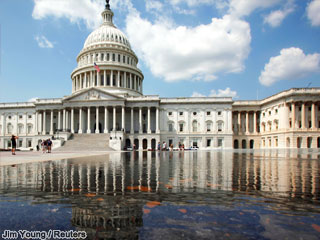
Congress: -the Republican led House -the Senate …both meet @10amET


The Senate convenes at 10:00amET Thursday 3, 2011

Following any Leader remarks, the Senate will proceed to a period of morning business until 11:00am with senators permitted to speak therein for up to 10 minutes each. The Republicans will control the first half and the Majority will control the final half.

At 11:00am, the Senate will resume consideration of S.23, the America Invents Act.

The following amendments are pending to S.23:

– Leahy amendment #114 (Title amendment)

– Bennet amendment #116 (small business fast track)

The Senate has reached an agreement to vote at 12:30pm in relation to the Feinstein amendment #133, as modified (strikes first to file provisions in the bill). The time until 12:30pm will be equally divided and controlled between the proponents and opponents with no amendments in order to the Feinstein amendment prior to the vote.

There will be a period of morning business from 2-4pm. The Majority will control the first hour and the Republicans will control the next hour.

This evening, Senator Reid filed cloture on S.23, the America Invents Act. By consent, the cloture vote will occur after the 2 judge votes on Monday, March 7 (the 2 judge votes will begin at 5:30pm).

As a result of cloture being filed, the filing deadline for first degree amendments is 1pm tomorrow, Friday, March 4. If your senator has a germane amendment and would like to preserve the ability to offer, please send a signed copy of the amendment to the cloakroom prior to the deadline so that we may file it at the desk for you. If you have already filed, there is no need to refile.

Votes:

31: Grassley motion to table the Feinstein amendment #133: , as modified; Tabled: 87-13

There will be no further roll call votes today.

Unanimous Consent:

Agreed to the Stabenow amendment #126 (Detroit satellite office) by voice vote

Agreed to Bingaman amendment #142 (PTO length of time between reviews).

Passed HR662, Surface Transportation Extension Act of 2011.

Adopted S.Res89, a resolution relating to the death of Frank W. Buckles, the longest surviving United States veteran of the First World War.

Adopted S.Res.90, a resolution supporting the goal of “International Women’s Day” and recognizing this year’s centennial anniversary of National Women’s Day.

S.Res.91, a resolution supporting the goals and ideals of Multiple Sclerosis Awareness Week.

Adopted S.Res.92, a resolution to authorize the payment of legal expenses of Senate employees out of the contingent fund of the Senate.

Confirmed the following nominations:

#35 Daniel L. Shields III, of Pennsylvania, a Career Member of the Senior Foreign Service, Class of Counselor, to be Ambassador Extraordinary and Plenipotentiary of the United States of America to Brunei Darussalam.

#36 Pamela L. Spratlen, of California, a Career Member of the Senior Foreign Service, Class of Counselor, to be Ambassador Extraordinary and Plenipotentiary of the United States of America to the Kyrgyz Republic.

#37 Sue Kathrine Brown, of Texas, a Career Member of the Senior Foreign Service, Class of Minister-Counselor, to be Ambassador Extraordinary and Plenipotentiary of the United States of America to Montenegro.

#38 David Lee Carden, of New York, to be Representative of the United States of America to the Association of Southeast Asian Nations, with the rank of Ambassador Extraordinary and Plenipotentiary.

#39 Eric G. Postel, of Wisconsin, to be an Assistant Administrator of the United States Agency for International Development, vice Jacqueline Ellen Schafer, resigned.

((((((((((((((((((((((((((((((((((((((((((((((((((((((((((((((((((((((((

CURRENT HOUSE FLOOR PROCEEDINGS

LEGISLATIVE DAY OF MARCH 3, 2011

112TH CONGRESS – FIRST SESSION

2:47 P.M. –

SPECIAL ORDER SPEECHES – The House has concluded all anticipated legislative business and has proceeded to Special Order speeches.

2:41 P.M. –

ONE MINUTE SPEECHES – The House proceeded further with one minute speeches.

Mr. Cantor asked unanimous consent That, when the House adjourns on Tuesday, March 8, 2011, it adjourn to meet at 10:00 a.m. on Wednesday, March 9, 2011 Agreed to without objection.

Mr. Cantor asked unanimous consent That, when the House adjourns on Friday, March 4, 2011, it adjourn to meet at 2:00 p.m. on Tuesday, March 8, 2011 for Morning-Hour Debate. Agreed to without objection.

Mr. Cantor asked unanimous consent That, when the House adjourns on Thursday, March 3, 2011, it adjourn to meet at 2:00 p.m. on Friday, March 4, 2011. Agreed to without objection.

H.R. 4:

to repeal the expansion of information reporting requirements for payments of $600 or more to corporations, and for other purposes

2:11 P.M. –

Motion to reconsider laid on the table Agreed to without objection.

On passage Passed by recorded vote: 314 – 112 (Roll no. 162).

1:46 P.M. –

Point of order raised by Mr. Weiner on the voice vote of the measure. Mr Weiner stated that the bill purportedly included a Federal income tax increase making the clause 5b of Rule XXI requirement for a three-fifths majority for passage of the measure applicable. Point of order overruled by the Chair.

1:43 P.M. –

On motion to table the motion to appeal the ruling of the chair Agreed to by the Yeas and Nays: 243 – 181 (Roll no. 161).

1:19 P.M. –

Mr. Camp moved to table the motion to appeal the ruling of the chair

Mr. Levin appealed the ruling of the chair. The question was then put on sustaining the ruling of the chair.

1:18 P.M. –

Point of order sustained against the motion to recommit with instructions.

1:06 P.M. –

Mr. Camp raised a point of order against the motion to recommit with instructions. Mr Camp states that the motion violates clause 10 of Rule XXI by proposing an increase in mandatory spending over a relevant period of time. Sustained by the Chair.

1:00 P.M. –

The instructions contained in the McNernney motion seek to require the Committee on Ways and Means to report the bill back to the House forthwith with an amendment which inserts sections entitled “NONREFUNDABLE PERSONAL CREDIT FOR TAXPAYERS SUBJECT TO A TAX INCREASE UNDER THE SMALL BUSINESS PAPERWORK MANDATE ELIMINATION ACT OF 2011”, “INCOME ATTRIBUTABLE TO DOMESTIC PRODUCTION ACTIVITIES”, and “MAJOR INTEGRATED OIL COMPANIES INELIGIBLE FOR LAST-IN, FIRST-OUT MEHTOD OF INVENTORY”.

Mr. McNerney moved to recommit with instructions to Ways and Means.

The previous question was ordered pursuant to the rule.

11:30 A.M. –

DEBATE – The House resumed debate on H.R. 4.

11:29 A.M. –

WORDS TAKEN DOWN – During the course of debate, exception was taken to certain words used in debate. Subsequently, unanimous consent was granted to withdraw the words and the House resumed debate on H.R. 4.

10:25 A.M. –

DEBATE – The House proceeded with two hours and thirty minutes of debate on H.R. 4.

Rule provides for consideration of H.R. 4 with 2 hours and 30 minutes of general debate. Motion to recommit with or without instructions is allowed. Measure will be considered read. Bill is closed to amendments. The resolution provides that an amendment in the nature of a substitute consisting of the text of the amendment recommended by the Committee on Ways and Means now printed in H.R. 705 shall be considered as adopted. The resolution waives all points of order against provisions in the bill, as amended. The waiver of all points of order against provisions in the bill, as amended, is prophylactic in nature.

Considered under the provisions of rule H. Res. 129.

10:05 A.M. –

ONE MINUTE SPEECHES – The House proceeded with one minute speeches, which by direction of the Chair would be limited to 10 per side of the aisle.

PLEDGE OF ALLEGIANCE – The Chair designated Mr. Wilson of SC to lead the Members in reciting the Pledge of Allegiance to the Flag.

10:04 A.M. –

The Speaker announced approval of the Journal. Pursuant to clause 1, rule I, the Journal stands approved.

10:01 A.M. –

The Speaker designated the Honorable Ted Poe to act as Speaker pro tempore for today.

10:00 A.M. –

The House convened, starting a new legislative day.

Ohio’s Assault On Workers’ Rights


In the largest political protest the state Capitol has seen in 15 years, thousands of demonstrators descended on the Ohio statehouse yesterday to protest Gov. John Kasich‘s (R) bill taking away workers’ collective bargaining rights. The demonstrators, estimated at 8,500 strong, are speaking out against a bill that would “dramatically curtail bargaining powers of government workers, as the state becomes the latest flash point in the fight over union rights.” While much of the focus in recent weeks has been on Wisconsin, Ohio Republicans are taking a page from Wisconsin Gov. Scott Walker’s (R) playbook to use the state’s budget woes as a pretext to cripple public sector unions with their own legislation, Senate Bill 5. Ohio’s bill would actually “go further than the one in Wisconsin by also affecting police officers and firefighters,” but unlike in the standoff in Wisconsin, Democrats in Ohio “don’t have the numbers to walk out and delay a vote.” The Ohio Senate Insurance, Commerce and Labor Committee approved the changes today , which come in the form of a 99-page amendment to the bill. The committee’s chairman, state Sen. Kevin Bacon (R) worried he would not have enough votes to bring the measure to the Senate floor after Republican Sen. Bill Seitz (R), a committee member, said he would oppose it. Seitz even wrote an op-ed to the Cincinnati Enquirer warning the bill “overreach[es].” In a stunning move this morning, the Republican leadership yanked Seitz off the Labor committee, replacing him with a supporter of S.B 5 ahead of the vote.

READ THE BILL : The bill and its amendment would enact “sweeping changes” to the state’s existing collective-bargaining law, allowing only “wages, hours, and terms and conditions” to be subject to collective bargaining, while health care benefits, pensions, and other issues would not. As many labor supporters have noted, however, management could simply unilaterally dock workers’ benefits packages to compensate for any pay increases gained through collective bargaining. More disturbingly, the bill would ban strikes. The penalty for illegal striking would be termination, the docking of twice the workers’ daily pay rate, or even 30 days in jail. It would also end binding arbitration as the method for resolving police and fire contract impasses, replacing it “with a completely unworkable, unfair system.” “Such an arrangement, said Jim Gilbert, head of the union representing most police officers in Franklin County, would almost certainly lead to a preordained outcome [of] which the employer approves.” On top of all this, S.B.5 and its 99-page amendment would limit paid vacation and sick leave. Kasich has said the bill is necessary to solve the state’s fiscal issues, and has even claimed it will help bring jobs to Ohio. But as Ohio Progressive blog Plunderbund noted, “Senate Bill 5 isn’t about creating jobs in Ohio” and Kasich knows it. Showing a stunning lack of faith in his bill’s ability to deliver jobs, Kasich recently told Newsweek that unemployment may remain high through the next election. “We have a long way to run. If the jobs come in ’13, then God bless them,” Kasich said.

THE OPPOSITION : As in Wisconsin, public employee unions started opposition to the bill, but it quickly spread to other labor groups, then to concerned citizens and groups who have not directly affected by the legislation, but also don’t want to see their state become a unfair place for workers. “Firefighters, teachers, nurses, labor unions and others” arrived early yesterday morning for the biggest turnout yet in a week of protests, and are expected to be back in front of the statehouse today. Without collective bargaining, state employees would be at the mercy of all-powerful employer with little recourse. Columbus firefighter Lt. David Blair told the Columbus Dispatch that for him, the issue is more than money. “For me, it’s about safety. Our fire gear is subject to negotiation. If they take away the tools to do our job, people will perish,” he said. And it’s not just labor unions and their allies. The Catholic bishops of Ohio weighed in against the bill, saying they “encourage leaders in government, labor, and business to pursue changes that promote the common good without the elimination of collective bargaining. We urge continued good faith in ongoing negotiations.” And Seitz, a Republican, wrote in his op-ed that “[t]he bill is flawed because it says the employees’ only rights in that case are to work under a perpetual wage freeze, with management dictating the outcome. This reduces collective bargaining to a sham .” Moreover, the 99-page amendment was released only Monday, and legislators are expected to vote on it today, giving them almost no time to read or consider it. There’s not even a summary from Ohio’s Legislative Service Commission, the state’s version of the Congressional Research Service. As Seitz wrote, “Neither will I support a bill without taking time to read and understand it.”

BETTER WAYS TO FIX THE BUDGET : Opponents of the bill note that the current collective bargaining law works just fine. Indeed, the number of public employee strikes plummeted after the law was enacted in 1983, and has remained low ever since. Yet Kasich argues that unions are crippling the Ohio government. But more importantly, as in Wisconsin, kneecapping unions will do little to solve the state’s budget woes. Kasich claims his union busting would save the state $1.3 billion, but if Kasich is serious about solving the budget problem, he would abandon his political attack on the unions and focus on things that would actually make a difference. One way to do this would be to crack down on the state’s special interest tax dodging and tax breaks for the rich. The Progress Report identified a number of areas in which this would be possible. Kasich could end Ohio’s 2005 tax cuts for the wealthiest to make them pay their fare share. Restoring the income tax rate to 7.5 percent on those making over $200,000, and creating a new 8.5 percent rate on income above $500,000 would generate $950 million a year. The state could also end tax credits and benefits for wealthy Ohioans who don’t need them. These include a tax exemption for Social Security and railroad retirement, the limiting of which could help save $55 million, a homestead property tax reduction, which could help save $118 million, among others. Ending some of these unnecessary tax credits may even find big bipartisan support. For example, Ohio actually has an “income-tax deduction for gambling losses,” the elimination of which could save the state $80 million every two years. The fact that Kasich and his Republican colleagues haven’t considered these options exposes his efforts for what they are — union busting in the guise of sound fiscal policy.

President Obama endorsed a commonsense, bipartisan proposals


Yesterday, President Obama endorsed a commonsense, bipartisan proposal from Senators Ron Wyden of Oregon, Scott Brown of Massachusetts, and Mary Landrieu of Louisiana regarding implementation of the Affordable Care Act.

Under the law you helped enact nearly one year ago, states get the chance to try innovative reforms, as long as those reforms don’t add to our deficit while meeting the goals we all share: affordable, accessible care for the American people.

The new bipartisan proposal — the Empowering States to Innovate Act — would allow states to implement health reforms that work for them starting in 2014 — three years sooner than the date originally laid out in the Affordable Care Act.

President Obama has made it clear that he is open to good ideas from both sides of the aisle about how to make care better and more affordable.

He’s living by those words — and this announcement is an important step in building on health reform.

Watch the President’s remarks on his endorsement of the plan and learn more about it, and then pass this along to folks you know who are interested in the future of health care in America.

As the President has said, now is not the time to re-fight the battles of the past two years, or roll back the progress we’ve made.

But solutions like this one will allow us to continue moving health insurance reform forward, building and shaping it so that it works for every state — and every American.

He knows that good ideas don’t necessarily come from one person, one party, or one state — that the best solutions are simply the ones that work.

And he knows it’s not the loudest voice in the room — but the most reasonable — that ultimately provides real leadership.

Take a look at a video of the President’s remarks about his endorsement of the new proposal here, and pass it on:

http://my.barackobama.com/EmpoweringStates

Thanks,

Mitch

Mitch Stewart

Director

Organizing for America

Take Action: Support the Women of Wal-Mart


As you may already know, the women of Wal-Mart have taken their fight for fair pay all the way to the Supreme Court.

Today the National Women’s Law Center, together with the American Civil Liberties Union and 32 other organizations, took a stand in support of the women of Wal-Mart by filing a friend-of-the-court brief in Wal-Mart v. Dukes, the Supreme Court case.

Pledge now to Stand with the Women of Wal-Mart and to continue to fight against pay discrimination. www.nwlc.org

The brief tells a shocking story. Women at Wal-Mart on average earned $5,000 less than men, even though women tended to have higher performance ratings and more seniority. Women also were less likely to be promoted to store manager positions and had to wait significantly longer for promotions than men.

As our new fact sheet highlights, scores of statements from women employed at Wal-Mart describe the gender stereotyping women regularly faced on the job. The claim in this case is that these sorts of stereotypes affected pay and promotion decisions at Wal-Mart because of Wal-Mart’s company-wide reliance on unchecked, subjective decision making by individual managers.

At the heart of this case is an important question — Is Wal-Mart too big to be held accountable?

We don’t think so. The Supreme Court has long held that when informal personnel practices lead to a discriminatory result, a class of employees can challenge this practice. The Supreme Court should rule that under these laws, there is no such thing as “too big to be held accountable.”

We will keep you updated on this case and provide opportunities to take action. Cases like this remind us of the profound and lasting impact our courts have on women and their families and why it’s important to confirm federal judges who understand the impact of the law on individuals and who are willing to hold powerful corporate interests accountable when they violate the law.

Will you pledge to Stand with the Women of Wal-Mart and continue to fight against pay discrimination?  www.nwlc.org

Thank you for continuing the fight against pay discrimination.

Sincerely,

Fatima Goss Graves

Vice President for Education and Employment

National Women’s Law Center

Wisconsin …help fight “class warfare”


The Club for Growth and other right-wing interest groups are flooding Wisconsin’s airwaves right now with ads in support of Governor Walker’s attacks on working families.

We’re fighting back with an ad about the people hurt hardest by his attacks. Our film crew interviewed folks in the street in Madison. Their stories are honest, powerful, and wrenching. One woman called Walker’s budget “class warfare” against working families.

People in Wisconsin need to see this powerful new ad. Can you chip in $3 to help us air it? Click on link below to take a look and donate.

http://act.boldprogressives.org/go/3173?akid=3460.392150.xdci1n&t=3

We’re running this ad with our friends at Democracy for America. We can win this fight, but we need to keep ramping up the pressure, day by day.

Thanks for being a bold progressive.

— Adam Green, Stephanie Taylor, Jason Rosenbaum, Amanda Johnson, and the PCCC team

P.S. Tune in to MSNBC at 8pm tonight for Lawrence O’Donnell‘s show. We’ll be on discussing this ad!

politics,pollution,petitions,pop culture & purses