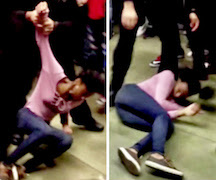
Last week, 15-year-old Jasmine Darwin was was recorded being body slammed by a police officer who works at Rolesville High School in Rolesville, North Carolina.1 The video captures Officer Ruben De Los Santos picking Jasmine up over his head and throwing her body to the ground. Jasmine is suffering from a concussion and Officer De Los Santos has been put on paid administrative leave, meaning he still has a job and will come back and continue working with children. That is unacceptable, Officer De Los Santos has to go!
This comes just over a year after the Spring Valley High incident where another young Black girl was body slammed by a school police officer in South Carolina.2 These two situations are disturbingly similar young Black girls are literally being thrown to the ground by adult men who, ironically, are being paid to provide safety in the classroom. These officers must be held accountable in order to set a precedent that Black children deserve to be treated with dignity. Over 100,000 of you signed our petition to get the officer fired in SC and we won. We can make that happen at #RolesvilleHigh with your help.
The Rolesville Police Department’s failure to immediately fire Officer De Los Santos perpetuates the harmful narrative that Black children deserve to be harshly reprimanded by execution of physically violence. The presence of law enforcement in schools and neighborhoods normalizes the criminalization and patrolling of Black children in areas are supposed to be “safe zones”.3
Instead of school staff working with young people to address behavioral issues, police criminalize and abuse them –doing everything but being a resource of safety.
Clinical trials are voluntary human research studies designed to answer specific questions about the safety and effectiveness of drugs, vaccines, devices, and other therapies—or to study new ways of using existing treatments.
The U.S. Food and Drug Administration is encouraging more people—including members of diverse racial and ethnic groups, women, and older adults—to participate in clinical trials. Read the Consumer Update to learn why.
Senate Majority Leader Mitch McConnell and co. have hit the ground running in the new year. This week, they’re working to pack in as many of Trump’s cabinet nominees’ confirmation hearings as possible. Like many congressional procedures, the cabinet confirmation process is not totally clear. And unlike many congressional proceedings there isn’t a Schoolhouse Rock video explaining the confirmation process. So we’ve been forced to take this explanation on ourselves.
Here’s what you need to know:
All cabinet-level officials, as well as hundreds of other agency heads and senior positions, require senate confirmation. The first step of the confirmation process is the vetting and disclosure process, which the vast majority of Trump’s nominees have not completed. Then, the nominee is given to the Senate committee with jurisdiction over the appointed position, the Senate Judiciary committee, for example, oversees the Attorney General. Full list of committee jurisdictions here. That committee then can hold hearings (happening this week) and either vote to move the nominee to the Senate floor for a full vote or refuse to do so, killing the nomination. The committee can report the nomination favorably, unfavorably, or without recommendation to the rest of the Senate. Once a nomination gets out of the committee, it goes to a full Senate vote, where it needs a simple majority vote.






 Senate Majority Leader Mitch McConnell and co. have hit the ground running in the new year. This week, they’re working to pack in as many of Trump’s cabinet nominees’ confirmation hearings as possible. Like many congressional procedures, the cabinet confirmation process is not totally clear. And unlike many congressional proceedings there isn’t a Schoolhouse Rock video explaining the confirmation process. So we’ve been forced to take this explanation on ourselves.


You must be logged in to post a comment.