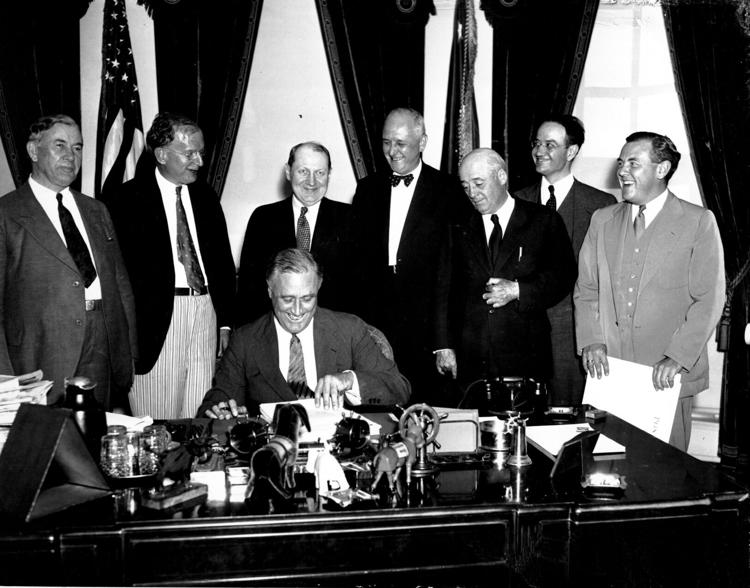
1935 – FDR signs the Neutrality Act


On August 31, 1935, President Franklin D. Roosevelt signs the Neutrality Act, or Senate Joint Resolution No. 173, which he calls an “expression of the desire…to avoid any action which might involve [the U.S.] in war.” The signing came at a time when newly installed fascist governments in Europe were beginning to beat the drums of war.

In a public statement that day, Roosevelt said that the new law would require American vessels to obtain a license to carry arms, would restrict Americans from sailing on ships from hostile nations and would impose an embargo on the sale of arms to “belligerent” nations. Most observers understood “belligerent” to imply Germany under its new leader, Adolf Hitler, and Italy under Benito Mussolini. It also provided the strongest language yet warning other countries that the U.S. would increase its patrol of foreign submarines lurking in American waters. This was seen as a response to Hitler’s March 1935 announcement that Germany would no longer honor the terms of the Treaty of Versailles, which prohibited Germany from rebuilding her military; he had then immediately stepped up the country’s submarine production.

Election Clause


The Constitution grants states primary authority to regulate elections while allowing Congress to intervene, and federal amendments protect voting rights against discrimination.

States’ Authority Over Elections

Article I, Section 4, Clause 1, known as the Elections Clause, gives state legislatures the power to determine the times, places, and manner of holding elections for Senators and Representatives. This means states are responsible for the procedural aspects of elections, such as voter registration, polling locations, and ballot design, unless Congress enacts laws to modify these rules.

The Constitution explicitly allows Congress to override state regulations, but the president has no authority over election rules govfacts.org.

Courts have emphasized that states may regulate elections to ensure fairness and efficiency, but they cannot infringe on fundamental voting rights 

Federal Protections and Voting Rights

The Constitution also includes amendments that protect voting rights and limit state power to discriminate:

  • 15th Amendment (1870): Prohibits denying the right to vote based on race, color, or previous condition of servitude usconstitution.net
  • 19th Amendment (1920): Grants women the right to vote usconstitution.net
  • 24th Amendment (1964): Eliminates poll taxes in federal elections usconstitution.net
  • 26th Amendment (1971): Lowers the voting age to 18 usconstitution.net
    Federal legislation, such as the Voting Rights Act of 1965, enforces these protections by preventing discriminatory practices at the state and local levels, including literacy tests and other barriers usconstitution.netusconstitution.net+1. While states manage the mechanics of elections, federal law ensures that these powers are exercised without violating

Key Takeaways

  • States have primary responsibility for election administration under the Elections Clause.
  • Congress can regulate or override state election rules to protect voting rights.
  • Constitutional amendments and federal laws prevent states from discriminating in voting.
  • State constitutions and laws provide detailed frameworks for fair elections, including redistricting and voter protections.
    This balance reflects the Constitution’s design to empower states in election management while ensuring that fundamental voting rights are protected at the federal level.

Sources: usconstitution.net, govfacts.org, congress.gov

2006 – California Senate passes Global Warming Solutions Act


On August 30, 2006, the California State Senate passes Assembly Bill (AB) 32—otherwise known as the Global Warming Solutions Act. The law made California the first state in America to place caps on carbon dioxide and other greenhouse gases, including those found in automobile emissions.

The Global Warming Solutions Act became law thanks to an alliance between the state’s Republican governor, Arnold Schwarzenegger, and its Democratic-controlled legislature. The bill’s passage solidified California’s role as a leader in enacting legislation aimed at combating global warming, or the increase in the overall temperature of the earth’s atmosphere due to the “greenhouse effect” caused by increased levels of carbon dioxide and other greenhouse gases. California—which represents 10 percent of the nation’s automobile market and is known for its struggles with air pollution—took the lead early in setting stricter fuel emissions standards than the federal government’s.

Despite his professed enthusiasm for the Hummer, a sport utility vehicle (SUV) known for its prodigious size (and prodigious emission of greenhouse gases), Schwarzenegger sought to uphold his state’s pioneering legislation regarding automobile emissions, passed during the tenure of his predecessor, Gray Davis. That law, AB 1493, required the California Air Resources Board (CARB) to regulate greenhouse gases under the state’s motor vehicle program.

The Global Warming Solutions Act went even further, calling for an overall 25 percent reduction in carbon dioxide emissions (or to 1990 levels) by 2025, a timetable that would bring California close to full compliance with the Kyoto Protocol, an international climate-change treaty signed in that Japanese city in 1997. Even after Schwarzenegger signed AB 32 into law in September 2006, California faced an uphill battle to enact these new standards against the resistance of the automotive industry, backed by the administration of former President George W. Bush

California continues to be a national leader in climate a

Source: history.com for the complete article

politics,pollution,petitions,pop culture & purses