
Joy Harjo, renowned for evocative poetry that weaves Indigenous culture and personal narrative, is appointed America’s first Native American poet laureate, a historic moment celebrating her powerful voice and rich storytelling.
Source: history.com

Joy Harjo, renowned for evocative poetry that weaves Indigenous culture and personal narrative, is appointed America’s first Native American poet laureate, a historic moment celebrating her powerful voice and rich storytelling.
Source: history.com
Alan Berg was born in Chicago in 1934, the son of a Jewish dentist and a clothing shop manager. As a youngster, he had bright red hair and a temper to match. His hobbies were golf, stamp collecting, and photography. At age seventeen he went off to college at the University of Colorado–Boulder, where he was happy to be away from his father, whom he viewed as a hypocritical anti-Semite. After two years in Boulder, Berg transferred to the University of Denver, then the University of Miami in Florida, DePaul University in Chicago, Northwestern University, and then back to DePaul, finally graduating from its law school. In 1958 he married Judy Halpern of Denver, and the couple settled in Chicago, where he practiced law. Berg was an able and successful criminal defense lawyer, and his affable glibness in front of juries served him well.
Berg began experiencing epileptic-like grand mal seizures, surviving all of them but often experiencing depression. He discovered that martinis calmed him down and soothed the anxieties he could not otherwise get rid of. He eventually abandoned his law practice and he and Judy moved back to Denver, where he entered St. Joseph Hospital to dry out. Berg opened his own clothing shop, the Shirt Broker, in Seventeenth Street’s Albany Hotel.
Bernard W. Robinson, the first African American
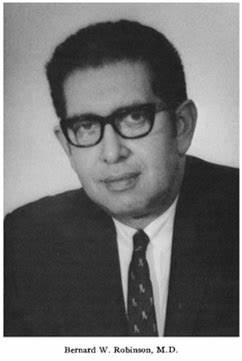
Naval officer, commissioned in the US Naval Reserve. Robinson attended Harvard Medical School and became a prominent radiologist after the war. Dedicated to the care of veterans, Robinson served in the Veterans Administration Hospitals system for the remainder of his career, interrupted only by his re-enlistment in the Navy from 1953-55. Robinson passed away suddenly in his Allen Park, Michigan home on August 23rd, 1972.
Robinson’s commission marks one of many firsts for African Americans during WWII, despite unfavorable odds. African Americans were not only fighting for victory abroad, but also victory at home against racial prejudice. On the Home Front and the battlefronts, blacks encountered restrictions solely based on the color of their skin. The military was segregated and African Americans struggled to find jobs in defense factories. If they did manage to secure work, it was usually at a much lower pay than their white counterparts.
Robinson’s experiences mirror other successes, acts of courage, and achievements of African Americans throughout the war. The Tuskegee Airmen became the first black pilots of the war, with a stellar flying record. The Montford Point Marines, who served in the Marshall Islands, Saipan, Guam, Iwo Jima and Okinawa, became the first African American Marines in the Corps’ 167 year history. The all-black 761st Tank Battalion spent 183 days in continuous combat, far surpassing the average of 17 days in continuous service.

Recognizing the accomplishments and sacrifices of returning black veterans, Harry Truman desegregated the military in 1948. Proving their skill and leadership on the battlefield, former servicemen like Ralph Abernathy, Whitney Young and Medger Evers began to fight for the second part of the Double Victory campaign – Victory at Home- as they returned to the United States at the war’s conclusion.
To learn more and download a fact sheet, visit WWII at a Glance
Teachers! Bring the experiences of African Americans during WWII into your classroom. Book our Double Victory Virtual Field Trip.
Posted by Chrissy Gregg, Virtual Classroom Coordinator at The National WWII Museum.
Resource nww2m.com
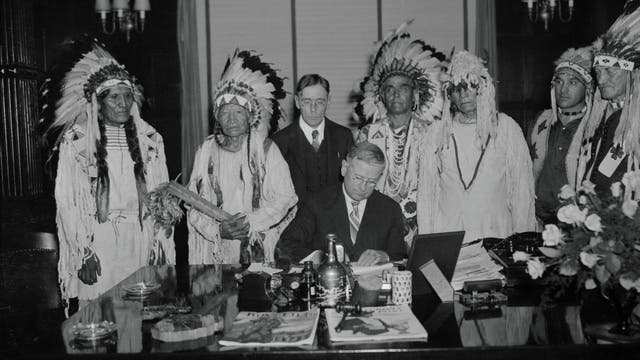
In a major reversal of federal policy toward Native Americans, President Franklin Delano Roosevelt signs the Indian Reorganization Act into law on June 18, 1934. Also known as the IRA, the Indian New Deal and the Wheeler-Howard Act, the act granted a new degree of autonomy to Native Americans in the United States, giving them greater control over their lands and allowing them to form legally recognized tribal governments.
In the early 1900s, federal policy toward Native Americans had promoted assimilation, pressuring tribes to leave reservations, move to cities and give up their traditional ways of life. After World War I, in gratitude toward Native Americans who had served in the military, Congress commissioned a study of conditions on Indian reservations across the U.S. The resulting report detailed the impoverished and unhealthy conditions in which many American Indians lived, finding a “vicious circle” in which economic opportunities were rare.
For the complete article history.com
Story by KOMO News Staff

Now that glass is being recycled again, here are some tips to help:
Source: KOMO News, for the complete article
image came from the internet, Sibelco


You must be logged in to post a comment.