2021 * Days of Remembrance Commemoration


Candles and flags of the liberating divisions have featured prominently in the Museum's Days of Remembrance ceremonies at the US Capitol. Carl Cox for US Holocaust Memorial Museum

The internationally recognized date for Holocaust Remembrance Day corresponds to the 27th day of Nisan on the Hebrew calendar. It marks the anniversary of the Warsaw Ghetto Uprising.

In Hebrew, Holocaust Remembrance Day is called Yom Hashoah. When the actual date of Yom Hashoah falls on a Friday, the state of Israel observes Yom Hashoah on the preceding Thursday. When it falls on a Sunday, Yom Hashoah is observed on the following Monday. In the United States, Days of Remembrance runs from the Sunday before Yom Hashoah through the following Sunday.

   2021   Thursday, April 8

Soruce: ushmm.org

  • began Wednesday, April 7
    • at sunset
  • ends Thursday, April 8
    • at nightfall

Source: internet

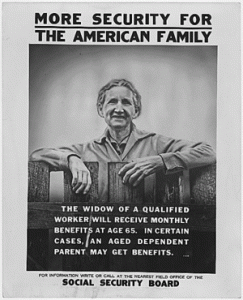
2000 – U.S. President Clinton signed the Senior Citizens Freedom to Work Act of 2000. The bill reversed a Depression-era law and allows senior citizens to earn money without losing Social Security retirement benefits.


The President Signs the “Senior Citizens’ Freedom to Work Act of 2000”
President Clinton signed into law P.L. 106-182, the Senior Citizens’ Freedom To Work Act of 2000. As yet, a public law number has not been assigned.

The legislation:
Eliminates the Social Security retirement earnings test in and after the month in which a person attains full retirement age–currently age 65. Elimination of the retirement test would be effective with respect to taxable years ending after December 31, 1999.
In the calendar year the beneficiary attains the full retirement age, permanently applies the earnings limit for those at the full retirement age through age 69 ($17,000 in 2000, $25,000 in 2001 and $30,000 in 2002) and the corresponding reduction rate ($1 for $3 offset) to all months prior to attainment of the full retirement age. (In applying the earnings test for this calendar year, only earnings before the month of attainment of full retirement age are considered.)

Permits, beginning with the month in which the beneficiary reaches full retirement age and ending with the month prior to attainment of age 70, the retired worker to earn a delayed retirement credit for any month for which the retired worker requests that benefits not be paid even though he/she is already on the benefit rolls.

On March 1, 2000, the House approved an earlier version of H.R. 5. The Senate approved an amended version of the legislation on March 22, 2000. The House agreed to the Senate amendment to the legislation and cleared the measure for transmission to the President on March 28, 2000. For additional detail, see Legislative Bulletins 106-16, 106-17, 106-18 and 106-19.

2000 – U.S. President Clinton signed the Senior Citizens Freedom to Work Act of 2000. The bill reversed a Depression-era law and allows senior citizens to earn money without losing Social Security retirement benefits.


1818 – A plan was passsed by the U.S. Congress that the U.S. flag would have 13 red and white stripes and 20 stars and that a new star would be added for the each new state.


[U.S. 20 star flag 1818]

image by Clay Moss, 23 December 2007

On April 4, 1818, a plan was passed by Congress at the suggestion of U.S. Naval Captain Samuel C. Reid in which the flag was changed to have 20 stars, with a new star to be added when each new state was admitted, but the number of stripes would remain at thirteen to honor the original colonies.

the internet

1621 – The Plymouth, MA, Colonists created the first treaty with Native Americans – Things we should remember


"First sight of the Indians." Illustration published in A Pictorial History of the United States circa 1852

By History.com Editors

At the Plymouth settlement in present-day Massachusetts, the leaders of the Plymouth colonists, acting on behalf of King James I, make a defensive alliance with Massasoit, chief of the Wampanoags. The agreement, in which both parties promised to not “doe hurt” to one another, was the first treaty between a Native American tribe and a group of American colonists. According to the treaty, if a Wampanoag broke the peace, he would be sent to Plymouth for punishment; if a colonist broke the law, he would likewise be sent to the Wampanoags.

In November 1620, the Mayflower arrived in the New World, carrying 101 English settlers, commonly known as the pilgrims. The majority of the pilgrims were Puritan Separatists, who traveled to America to escape the jurisdiction of the Church of England, which they believed violated the biblical precepts of true Christians. After coming to anchor in what is today Provincetown harbor in the Cape Cod region of Massachusetts, a party of armed men under the command of Captain Myles Standish was sent to explore the immediate area and find a location suitable for settlement.

In December, the explorers went ashore in Plymouth, where they found cleared fields and plentiful running water; a few days later the Mayflower came to anchor in Plymouth harbor, and settlement began.

The first direct contact with a Native American was made in March 1621, and soon after, Chief Massasoit paid a visit to the settlement. After an exchange of greetings and gifts, the two peoples signed a peace treaty that lasted for more than 50 years.

Citation Information
Article Title
The Pilgrim-Wampanoag peace treaty
Author
History.com Editors
Website Name
HISTORY
URL
https://www.history.com/this-day-in-history/the-pilgrim-wampanoag-peace-treaty
Access Date
April 2, 2020
Publisher
A&E Television Networks
Last Updated
March 30, 2020
Original Published Date
February 9, 2010


politics,pollution,petitions,pop culture & purses