
 Lonnie Bunch, museum director, historian, lecturer, and author, is proud to present A Page from Our American Story, a regular on-line series for Museum supporters. It will showcase individuals and events in the African American experience, placing these stories in the context of a larger story — our American story. Lonnie Bunch, museum director, historian, lecturer, and author, is proud to present A Page from Our American Story, a regular on-line series for Museum supporters. It will showcase individuals and events in the African American experience, placing these stories in the context of a larger story — our American story. |
||
A Page From Our American StoryDuring what is often described as boxing’s “Golden Age” — approximately 1930 to 1955 — Joe Louis, the “Brown Bomber,” would become its undisputed king.Not only would  Louis dominate his sport during this period, he transcended the color barrier and was cheered by Americans of allraces.Joe Louis Barrow — the grandson of a slave and the great grandson of a slave owner — was born in poverty on May 13, 1914. The Barrow home in Lafayette, Alabama was next to a cotton field. Growing up, Louis and his seven siblings often slept three and four to a bed.The lack of jobs and the violence waged against African Americans by a revived Ku Klux Klan in the South led Louis’ mother, Lily,to take her family and join thousands of blacks in the Great Migration north.Portrait of Joe Louis, Greenwood Lake, N.Y. Louis dominate his sport during this period, he transcended the color barrier and was cheered by Americans of allraces.Joe Louis Barrow — the grandson of a slave and the great grandson of a slave owner — was born in poverty on May 13, 1914. The Barrow home in Lafayette, Alabama was next to a cotton field. Growing up, Louis and his seven siblings often slept three and four to a bed.The lack of jobs and the violence waged against African Americans by a revived Ku Klux Klan in the South led Louis’ mother, Lily,to take her family and join thousands of blacks in the Great Migration north.Portrait of Joe Louis, Greenwood Lake, N.Y.September 15, 1941. Carl Van Vechten (1880 – 1964).They settled in Detroit, and Joe began learning the craft of cabinet making and taking violin lessons. He was about 11-years-old when a friend introduced him to boxing. As a teenager, Louis gained a reputation as a top-flight amateur fighter. He dropped “Barrow” from his name, hoping to keep his boxing a secret from his mother. But winning 50 of 54 amateur fights – 43 by knockouts — brought headlines on newspaper sports pages in Detroit and around the Midwest. It was impossible to hide his remarkable power, speed, and innate tactical mind — skills that helped Louis become one of the greatest boxers in history.He soon gained the attention of John Roxborough, head of the illegal gambling rackets in the black communities of Detroit. What Roxborough offered Louis was unique to the sport of boxing at the time. Roxborough had watched countless white managers burn out African American fighters before their prime. He promised Louis the best training and opportunities. Roxborough quickly brought in boxing promoter Julian Black and respected trainer Jack Blackburn to groom Louis for greatness. Roxborough was true to his word, guiding Louis with care and, in the process, attaining record prize purses — not just for a black boxer, but for boxers of any color. Roxborough was also a keen marketer. The image white America had of African American boxers had been shaped by Jack Johnson. Johnson, though a powerful champion, was viewed as militant and a womanizer, among other things. With “the shadow of Johnson” stalking Louis, Roxborough created a list of “commandments” that Louis would have to follow. These “commandments” included:
The public relations strategy worked. Louis’ talent did the rest. As Louis wrote in his autobiography: “Mr. Roxborough was talking about Black Power before it became popular.”
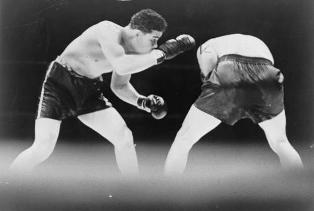
Joe Louis looks for an opening during boxing match
His first professional bouts of note were victories against Italian giant Primo Carnera, and American Max Baer, both former champions. The bout with Carnera foreshadowed how Louis’ life and career would become politicized. Carnera was touted by Benito Mussolini as the symbol of his new, fascist Italy. Louis battered Carnera, winning by knockout in the sixth round. Louis won 27 professional fights in a row — 23 by knockouts — and was on track to fight “Cinderella Man” James Braddock for the title. However, Louis’ surprising loss to German Max Schmeling on June 19, 1936 temporarily delayed a title shot. Schmeling, who was not a Nazi, was hailed by Adolf Hitler as an example of the superiority of the Aryan race. Eventually, Louis got his title fight against Braddock, knocking him out on June 22, 1937 and winning the heavyweight crown. After the fight, Malcolm X said, “Every Negro boy who could walk wanted to be the next Brown Bomber.” Now it was time for Schmeling again. By the late 1930s, Hitler had started his attempt to conquer Europe, and the Louis-Schmeling rematch took on even more meaning. It was reported that Hitler called Schmeling just before the fight and ordered him to win for the sake of Nazi Germany. Louis, despite America’s racial divide, was seen as freedom and democracy’s defender. Franklin Roosevelt invited Louis to the White House. There, more than two years before the United States entered the war, Roosevelt felt Louis’ bicep and said, “Joe, we need muscles like these to defeat Germany.” It wasn’t a fight between two men; it was a battle of ideologies. On June 22, 1938 — exactly one year after becoming world champion — Louis dispatched Schmeling two minutes into Round One. Instantly Louis became more than just a champion. At a time when boxing was at its zenith and the heavyweight champion was considered the greatest athlete in the world, Louis achieved even more. He became a hero to Americans of every race and background. Louis would hold the crown for 12 years — longer than any fighter past or present has held a title in any weight class. At his prime, Louis enlisted in the Army in 1942, where he rose to the rank of sergeant. He fought hundreds of exhibition matches to entertain the troops and raise money for the Armed Services. Louis even donated money to military relief funds. After the war, Louis won four more fights — two against Jersey Joe Walcott — and retired. He had defended his title 25 times, another record, and only three of those bouts went the distance. World Heavyweight champ Almost two years later, Louis had to change his plans. Louis’ lifestyle — his generosity to friends and family was well known — coupled with his boxing schedule had left little time for keeping track of the accounting, including filing his taxes. Ignoring all that Louis had done for his country during the war, the IRS demanded more than $1 million in back taxes. He stepped back into the ring well past his prime and was pummeled by the current champion, Ezzard Charles. Then, in 1951, Louis was knocked out by Rocky Marciano. Louis retired from the ring again, but he still needed money to pay the IRS. He took odd jobs, including a stint as a professional wrestler. His last job was as the official greeter at Caesar’s Palace in Las Vegas. After his boxing career was over, Louis would become good friends with Schmeling. Sports writers respected Louis as much for his kind, generous nature as they did for his boxing brilliance. When he died on April 12, 1981, President Ronald Reagan said Louis was “more than a sports legend — his career was an indictment of racial bigotry and a source of pride and inspiration for people around the world.” Honoring the family’s request, Reagan waived the requirements and Sgt. Joe Louis was buried in Arlington National Cemetery with full military honors. At the height of his popularity, people said Louis was “a credit to his race.” In response, Boxing Hall of Fame sports writer Jimmy Cannon wrote: “Yes, Joe Louis is a credit to his race — the human race.”
|


BREAKING NEWS MORNING [6AM] 2/18/19 [Full] | pence MET WITH SILENCE AFTER MENTIONING trump IN SPEECH

some rich guys don’t need another tax cut …


Shame on Google for restricting workers’ right to organize! demandprogress.org

Shame on Google for working to roll back workers’ rights!
Turns out that working for Google isn’t all foosball tables and espresso machines.
Recently Google is working behind the scenes to restrict workers’ rights to organize their workplace,1 including circulating petitions, planning walkouts, and even talking about forming a union. Tell Google “Shame on you” for restricting workers’ rights.
Google management has been more than a little concerned about their employees because year after year they’re getting more vocal about calling out the company on their wrongdoing.
From protesting Google’s Project Maven contract with the DoD, to an organized walkout over sexual harassment scandals, Google’s employees are using grassroots pressure and labor solidarity to make a difference.2 And Google is big mad about it!
That’s why Google is quietly working to overturn Obama-era workplace protections that allow workers to use email to organize amongst themselves. And they aren’t just talking about Google’s workers, but ALL workers who have a work email account.
Tell Google “Shame on you” for trying to limits workers’ rights.
Sources:
1. Wired, “Google Wanted To Prohibit Workers From Organzing By Email,” January 24, 2019.
2. Wired, “Google Walkout Is Just The Latest Sign Of Tech Worker Unrest,” November 1, 2018.
demandprogress.org
Share this:

New from CIA truth-teller Jeffrey Sterling – rootsaction.org

It has been a year since I walked out of a federal prison after two and a half years of incarceration. Though “free” of the prison, I remain a prisoner of the criminal justice system for a time longer — having been wrongfully tried, wrongfully convicted and wrongfully sentenced as a whistleblower. A big question for me has been, What has this all really been about?
I have not been really sure if I could be categorized as a whistleblower, at least in the sense of the current times. I had indeed blown the whistle on wrongs I witnessed and experienced while in the Central Intelligence Agency, but unlike what had been in the charges and the trial, I did so officially to both the House and Senate Intelligence Committees. And for those actions, I was sent to prison.
There have been so many moments during this ordeal — from the time when I decided to file a lawsuit against the CIA to being found guilty and sent to prison for a crime I did not commit — I have struggled mightily to find any meaning to it all. The search may be in vain, but I may have found at least some semblance of meaning to add to this ordeal through one of my saving graces while in prison, Shakespeare.
While in the hell of prison, I was hungry for the words of the Bard. I had always found a comfort in the tales told by Shakespeare and did my best to read any and everything of his I could get my hands on. I was so very fortunate that so many supporters sent me many analytical works to go along with my tattered, unabridged version.
That hunger has continued since leaving prison.
I recently finished reading Stephen Greenblatt’s excellent book Tyrant: Shakespeare on Politics and had my eyes opened to an interpretation of the whistleblower I had known for longer than I realized.
What has always attracted me to Shakespeare was his depiction of us and the drama of our lives. What is wonderful about Tyrant is that Greenblatt once again reminds us that the supposed uniqueness of today is nothing new, it was depicted over four hundred years ago. I was particularly struck by what Greenblatt wrote about King Lear. I had no idea when I first read King Lear so many years ago that Shakespeare had written about whistleblowers.
The very definition of the whistleblower is embodied in one of the most un-noted characters in Shakespeare, Cornwall’s servant from King Lear. I find that some of the most didactic characters in Shakespeare can come from so-called lesser knowns, the “knocking” porter in Macbeth, the asp-bearing clown in Antony and Cleopatra and the gravedigging clown in Hamlet. Greenblatt teaches of another unsung character with the servant’s first lines in King Lear, “Hold your hand, my lord…”
It is such a powerful first line as Greenblatt points out, “The words are not spoken by one of Gloucester’s sons, by a noble bystander, by a gentleman in disguise, or even by someone in Gloucester’s household. They are spoken by one of Cornwall’s own servants, someone long accustomed simply to doing his bidding. ‘I have served you ever since I was a child,’ he declares. ‘But better service have I never done you/Than now to bid you hold.’ … it stages unforgettably a moment when someone in the ruler’s service feels compelled to stop what he is witnessing.”
Greenblatt also is astute in noting how Shakespeare depicts how power does not react kindly to those who have the nerve to stand up to it; the punishment is swift and terrible. Greenblatt shows in Tyrant how “Regan is outraged at the interruption: ‘How now, you dog?’ And Cornwall, drawing his sword and using the term for feudal vassal, is no less so: ‘My villein?’ There follows a violent skirmish, master against servant, that ends when Regan, astonished that a menial would dare anything of the kind — ‘A peasant stand up thus?’ — runs him through and kills him.”
That scene, as a servant attempts to stop Cornwall from gouging out the eyes of Gloucester, is the very embodiment of what it means to be a whistleblower and what a whistleblower faces. This man, this nameless minor character stands up to the powers that be, the powers that he dutifully serves and says “stop.”
I particularly like the way Greenblatt summarizes this nameless hero and where he stood with Shakespeare: “Shakespeare did not believe that the common people could be counted upon as a bulwark against tyranny. They were, he thought, too easily manipulated by slogans, cowed by threats, or bribed by trivial gifts to serve as reliable defenders of freedom. His tyrannicides are drawn, for the most part, from the same elite whose members generate the unjust rulers they oppose and eventually kill. In King Lear’s nameless servant, however, he created a figure who serves as the very essence of popular resistance to tyrants. That man refuses to remain silent and watch. It cost him his life, but he stands up for human decency. Though he is a very minor figure with only a handful of lines, he is one of Shakespeare’s great heroes.”
It was difficult reading that scene while in prison, and Greenblatt has helped me understand why. I won’t go so far as to see myself as a hero. But, I can certainly identify with that nameless character and the anguish he must have felt. Against discrimination at the CIA and a dangerously flawed operation I stood up and said “Hold your hand…” And much like that nameless servant, for such insolence I was essentially “run through” by the Department of Justice who played an effective Regan to the CIA’s Cornwall.
Whether I am to be considered a whistleblower or not, having some meaning to grasp onto provides some peace despite the hurt and loss. Finding this identification has been like discovering a sort of acceptance with other nameless servants like John Kiriakou, Thomas Drake, Daniel Ellsberg, Terry Albury among countless, un-noted others who also said “Hold your hand…” to power. They remind us as Greenblatt points out that it is usually the unsung who take a stand and usually pay an unjust price.
As I near the time when the shackles of my ordeal are removed, I feel a motivation and obligation to give name to the nameless and fight against the condemnation that has been the unfortunate norm when the servant stands up to the wrongs of power. The RootsAction Education Fund is part of that effort and I am grateful for the platform and assistance it continues to provide.
Jeffrey Sterling
February 2019
_____________________________
PS from the RootsAction Education Fund team:
Jeffrey’s refusal to knuckle under to illegitimate power has come at a very steep personal cost. That’s the way top CIA officials wanted it. His enduring capacity to speak truthfully can help strengthen a wide range of whistleblowers — past, present and future.
You can help make that happen with a tax-deductible donation of any amount. rootsaction.org


You must be logged in to post a comment.