Tag Archives: Congress

Lupita Nyong’o and skin whitener ~repost reminder …a lifeline


Wethepeople

So, this speech given by Lupita Nyong’o was at the Essence Magazine 7th Annual Black Women in Hollywood Luncheon in Beverly Hills, California, USA, she was honoured with the Breakthrough Performance Award. It was 2014

I had to read and re-read the speech below because she addressed my own call for People of Colour to STOP the practice of skin whitening. This practice is far from new, it has unfortunately become a billion dollar snake that needs its head cut off, a severe reprimand of those who push white is right, begin to provide services that help those who hate themselves and the skin they live in. The speech is beyond illuminating lest we say eloquent and she addressed a letter, in which she talked about a fan who wrote to her about hating her dark skin so much she had bought the controversial skin lightening cream by Dencia called Whitenicious …Lupita spoke about Dencia’s skin bleaching cream, her own issues with hating her dark skin as a teenager & more … below

Lupita’s speech:

I wrote down this speech, I had no time to practice so this will be the practicing session.

Thank you Alfre, for such an amazing, amazing introduction and celebration of my work. And thank you very much for inviting me to be a part of such an extraordinary community.

I am surrounded by people who have inspired me, women in particular whose presence on screen made me feel a little more seen and heard and understood. That it is ESSENCE that holds this event celebrating our professional gains of the year is significant, a beauty magazine that recognizes the beauty that we not just possess but also produce.

I want to take this opportunity to talk about beauty, Black beauty, dark beauty. I received a letter from a girl and I’d like to share just a small part of it with you: “Dear Lupita,” it reads, “I think you’re really lucky to be this Black but yet this successful in Hollywood overnight. I was just about to buy Dencia’s Whitenicious cream to lighten my skin when you appeared on the world map and saved me.”

My heart bled a little when I read those words, I could never have guessed that my first job out of school would be so powerful in and of itself and that it would propel me to be such an image of hope in the same way that the women of The Color Purple were to me.

I remember a time when I too felt unbeautiful. I put on the TV and only saw pale skin, I got teased and taunted about my night-shaded skin. And my one prayer to God, the miracle worker, was that I would wake up lighter-skinned. The morning would come and I would be so excited about seeing my new skin that I would refuse to look down at myself until I was in front of a mirror because I wanted to see my fair face first. And every day I experienced the same disappointment of being just as dark as I was the day before. I tried to negotiate with God, I told him I would stop stealing sugar cubes at night if he gave me what I wanted, I would listen to my mother’s every word and never lose my school sweater again if he just made me a little lighter. But I guess God was unimpressed with my bargaining chips because He never listened.

And when I was a teenager my self-hate grew worse, as you can imagine happens with adolescence. My mother reminded me often that she thought that I was beautiful but that was no conservation, she’s my mother, of course she’s supposed to think I am beautiful. And then…Alek Wek. A celebrated model, she was dark as night, she was on all of the runways and in every magazine and everyone was talking about how beautiful she was. Even Oprah called her beautiful and that made it a fact. I couldn’t believe that people were embracing a woman who looked so much like me, as beautiful. My complexion had always been an obstacle to overcome and all of a sudden Oprah was telling me it wasn’t. It was perplexing and I wanted to reject it because I had begun to enjoy the seduction of inadequacy. But a flower couldn’t help but bloom inside of me, when I saw Alek I inadvertently saw a reflection of myself that I could not deny.

Now, I had a spring in my step because I felt more seen, more appreciated by the far away gatekeepers of beauty. But around me the preference for my skin prevailed, to the courters that I thought mattered I was still unbeautiful. And my mother again would say to me you can’t eat beauty, it doesn’t feed you and these words plagued and bothered me; I didn’t really understand them until finally I realized that beauty was not a thing that I could acquire or consume, it was something that I just had to be.

And what my mother meant when she said you can’t eat beauty was that you can’t rely on how you look to sustain you. What is fundamentally beautiful is compassion for yourself and for those around you. That kind of beauty enflames the heart and enchants the soul. It is what got Patsey in so much trouble with her master, but it is also what has kept her story alive to this day. We remember the beauty of her spirit even after the beauty of her body has faded away.

And so I hope that my presence on your screens and in the magazines may lead you, young girl, on a similar journey. That you will feel the validation of your external beauty but also get to the deeper business of being beautiful inside.

There is no shame in Black beauty.

 Lupita’s  speech  is a letter filled with humor , love and a lot of wisdom for little girls of colour from 1 – 98 who need to be taught self-love while the entertainment business needs to accept that POC come in all colours shapes sizes, speak differently and some of us don’t sing or dance, but plenty of us have great talent that should be accepted without having to make drastic changes to our features like skin whitening to get a part or a job …crossover

~~ Nativegrl77

HIPAA Rights … You should know them – a repost


Dept. of Health & Human Services

Information is powerful medicine. The Health Insurance Portability and Accountability Act (HIPAA) gives you the right to get your personal health information, make sure it’s correct and know who has seen it. With access to your own medical records, you can make decisions with your health care provider, track your medications and dosages, and much more.

Understand Your HIPAA Rights

Know Your Rights: HIPAA Privacy Rule

Read More: Information Is Powerful Medicine: Understanding Your HIPAA Rights

MLK jr. speech 5/17/1957 ~ Give Us the Ballot ~ In Memory


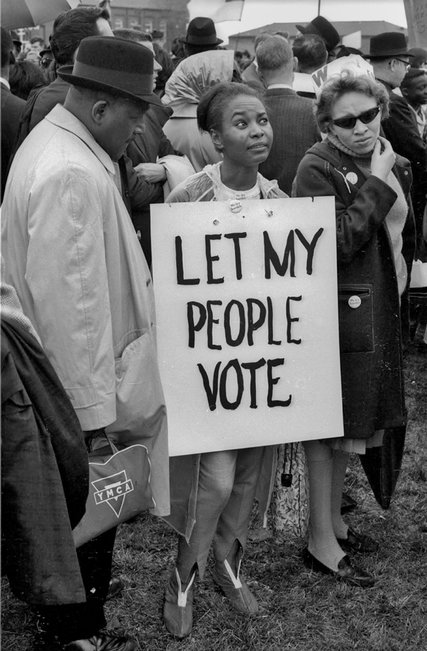
“Give Us the Ballot, We Will Transform the South”

giveustheballot

by Martin Luther King, Jr.
Speech given before the Lincoln Memorial at the March on Washington, May 17, 1957

Three years ago the Supreme Court of this nation rendered in simple, eloquent and unequivocal language a decision which will long be stenciled on the mental sheets of succeeding generations. For all men of good will, this May 17 decision came as a joyous daybreak to end the long night of segregation. It came as a great beacon light of hope to millions of distinguished people throughout the world who had dared only to dream of freedom. It came as a legal and sociological deathblow to the old Plessy doctrine of “separate-but-equal.” It came as a reaffirmation of the good old American doctrine of freedom and equality for all people.

Unfortunately, this noble and sublime decision has not gone without opposition. This opposition has often risen to ominous proportions. Many states have risen up in open defiance. The legislative halls of the South ring loud with such words as “interposition” and “nullification.” Methods of defiance range from crippling economic reprisals to the tragic reign of violence and terror. All of these forces have conjoined to make for massive resistance.

But, even more, all types of conniving methods are still being used to prevent Negroes from becoming registered voters. The denial of this sacred right is a tragic betrayal of the highest mandates of our democratic traditions and its is democracy turned upside down.

So long as I do not firmly and irrevocably possess the right to vote I do not possess myself. I cannot make up my mind — it is made up for me. I cannot live as a democratic citizen, observing the laws I have helped to enact — I can only submit to the edict of others.

So our most urgent request to the president of the United States and every member of Congress is to give us the right to vote. Give us the ballot and we will no longer have to worry the federal government about our basic rights. Give us the ballot and we will no longer plead to the federal government for passage of an anti-lynching law; we will by the power of our vote write the law on the statute books of the southern states and bring an end to the dastardly acts of the hooded perpetrators of violence. Give us the ballot and we will transform the salient misdeeds of blood-thirsty mobs into calculated good deeds of orderly citizens. Give us the ballot and we will fill our legislative halls with men of good will, and send to the sacred halls of Congressmen who will not sign a Southern Manifesto, because of their devotion to the manifesto of justice. Give us the ballot and we will place judges on the benches of the South who will “do justly and love mercy,” and we will place at the head of the southern states governors who have felt not only the tang of the human, but the glow of the divine. Give us the ballot and we will quietly and nonviolently, without rancor or bitterness, implement the Supreme Court’s decision of May 17, 1954.

<!–Read about recent allegations of voter disenfranchisement in Florida
and other states across the country in these articles.

17

–>

Learn more about Martin Luther King, Jr. and read more of his speeches and writings at The Martin Luther King, Jr. Papers Project at Stanford University.

Resources: pbs.org

Justice For Some … things to remember in this 21st Century, a repost from 2015


By CAP Action War Room

The Cleveland Police Department Reaches a Settlement with the Department of Justice

Memorial Day weekend has hosted several important developments in the world of criminal justice. Today, the Cleveland Police department—which has come under fire in recent months in the nationwide debate over police tactics—agreed to follow some of the strictest standards in the nation over its officers’ use of force. Cleveland agreed to the terms as part of a settlement reached with the Department of Justice over what justice officials called a “pattern of unconstitutional policing and excessive use of force.”

According to the Justice Department’s report, the Cleveland police department used stun guns inappropriately, punched and kicked unarmed people, shot at people who did not pose a threat, and failed to report or investigate most of these incidents. As a part of the settlement, Cleveland agreed to some of the most rigorous policing standards in the nation. These include:

  • Prohibiting officers from unholstering a firearm “unless the circumstances create a reasonable belief that lethal force may become necessary,” and documenting every time that occurs.
  • Banning pistol whipping, the firing of warning shots, and the use of neck holds (that pistol whipping had to be explicitly barred says enough).
  • Creating a community police commission, made up of ten representatives from around the community.
  • Allowing an independent monitor to track its progress.

The settlement comes just two days after a white Cleveland officer who fired at least 49 shots at two unarmed African Americans was acquitted of manslaughter by an Ohio judge. Officer Brelo’s acquittal—as the latest in a series of troubling racially charged incidents across the US in places like Baltimore, Staten Island, and Ferguson, MO—prompted protests that remained largely peaceful but still resulted in the arrest of 71 people.

Some bad news also came out of the criminal justice sphere this weekend. On Friday, Maryland Governor Larry Hogan vetoed three important criminal justice reform bills. In addition to vetoing a bill to limit civil asset forfeiture, and a bill to remove the penalty for marijuana paraphernalia, Hogan also vetoed a felon re-enfranchisement bill that would have restored voting rights to 60,000 ex-felons. Restoring access to the ballot for ex-felons is a priority in the criminal justice reform community and Hogan’s veto will serve as an important test to see whether reform advocates will show that choices like Hogan’s can have political repercussions.

BOTTOM LINE: Agreements like the one made between Cleveland and the Department of Justice have the potential to create meaningful change to a flawed system. But as Gov. Hogan’s vetoes remind us, there is much more work to be done to convince some elected officials to do their part.

In the Library: “Einstein on Race and Racism” by Jerome and Taylor


TumblrAlbertEnsteina0630a335c22bfc39dac14f5bdde1dfd Did Einstein speak about racism at Lincoln University?

Here is the text of the email:   Here’s something you probably don’t know about Albert Einstein.

In 1946, the Nobel Prize-winning physicist traveled to Lincoln University in Pennsylvania, the alma mater of Langston Hughes and Thurgood Marshall and the first school in America to grant college degrees to blacks.

At Lincoln, Einstein gave a speech in which he called racism “a disease of white people,” and added, “I do not intend to be quiet about it.” He also received an honorary degree and gave a lecture on relativity to Lincoln students.
In fact, many significant details are missing from the numerous studies of Einstein’s life and work, most of them having to do with Einstein’s opposition to racism and his relationships with African Americans.

Einstein continued to support progressive causes through the 1950s, when the pressure of anti-Communist witch hunts made it dangerous to do so. Another example of Einstein using his prestige to help a prominent African American occurred in 1951, when the 83-year-old W.E.B. Du Bois, a founder of the NAACP, was indicted by the federal government for failing to register as a “foreign agent” as a consequence of circulating the pro-Soviet Stockholm Peace Petition. Einstein offered to appear as a character witness for Du Bois, which convinced the judge to drop the case.
In the wake of the monumental effort to digitize Einstein’s life and genius for the masses, let’s hope that more of us will acknowledge Einstein’s greatness as a champion of human and civil rights for African-Americans as one of his greatest contributions to the world.

Origins:   The e-mail reproduced above is an excerpt from a 2007 Harvard University Gazette article about a talk given by Fred Jerome and Rodger Taylor, authors of the 2006 book Einstein on Race and Racism. As related in that article, Jerome and Taylor undertook their effort in order to “recognize and correct many significant details missing from the numerous studies of Einstein’s life and work, most of them having to do with Einstein’s opposition to racism and his relationships with African Americans:

Nearly fifty years after his death, Albert Einstein remains one of America’s foremost cultural icons. A thicket of materials, ranging from scholarly to popular, have been written, compiled, produced, and published about his life and his teachings. Among the ocean of Einsteinia — scientific monographs, biographies, anthologies, bibliographies, calendars, postcards, posters, and Hollywood films — however, there is a peculiar void when it comes to the connection that the brilliant scientist had with the African American community. Virtually nowhere is there any mention of his relationship with Paul Robeson, despite Einstein’s close friendship with him, or W.E.B. Du Bois, despite Einstein’s support for him.
This unique book is the first to bring together a wealth of writings by Einstein on the topic of race. Although his activism in this area is less well known than his efforts on behalf of international peace and scientific cooperation, he spoke out vigorously against racism both in the United States and around the world.

In May 1946, Einstein made a rare public appearance outside of Princeton, New Jersey (where he lived and worked in the latter part of his life), when he traveled to the campus of Pennsylvania’s Lincoln University, the United States’ first degree-granting black university, to take part in a ceremony conferring upon him the honorary degree of doctor of laws. Prior to accepting that degree, he delivered a ten-minute speech to the assembled audience in which he called upon the United States to take a leading role in preventing another world war and denounced the practice of segregation. Because mainstream U.S. newspapers reported little or nothing about the event, a full transcript of Einstein’s speech that day does not exist — the only existing record of his words is a few excerpts pieced together from quotes reproduced in coverage by the black press:

The only possibility of preventing war is to prevent the possibility of war. International peace can be achieved only if every individual uses all of his power to exert pressure on the United States to see that it takes the leading part in world government.
The United Nations has no power to prevent war, but it can try to avoid another war. The U.N. will be effective only if no one neglects his duty in his private environment. If he does, he is responsible for the death of our children in a future war.
My trip to this institution was in behalf of a worthwhile cause.

There is a separation of colored people from white people in the United States. That separation is not a disease of colored people. It is a disease of white people. I do not intend to be quiet about it.
The situation of mankind today is like that of a little child who has a sharp knife and plays with it. There is no effective defense against the atomic bomb … It can not only destroy a city but it can destroy the very earth on which that city stood.

As the authors of “Einstein on Race and Racism” noted, Einstein’s comments about segregation at Lincoln University reflected his own experiences in both his native Germany and his adopted home in the United States and were part of a pattern of his attempting to ameliorate the effects of discrimination:

According to Jerome and Taylor, Einstein’s statements at Lincoln were by no means an isolated case. Einstein, who was Jewish, was sensitized to racism by the years of Nazi-inspired threats and harassment he suffered during his tenure at the University of Berlin. Einstein was in the United States when the Nazis came to power in 1933, and, fearful that a return to Germany would place him in mortal danger, he decided to stay, accepting a position at the recently founded Institute for Advanced Study in Princeton, N.J. He became an American citizen in 1940.

But while Einstein may have been grateful to have found a safe haven, his gratitude did not prevent him from criticizing the ethical shortcomings of his new home.
“Einstein realized that African Americans in Princeton were treated like Jews in Germany,” said Taylor. “The town was strictly segregated. There was no high school that blacks could go to until the 1940s.”
Einstein’s response to the racism and segregation he found in Princeton (Paul Robeson, who was born in Princeton, called it “the northernmost town in the South”) was to cultivate relationships in the town’s African-American community. Jerome and Taylor interviewed members of that community who still remember the white-haired, disheveled figure of Einstein strolling through their streets, stopping to chat with the inhabitants, and handing out candy to local children.
One woman remembered that Einstein paid the college tuition of a young man from the community. Another said that he invited Marian Anderson to stay at his home when the singer was refused a room at the Nassau Inn.