Information is powerful medicine. The Health Insurance Portability and Accountability Act (HIPAA) gives you the right to get your personal health information, make sure it’s correct and know who has seen it. With access to your own medical records, you can make decisions with your health care provider, track your medications and dosages, and much more.
by Martin Luther King, Jr.
Speech given before the Lincoln Memorial at the March on Washington, May 17, 1957
Three years ago the Supreme Court of this nation rendered in simple, eloquent and unequivocal language a decision which will long be stenciled on the mental sheets of succeeding generations. For all men of good will, this May 17 decision came as a joyous daybreak to end the long night of segregation. It came as a great beacon light of hope to millions of distinguished people throughout the world who had dared only to dream of freedom. It came as a legal and sociological deathblow to the old Plessy doctrine of “separate-but-equal.” It came as a reaffirmation of the good old American doctrine of freedom and equality for all people.
Unfortunately, this noble and sublime decision has not gone without opposition. This opposition has often risen to ominous proportions. Many states have risen up in open defiance. The legislative halls of the South ring loud with such words as “interposition” and “nullification.” Methods of defiance range from crippling economic reprisals to the tragic reign of violence and terror. All of these forces have conjoined to make for massive resistance.
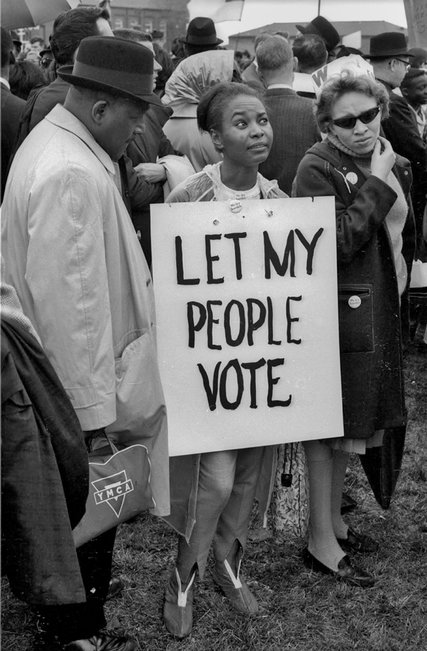
But, even more, all types of conniving methods are still being used to prevent Negroes from becoming registered voters. The denial of this sacred right is a tragic betrayal of the highest mandates of our democratic traditions and its is democracy turned upside down.
So long as I do not firmly and irrevocably possess the right to vote I do not possess myself. I cannot make up my mind — it is made up for me. I cannot live as a democratic citizen, observing the laws I have helped to enact — I can only submit to the edict of others.
So our most urgent request to the president of the United States and every member of Congress is to give us the right to vote. Give us the ballot and we will no longer have to worry the federal government about our basic rights. Give us the ballot and we will no longer plead to the federal government for passage of an anti-lynching law; we will by the power of our vote write the law on the statute books of the southern states and bring an end to the dastardly acts of the hooded perpetrators of violence. Give us the ballot and we will transform the salient misdeeds of blood-thirsty mobs into calculated good deeds of orderly citizens. Give us the ballot and we will fill our legislative halls with men of good will, and send to the sacred halls of Congressmen who will not sign a Southern Manifesto, because of their devotion to the manifesto of justice. Give us the ballot and we will place judges on the benches of the South who will “do justly and love mercy,” and we will place at the head of the southern states governors who have felt not only the tang of the human, but the glow of the divine. Give us the ballot and we will quietly and nonviolently, without rancor or bitterness, implement the Supreme Court’s decision of May 17, 1954.
<!–Read about recent allegations of voter disenfranchisement in Florida
and other states across the country in these articles.
The Cleveland Police Department Reaches a Settlement with the Department of Justice
Memorial Day weekend has hosted several important developments in the world of criminal justice. Today, the Cleveland Police department—which has come under fire in recent months in the nationwide debate over police tactics—agreed to follow some of the strictest standards in the nation over its officers’ use of force. Cleveland agreed to the terms as part of a settlement reached with the Department of Justice over what justice officials called a “pattern of unconstitutional policing and excessive use of force.”
According to the Justice Department’s report, the Cleveland police department used stun guns inappropriately, punched and kicked unarmed people, shot at people who did not pose a threat, and failed to report or investigate most of these incidents. As a part of the settlement, Cleveland agreed to some of the most rigorous policing standards in the nation. These include:
Banning pistol whipping, the firing of warning shots, and the use of neck holds (that pistol whipping had to be explicitly barred says enough).
Creating a community police commission, made up of ten representatives from around the community.
Allowing an independent monitor to track its progress.
The settlement comes just two days after a white Cleveland officer who fired at least 49 shots at two unarmed African Americans was acquitted of manslaughter by an Ohio judge. Officer Brelo’s acquittal—as the latest in a series of troubling racially charged incidents across the US in places like Baltimore, Staten Island, and Ferguson, MO—prompted protests that remained largely peaceful but still resulted in the arrest of 71 people.
Some bad news also came out of the criminal justice sphere this weekend. On Friday, Maryland Governor Larry Hogan vetoed three important criminal justice reform bills. In addition to vetoing a bill to limit civil asset forfeiture, and a bill to remove the penalty for marijuana paraphernalia, Hogan also vetoed a felon re-enfranchisement bill that would have restored voting rights to 60,000 ex-felons. Restoring access to the ballot for ex-felons is a priority in the criminal justice reform community and Hogan’s veto will serve as an important test to see whether reform advocates will show that choices like Hogan’s can have political repercussions.
BOTTOM LINE: Agreements like the one made between Cleveland and the Department of Justice have the potential to create meaningful change to a flawed system. But as Gov. Hogan’s vetoes remind us, there is much more work to be done to convince some elected officials to do their part.
Goodwill in Tacoma is beginning to sell African artifacts valued at more than $11,000.
The 55 artifacts, from the mid-19th to mid-20th century, were used in tribal life and for tribal ceremonies. An anonymous donor left the 55 artifacts at the Port Townsend Goodwill store last month.
The items will be sold online at Shopgoodwill.com, a site used to produce the highest prices for items. The site uses competitive bidding to sell high-end fashion, jewelry, art and other items.
Go to the search portion of the site, pick Tacoma in the drop-down menu of sellers, then search for the items.
Goodwill wants the public to know about the online sales. Officials figure if people know valuable goods can fetch a good price, they might be more willing to donate.
“Many people hesitate to donate their high-end furniture, jewelry, clothing, art and collectibles because they assume their treasures will end up for $4 in our thrift stores,” said Dylan Lipert, manager of online sales, in a news release. “My job is to make sure that doesn’t happen.”
(The gallery above shows some of the artifacts, as well as other items that have or will be sold online.)
More than 140 Goodwill agencies provide items for sale online. In the past six years, Tacoma online operations have more than doubled in size and sales from $2.1 million in FY 2008 to $4.5 million in FY 2013.
SEATTLE — Someone recently donated an old vest to Goodwill, and while that could happen everyday, this one was unusual.
By old, we mean a century old. It’s a beaded Native American vest that’s so valuable, Goodwill couldn’t bear to sell it.
Instead, the non-profit decided to make its own donation. Now, curators from the Burke Museum are analyzing the vest.
It’s an exquisitely detailed piece from the early 1900s. Everything from the color of the beads to the geometric designs to the velvet lining is a clue pointing to the vest’s history.
“Whoever gave it to Goodwill probably knew more about it. They probably knew their grandfather got it while on a train ride through Glacier. That’s the kind of information we’d love to have,” said Robin Wright, Curator of Native American Art.
The vest was inside a trunk, donated to Goodwill in 2006. Someone recognized its value, and instead of going up for sale, the vest went into storage.
Katherine Boury of Goodwill explained, “We have to make the decision, what’s the best use of the donation. In this case because it’s of cultural significance, it seems it would be best to be accessible to everyone.”
Assessors pinpointed it as Native American work from the northern plains.
“There’s been some discussion with various experts about which particular tribe and we’re not able to say precisely which tribe it might be,” said Wright.
It might have been regalia for a pow wow, but at some point, it seems it was sold to a tourist.
Written on the lining – a price tag of $18 – for a vest that probably took several months to make. There is no price on the vest now, and while there are still questions about where it came from, there’s no question where it’s going.
The museum will keep the vest in its collection for the public to see and treasure.
Do you think you have an artifact in your home? Take up to three objects to the annual Artifact ID Day at the Burke on Feb. 9.
The Hopi tribe of northeastern Arizona and supporters including the U.S. ambassador to France and actor Robert Redford had urged the Paris auction house to suspend the sale due to the masks’ cultural
The gavel came down on 70 sacred Hopi Indian masks at the Drouot auction house in Paris on Friday, generating $1.2 million for the owners and auctioneers – and anger and emotional cries from
wonder if there are updates on any of these stories and hopefully progress on stopping this from happening… return them to their place of origin





You must be logged in to post a comment.