Tag Archives: Food

A Matter of Racial Justice – Posted in 2014, did the boost even happen? Black History


By

Like CAP Action on Facebook and follow us on Twitter!

A $10.10 Minimum Wage Means A $16.1 Billion Boost For People Of Color

Among the many important reasons to raise the minimum wage to $10.10, the issue is a matter of racial justice. Take a look at the graphic below from the Center for American Progress outlining how much racial groups would benefit if we raise the wage to $10.10 per hour:

minwage_color

People of color are far more likely to work minimum wage jobs: they represent 42 percent of those earners even though they make up just 32 percent of the workforce. And people of color who earn minimum wage are far more likely to live in poverty than average. A 2013 study found that three and a half million people of color would be lifted out of poverty if Congress passes a law raising the minimum wage to $10.10 — out of the six million total. That is 60 percent.

As we have mentioned before, raising the minimum wage has numerous positive economic effects for all Americans, like taking a step to reduce income inequality. It would also reduce government spending, providing an estimated savings from food stamps of $46 billion over ten years as fewer people with jobs need to rely on the program.

BOTTOM LINE: Low-wage jobs have dominated job growth since the end of the Great Recession, and these jobs are done disproportionately by people of color. New data shows yet another reason to raise the minimum wage to $10.10: it would provide a $16.1 billion boost to people of color and go a long way toward making sure that Americans working a full-time job don’t have to live in poverty.

On This Day ~~ Haiti … In memory


Massive earthquake strikes Haiti, 2010
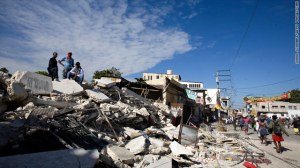
On this day in 2010, a magnitude 7.0 earthquake devastates the Caribbean island nation of Haiti. The quake, which was the strongest to strike the region in more than 200 years, left over 200,000 people dead and some 895,000 Haitians homeless.

The earthquake hit southern Haiti at 4:53 p.m. local time. The nation’s capital, Port-au-Prince, a densely populated city located about 15 miles from the quake’s epicenter, suffered widespread devastation. Countless dwellings were reduced to rubble, while hospitals, churches and schools collapsed and roads were blocked with debris. Numerous government structures were heavily damaged or destroyed, including the presidential palace, parliament building and main prison. (At the time of the quake, Haiti lacked a national building code, and many structures were shoddily constructed.) In the aftermath of the quake, amidst fears that victims’ decomposing corpses could spread disease, trucks picked up thousands of bodies and dumped them into mass graves.

Even before the earthquake, Haiti, which occupies the western third of the island of Hispaniola (the Dominican Republic occupies the other two-thirds), was the poorest country in the Western Hemisphere, with 80 percent of its 9 million residents existing in poverty. Political corruption and violence, disease, malnutrition and limited access to education were a way of life for many in Haiti, which gained its independence from France in an 1804 slave revolt.

A large-scale, international relief operation was launched soon after the quake hit, with the United States taking charge and sending thousands of military troops to Haiti to deliver supplies, assist with search-and-rescue efforts and help maintain order. Relief efforts initially were hampered by earthquake damage to roads, communication systems and the Port-au-Prince airport and main port.

Governments and individuals around the world made donations and pledges of aid to Haiti totaling billions of dollars. However, on the first-year anniversary of the disaster, reconstruction efforts were still in their infancy. Thousands of people left homeless by the quake were living in tents, and only a small portion of the heavy debris resulting from the disaster had been cleared.

resource: history.com

i would like to add that the problem is getting access to education due to dollars and the fact that they are mostly privately run least we talk about the limited jobs in public schools and wages tend to be lower in non-public schools.

The Story of the Horse


The Story of the HorseIn any discussion of the history of humankind, it becomes quickly apparent that this narrative would be utterly different without the inclusion of horses.

In our July/August 2015 issue, executive editor Jarrett A. Lobell and online editor Eric A. Powell bring us a special section, “The Story of the Horse,” in which they explore the unique roles that this animal has played in diverse areas of the human experience, and the evolving relationship we have had with horses across the millennia.

to get the complete article click on the link above!

Cyclosporiasis: Most U.S. cases reported in warmer months


Cyclosporiasis is an intestinal illness caused by the protozoan (unicellular) parasite Cyclospora cayetanensis.

Cyclosporiasis can occur at any time of the year, but most of the reported cases and outbreaks in the United States occur during the spring and summer months, particularly from May through August. About half of all U.S. cases that are not associated with a known outbreak occur in people with a recent history of travel outside the United States and Canada.

Cyclosporiasis is acquired by eating food or drinking water that is contaminated with human feces. In the United States, cyclosporiasis outbreaks have been reported almost every year since the mid-1990s and have been associated with various types of imported fresh produce.

Symptoms of cyclosporiasis begin an average of seven days after ingestion of sporulated oocysts (eggs), the infective form of the parasite. The most common symptom is watery diarrhea. Other common symptoms include loss of appetite, nausea, abdominal cramps, weight loss, fatigue, and myalgia (muscle pain); vomiting and low-grade fever also may occur.

Cyclospora infection is diagnosed by examining stool. A special test is required to detect the parasite, so health care professionals should specifically request testing for Cyclospora. Patients might need to provide up to three stool samples collected on different days because even people who show symptoms might not shed enough oocysts in their stool to show up in laboratory testing.

Cyclosporiasis is treated with a common antibiotic. If the infection is not treated, symptoms can last for several weeks to a month or more. There is no vaccine for cyclosporiasis. People can lower the risk of getting cyclosporiasis by avoiding food or water that may have been contaminated with feces. Rinsing fresh produce can reduce—but may not eliminate—the chances of getting cyclosporiasis. Treating food or water with chlorine or iodine is unlikely to kill Cyclospora oocysts. Safe food and water habits are recommended when traveling

“First Amendment ONLY for Christians,” Says Republican Alabama Chief Justice-reminder