Tag Archives: Senate

Ratcheting Up The Repeal Threat


By

The Latest Conservative Attempt To Sabotage Obamacare Just Got A Lot More Serious

In a surprise move late last week, the Supreme Court agreed to hear the case of King v. Burwell, a lawsuit seeking to strip premium tax credits from people living in states with a federally-operated insurance marketplace. If the lawsuit, which employs an overt misreading of the Affordable Care Act, is successful, it would hike premiums by triple digits and make health coverage unaffordable for millions of Americans. We have written about the case before, when a panel of the Fourth Circuit Courts of Appeals ruled on it and unanimously upheld the law. But that wasn’t enough for at least four Justices, who now think it worthwhile that the case be argued in front of the nation’s highest court.

Make no mistake, the lawsuit is a strategic attempt at repeal by another name by ideological conservatives. Here are five key things to keep in mind about it:

1. The Affordable Care Act is working. Millions of people have the peace of mind of knowing they have quality, affordable coverage when they need it most. Thanks to the ACA, 10.3 million people now have health care who did not have it before. That includes 7.1 million people who are enrolled in state and federal marketplaces and currently paying their premiums.

2. Nothing has changed as a result of the Supreme Court’s decision. This lawsuit will not stop people from choosing health care that works for them, with access to the financial assistance available, when open enrollment begins November 15. Consumers should be confident that financial help will be available for them to help make health coverage more affordable. In an event today at the Center for American Progress, Health and Human Services Secretary Sylvia Matthews Burwell reassured that “open enrollment this year will be a positive experience for the consumer.”

3. The law is clear. Those challenging the law cherry pick a single clause in the law’s text where it appears to limit the subsidies to individuals who obtain insurance through “an Exchange established by the State” — and not the federal exchange (which operates in 36 states). They ignore the entire intent of the law, which was to provide premium tax credits for anyone eligible, regardless if they lived in a state with its own marketplace or a federal marketplace. Indeed, in the ruling of the Fourth Circuit, Judge Roger Gregory quoted a longstanding legal doctrine, writing, “We ‘will not usurp an agency’s interpretive authority by supplanting its construction with our own.’ ” The authors of the law also have written that “none of us contemplated that the bill as enacted could be misconstrued” as the King lawsuit attempts to do. We are confident the Supreme Court will agree.

4. This is an attempt at repeal by another name. This lawsuit is unquestionably a part of a wider effort to try to undermine and repeal the Affordable Care Act. The lead plaintiff in a similar case, Jacqueline Halbig, was an appointee in the George W. Bush administration. Another plaintiff in the Halbig case, Sarah Rumpf, described herself as a “Republican operative .”

5. Repealing the tax credits would make insurance inaccessible for millions of Americans and could mean the difference between life and death. Of the 5.4 million people enrolled in the federal marketplaces, 87 percent picked a plan using federal tax credits, lowering the amount of what they paid for their monthly premium from $346 to $82, on average. Without the tax credits, these people would be paying an average of $264 more per month, a 322 percent increase. The Rand Corporation modeled what would happen without subsidies and found that “in scenarios in which the tax credits are eliminated, our model predicts a near ‘death spiral,’ with very sharp premium increases and drastic declines in individual market enrollment.” It is no exaggeration to say that this decline in enrollment could cost some people their lives.

On the surface, the case presents an all or nothing choice for the Court’s conservatives. Either they reverse the Fourth Circuit decision that did not defund the law and hand a sweeping victory to conservatives who oppose the Affordable Care Act; or they affirm the court’s decision, earning the gratitude of the people who will die without a fully operational law and the scorn of the law’s opponents. ThinkProgress Justice editor Ian Millhiser writes that there is also potentially a third way that could placate conservative and save the ACA at the same time.

BOTTOM LINE: Despite the unexpected news that the Supreme Court has agreed to hear King v. Burwell, nothing has changed: financial assistance is available to consumers and open enrollment will proceed starting November 15. We trust that when the Supreme Court does make its decision, common sense and decades of legal precedent will prevail.

The President wants you to see this:


 President Obama asked the FCC to put in place strong rules to protect the Internet.

Every day, the Internet unlocks countless possibilities for creation and innovation. And one reason it’s been so successful is a level playing field: Most service providers have traditionally treated all Internet traffic equally.

That’s the principle of “net neutrality.” It’s an idea that says an entrepreneur’s fledgling company should have the same chance to succeed as established corporations, and access to a high school student’s blog shouldn’t be unfairly slowed down to make way for advertisers with more money.

As the FCC considers new rules, we simply can’t take that principle for granted.

Hear directly from President Obama why he supports net neutrality, and what that means for you. Then pass this message on to anyone who cares about the future of the Internet.


Watch this important message from President Obama.

http://www.whitehouse.gov/net-neutrality


My aunt’s dying wish


Help my dying Aunt Gregoria meet with her imprisoned son one final time

Aetzaly Gonzalez
Salida, California

BREAKING: (more good news!)


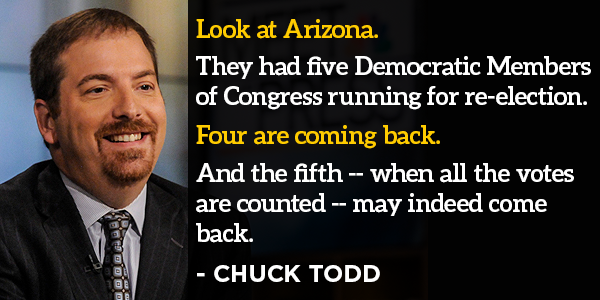
In case you missed Meet the Press , here’s what YOU made possible:

That’s right — despite the Republican wave, Democrats are 4-for-4 in deep-red Arizona.

And that fifth too-close to call race?

That’s gun violence prevention advocate and former Congresswoman Gabby Giffords’ old seat.

We were down on Election Night, but we just some great news: Former Giffords aide Ron Barber has closed the gap to 341 votes.

If this trend holds, Barber can still pull into the lead and win!

We wouldn’t have this opportunity to win without you:

Your donations and volunteer hours allowed to us reach out to key voters in this race over 133,000 times.
133,000 Door Knocks and Phone Calls

And the current margin?

341 votes

We just can’t say it enough: Your grassroots support is literally making the difference between victory and defeat in these close races.

We can’t say thank you enough for all you’ve done.

All of us at the DCCC

P.S. The single most important thing we can do right now is ensure that every vote is counted fairly and accurately. Unfortunately the Republicans are already trying to throw out ballots:

Tucson Weekly:
In what remains one of the tightest congressional races in the country, Republican candidate Martha McSally’s legal team is taking steps to toss out the ballots of voters in Pima County

Problems At The Polls


By

State Laws And Election Administration Errors Causing Problems On Election Day

***The polls are set to close in a few hours. If you have yet to vote, what are you waiting for? Vote! Click here to get all the information you need when you go to the polls. A number of state laws have changed and may have altered the required documents you need to cast a ballot.***

Throughout the course of Election Day, ThinkProgress has been reporting on the ground from seven states across the country. They have gone beyond the horserace to uncover how the election process is going for voters. And they are finding numerous problems, whether the result of new state voter suppression laws, election administration issues, or something else. Here are a few (and check out the liveblog for more):

  • North Carolina’s New Election Restrictions Are Turning Away Voters: At two polling places south of the city center, voters are turning up in steady numbers throughout the morning. But many of them aren’t casting ballots: they are being turned away because they aren’t at their correct precinct.
  • Georgia Voter Redirected To Polling Place 35 Miles Away: Georgia Secretary of State Brian Kemp’s office failed to process tens of thousands of voter registration cards — mostly in heavily African-American counties — before the election, and it’s causing confusion at the polls. Karl Ragland and his wife moved to Atlanta from Covington, Ga., earlier in the year and submitted a change of address form to the Board of Elections. But when they showed up at their new polling place in Atlanta, they learned that the form had never been processed. Karl now has to drive 35 miles to Covington to vote, causing him to miss up to two hours of work. “I am going to vote today,” Karl said.
  • Texas Voting Restrictions Sow Confusion At The Polls: At a polling site in Third Ward, a historically African American neighborhood in Houston, two voters have been turned away for lacking a photo ID. One had simply left it at home, and would have to make an additional trip to the polls. The other had to cast a provisional ballot, which has a much lower chance of being counted.
  • More Than 21,000 Kansans Could Be Blocked From Voting On Election Day: Tens of thousands of Kansans who registered to vote may find themselves ineligible on Tuesday as a result of a new law that “requires people registering to vote for the first time to provide proof of citizenship, such as a birth certificate or passport,” the Wichita Eagle reported on Friday. As of Oct. 31, 21,473 registered voters had not sent in documentation showing that they are American citizens.
  • Atlanta Voters Are Being Required To Pay To Park: In one of Atlanta’s largest voting precincts, voters are complaining about being required to pay as they leave the parking lot next to Georgia Tech’s student center polling site, even though signs advertised free parking on Election Day. Advocates say that requiring people to pay extra fees during the process of voting essentially amounts to a poll tax.
  • Miami Man Waited More Than 4 Hours To Vote After Poll Workers Refused To Allow Address Change: Florida law allows voters to change their address at the polls on Election Day. But because poll workers have not been adequately trained on Florida’s Electronic Voter Identification System (EVID), some voters who have recently moved are having problems casting ballots in their new precincts. Opa-Locka resident Eugene Gonzalez arrived at his polling location at 8:30 this morning, but did not cast his ballot until 1 pm because poll workers mistakenly told him that he needed to vote in Broward County, where he lived previously and was still registered.
  • Alabama Voters With Public Housing, Shelter IDs Are Being Turned Away: At least three Alabama citizens apparently have been denied their right to vote thanks to the state’s voter ID law, a last-minute decision by the state that public housing and shelter ID’s are not valid proof of identity.
  • Longtime Voter Removed From Voter Rolls In Ohio: Jamil Smith, a producer for MSNBC’s Melissa Harris-Perry show, reported on Twitter this morning that his father encountered a serious problem attempting to vote: “My father, who has voted in every election as long as he can remember, tells me his name wasn’t on the rolls this morning. He lives in Ohio.” It’s unclear how Smith’s father’s name was removed from the voter rolls, but Ohio was one of several states that signed onto a voter purge scheme devised by Kansas Secretary of State Kris Kobach (R) that developed a lost of voters under consideration for purging by simply finding people who share the same first and last name as a voter in another state.

BOTTOM LINE: These problems at the polls are just a few extremely concerning examples that should be immediately corrected — and could be illegal or unconstitutional. In response to this and other anecdotal evidence of barriers to voting, the Center for American Progress has issued letters to Secretaries of State in Kansas, North Carolina, Alabama, and Georgia, urging them to take “immediate action” to rectify these concerns. Voting is a fundamental deomcratic right, and it should be free, fair, and accessible to all citizens.